




| Title of Reference Design | RGB LED |
| Image | 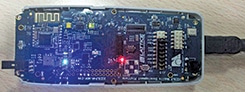 |
| Key Attractions | The reference design offers comprehensive control over colour, brightness, and blinking via a user-friendly interface, which is suitable for rapid customisation in diverse applications. |
| Highlights | The Lattice RGB reference design offers a low-cost option that incorporates an LED for any design, enabling adjustments to LED functions to meet specific application requirements. This design provides control over an RGB LED’s colour, brightness, intensity, blink rate, and breathing dynamics through a software GUI, compatible with MAC and Windows PCs via USB. It allows control of LED functionalities and testing on a few hardware evaluation boards. The iCE40 Ultra mobile development platform operates multi-colour LEDs with individual brightness settings through pulse width modulation (PWM), automatic blinking, and an optional breath on/off feature, powered by an iCE40 Ultra device. This device features an I2C slave interface, data control, buffer, and LED control functionalities, and is paired with an RGB driver that includes a constant current sink and a power-on reset function. |
| Applications | The reference design can be interfaced with the application processor to drive the LED effectively. |
| OEM Brand | Lattice Semiconductor |
| URL | click here |
| Title of Reference Design | 6A RGB LED Driver |
| Image | 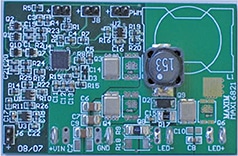 |
| Key Attractions | The reference design for a 6A step-down LED driver in portable projectors efficiently manages RGB LEDs, ensuring constant current and rapid adjustments with minimal ripple for optimal lighting. |
| Highlights | Analog Devices’ reference design for a 6A step-down LED driver, intended for portable projectors, uses the MAX16821, a PWM LED driver, to power a single LED with three units needed for RGB LEDs. The design operates from a 10V to 15V supply, stepping down to a constant current for an LED with a forward voltage range of 4.5V to 6V. Implemented with a switching frequency of 300kHz set by a 200kΩ resistor, the system manages a steady current through regulation of inductor current, matching the LED current. This configuration uses dual control loops: an inner current loop that adjusts based on the outer voltage loop’s output, and an outer voltage loop that sets the inner loop’s regulation parameters. Furthermore, the design allows the LED current to adjust within 1µs to changes when set at 6A during PWM, using a small output capacitor and a larger inductor to maintain low current ripple and stable inductor current at 6A. |
| Applications | The reference design is suitable for applications such as projectors, large-scale displays, and advanced lighting setups. |
| OEM Brand | Analog Devices (ADI) |
| URL | click here |
| Title of Reference Design | RGB LED Lighting |
| Image | 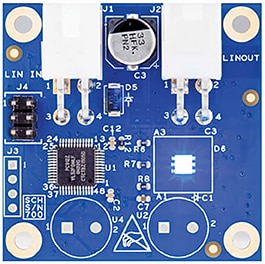 |
| Key Attractions | The reference design board controls and diagnoses RGB LEDs through a network, featuring port integration, voltage regulation, and a background debug system for enhanced management of internal resources. |
| Highlights | The S12ZVL32-LED is a reference design board by NXP Semiconductors for controlling and diagnosing RGB LEDs through a local interconnect network (LIN).The port integration module on the board manages connections between peripheral modules and I/O pins, overseeing electrical properties, and handling signal prioritisation and multiplexing for shared pins. Important components include the voltage regulator and LIN physical layer. Additionally, the background debug controller (BDC), a single-wire, background debug system integrated into the on-chip hardware, minimises CPU intervention and connects via the device’s BKGD pin. The S12ZBDC maintains the S12 serial interface protocol and introduces a handshake protocol with an expanded BDC command set, supporting the instruction set unique to the S12Z device family and enabling access to internal resources via the BDC serial interface. The devices also support various power modes, such as run, wait, and stop, and different operating modes, with the BDC functionality dependent on the device’s security status. |
| Applications | The reference design is suitable for automotive and industrial applications, including sensor interfaces, actuators, switch panels, and ambient lighting. |
| OEM Brand | NXP |
| URL | click here |
| Title of Reference Design | Multi-String RGB LED Drivers |
| Image | 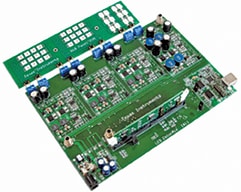 |
| Key Attractions | The reference design provides precise control over multiple LED strings, enabling independent adjustment of colour and brightness for up to eight strings, which is perfect for dynamic and customisable lighting applications. |
| Highlights | The multi-string RGB LED lighting reference design TIDM-RGB-LED by Texas Instruments provides control over multiple LED strings with features like dimming and colour mixing. It supports independent management of up to eight LED strings, each digitally controlled for colour and brightness adjustments. The design includes an LED driver with eight digitally regulated DC/DC power converters, one for each LED string, which allows for detailed colour mixing and varied lighting scenarios with both coloured and white light. This is achieved using six boost DC/DC converters for the RGB strings and two SEPIC converters for white LEDs, enabling a range of lighting effects. The design operates efficiently within a 12-18V DC input range, accommodates up to 50mA per string, and includes over-current protection to prevent damage. Each string’s brightness can be independently adjusted, supported by the colour mixing capabilities of the microcontroller, which provides digital control. |
| Applications | The reference design is suitable for automotive, entertainment, retail, and decorative lighting applications. |
| OEM Brand | Texas Instruments (TI) |
| URL | click here |
| Title of Reference Design | Smart LED |
| Image |  |
| Key Attractions | The reference design allows wireless control of brightness, colour, and modes through a mobile app, with RGB colour mixing and Bluetooth connectivity, suitable for homes, commercial spaces, and outdoor lighting. |
| Highlights | The smart LED reference design is powered by the RL78/G1D BLE microcontroller from Renesas, which connects the LED system to a mobile app, allowing for smart lighting applications in various settings. Users can wirelessly adjust lighting settings such as brightness, colour, and modes through an app interface. The peripheral board houses the power supply and an RGB LED driver circuit, which are responsible for controlling light intensity and colour through a 3-channel transistor setup for the RGB LEDs. Each transistor controls one colour channel—red, green, or blue—allowing for a range of lighting effects. Bluetooth connectivity provides a low-energy, stable communication link, making this design suitable for smart home environments, commercial spaces, and outdoor lighting. However, users must verify the circuit’s performance in their specific applications due to potential variations in components, temperature changes, and PCB layout that may affect functionality. |
| Applications | The reference design is meant for applications such as smart home lighting, mood lighting in commercial spaces, and customisable outdoor lighting systems. |
| OEM Brand | Renesas |
| URL | click here |
Nidhi Agarwal is Senior Technology Journalist at EFY. She is an Electronics and Communication Engineer with over five years of academic experience. Her expertise lies in working with development boards and IoT cloud. She enjoys writing as it enables her to share her knowledge and insights related to electronics with like-minded techies.