As power demands rise, digital power supplies provide a forward-thinking solution, optimising efficiency and reducing component complexity through digital control.
Table of Contents
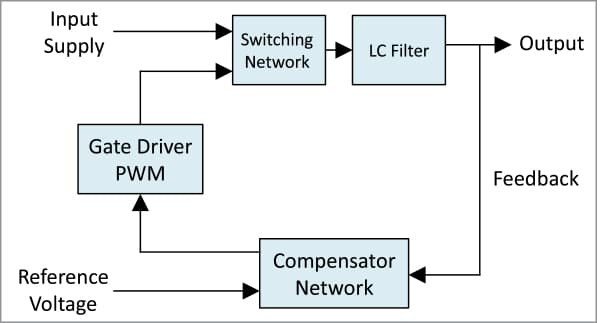
A typical DC-DC power supply, such as a buck power supply, comprises an input supply, switching network, and passive elements (L and C) for filtering, feedback, compensation network, pulse width modulation (PWM), reference voltage, and output power.
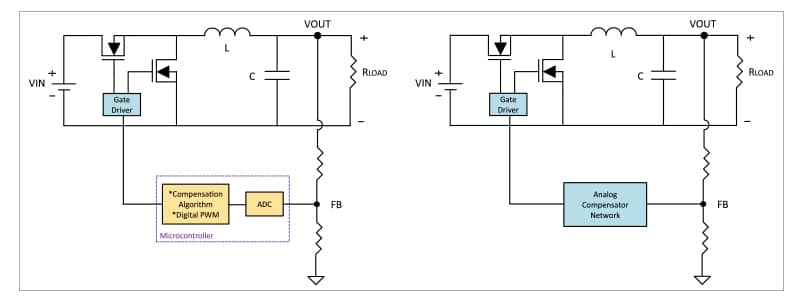
A digital power supply replaces the analogue compensation network with an analogue-to-digital converter (ADC), compensation algorithm, and digital PWM implemented inside the microcontroller.
Advantages of Digital Power Supply
Digital power supplies present numerous benefits, primarily by eliminating components and reducing manufacturing costs. They enable systems design with multiple and variable outputs while minimising real estate requirements on circuit boards. A single microcontroller (MCU) can implement multiple power rails, significantly enhancing design efficiency.
Furthermore, digital power supplies deliver higher efficiency across the entire operational range, offering the capability to combine multiple control loops or functions into a single device. The flexibility provided by software-programmable solutions allows for adjustments in control loop performance through software modifications, ensuring adaptability to changing requirements.

Additionally, these systems support advanced features such as auto-tuning, self-testing, power-up sequence setups, communication across other channels, and even failure prediction, making them versatile and future-ready.
Disadvantages of Digital Power Supply
Despite their numerous advantages, digital power supplies come with certain limitations. The loop bandwidth is constrained by the computing power of the microcontroller and the overhead tasks it handles.
Additionally, the resolution of the PWM module limits the accuracy of feedback loop regulation. Constraints in ADC resolution and sampling rates further affect performance, while the overall capability of the microcontroller (CPU) remains a critical factor in determining the system’s effectiveness.

These challenges underline the need for careful design and component selection in digital power supply systems.
Control Algorithms in Switching Regulators
Typically, switching regulators have two types of control algorithms; each has advantages and disadvantages.
Voltage Mode Control (VMC)
- Fixed switching frequency
- Single feedback loop
- Double pole compensation
- Slower dynamic response
Peak Current Mode Control (PCMC)
- Built-in current limiting
- Faster response to input voltage changes
- Two feedback loops
- Single pole compensation
- Slope compensation is required
- Blanking is necessary to handle current spikes
Types of Compensators
Typically, there are two types of compensators: