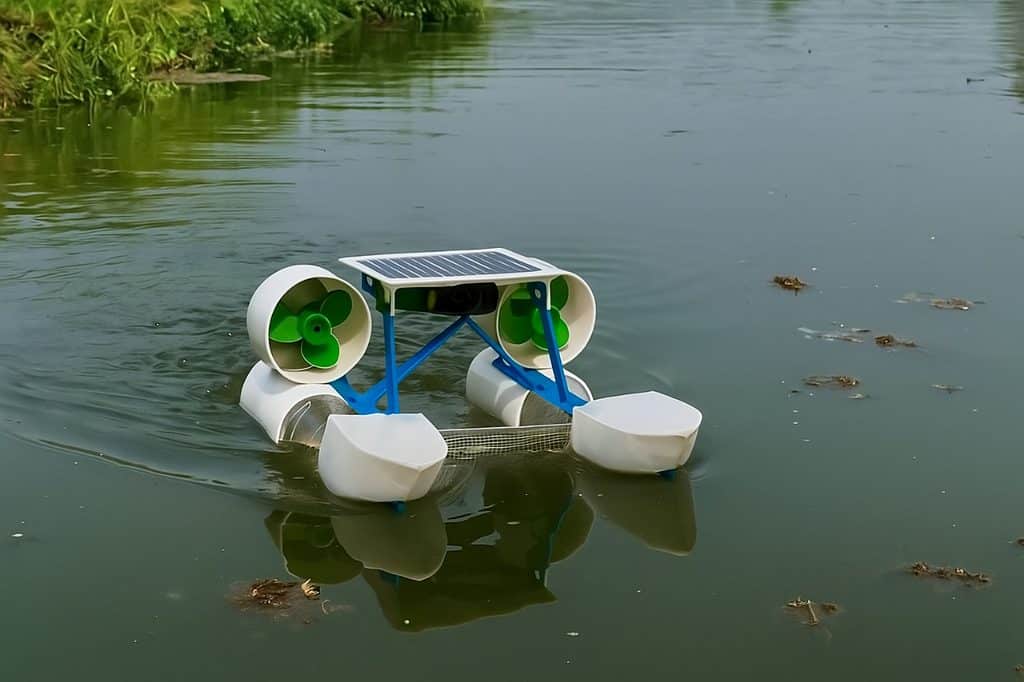
AquaRobo: An AI-Based Autonomous Surface Vehicle for Floating Waste Collection and Waterway Cleaning** is an intelligent water-cleaning system designed to address the growing problem of plastic pollution, floating debris, and invasive aquatic weeds in urban canals and inland water bodies. Conventional barrier-based skimmers primarily trap floating waste and often require manual retrieval, frequent unloading, and labour-intensive maintenance. AquaRobo aims to overcome these limitations through an unmanned surface vehicle (USV) that actively collects floating waste while autonomously navigating waterways.
The vessel uses above-water propulsion motors to reduce the risk of entanglement associated with underwater propellers operating in weed-filled and debris-laden environments. As the vehicle moves through a polluted waterway, floating waste is guided into a trailing net-based collection and packaging mechanism designed to support continuous collection and reduce the need for frequent unloading. An Arduino UNO Q serves as the real-time hardware interface, acquiring sensor data and coordinating peripherals such as the GPS module, inertial measurement unit (IMU), electronic speed controllers (ESCs), and brushless DC (BLDC) propulsion motors. The Arduino UNO Q communicates with a Raspberry Pi 4, which handles the higher-level computational tasks, including AI-based computer vision for waste detection and density estimation, autonomous navigation, route planning, and operational decision-making.
By combining edge AI, autonomous surface mobility, coordinated propulsion control, and continuous waste collection, AquaRobo provides a potential alternative to conventional manual and barrier-based canal-cleaning approaches. The system aims to improve collection efficiency, reduce direct worker exposure to polluted waterways, and support more consistent cleaning operations in narrow or difficult-to-access canals. Future development can incorporate waste-density mapping, collection-capacity monitoring, and performance reporting to help prioritize polluted areas. Practical evaluation under varying water currents, debris loads, and weather conditions will be necessary to validate navigation reliability, collection efficiency, weed-handling capability, and sustained autonomous operation.
Team members
| S. No. | Name | Role |
| 1 | Aarya Mishra | AI Integration – developing and integrating the AI-based computer vision system for floating-waste detection, waste-density estimation, autonomous navigation and path optimisation; integrating the AI module with the onboard control system and IoT platform. |
| 2 | Soumik | Control Systems – developing the control system of the autonomous vessel, including navigation control, motor control, sensor integration, autonomous operation, and coordination between the AI module, propulsion system, and onboard electronics. |
Component List
| ID | Name | Role in System | Qty |
| 1 | Raspberry Pi 4 Model B | High-level AI processing – computer vision, autonomous navigation, decision-making | 1 |
| 2 | Raspberry Pi Camera Module | Real-time video feed for AI-based waste detection | 1 |
| 3 | Arduino Uno Q | Real-time hardware interface – peripheral control & low-level sensor acquisition | 1 |
| 4 | GPS Module | Vessel location tracking, geo-tagging | 1 |
| 5 | IMU (Inertial Measurement Unit) | Orientation and motion sensing | 1 |
| 6 | 1200KV Brushless DC (BLDC) Motor | Above-water propulsion (avoids underwater entanglement) | 2* |
| 7 | Electronic Speed Controller (ESC) | Propulsion motor speed control | 2* |
| 8 | Solar Panel + Battery Pack | Onboard power supply | 1 |
| 9 | Trailing Net-based Collection Assembly | Waste storage / packaging | 1 |
*BLDC motor / ESC quantity reflects the twin above-water propulsion layout shown in the prototype photos – confirm final BOM count before submission.
Project Explanation Step By Step
Urban canals and inland water bodies are heavily polluted with plastic waste, floating debris, and invasive weeds. Canals such as the Buckingham Canal (Chennai), Cooum Canal, Agra Canal ,and Indira Canal are frequently choked by fast-spreading weeds like water hyacinth, causing blocked water flow, urban flooding during rains, and degraded water quality that affects irrigation and aquatic life. Existing barrier-based skimmer systems only trap floating waste and still depend on manual retrieval using labour, boats, cranes, or heavy machinery, a process that is slow, costly, unsafe for workers, and limited to narrow-space access. Because collected waste is not removed automatically, such systems require frequent unloading, allow debris to re-accumulate downstream, and leave authorities without continuous monitoring to react to pollution build-up in time.
AquaRobo is an AI-based unmanned surface vehicle that actively collects floating waste instead of merely trapping it. The vessel is propelled by above-water propulsion motors rather than underwater propellers, removing the risk of entanglement with algae, weeds, and other waste while still allowing it to navigate the optimal path for maximum collection efficiency. Waste displaced into the vessel’s path is continuously transferred into a trailing net-based packaging mechanism, enabling uninterrupted cleaning operations without the frequent unloading that manual and barrier-based systems require.
On board, an Arduino Uno Q acts as the real-time hardware interface — integrating and controlling peripherals such as the GPS module, IMU, ESC, and BLDC propulsion motors while handling low-level sensor data acquisition. It communicates with a Raspberry Pi 4, which runs the AI-based computer-vision pipeline for waste detection and density estimation, autonomous navigation, and high-level decision-making.
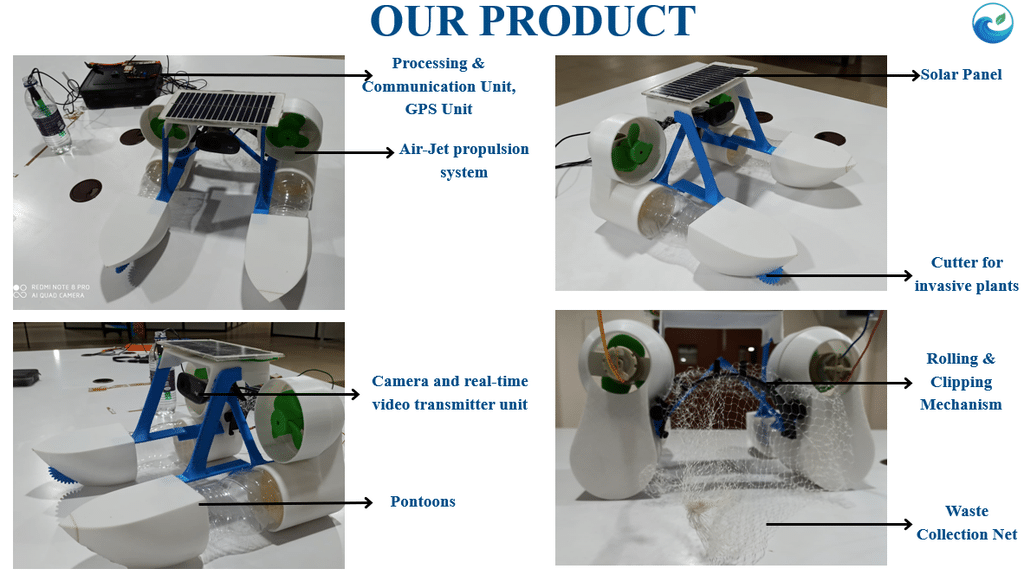
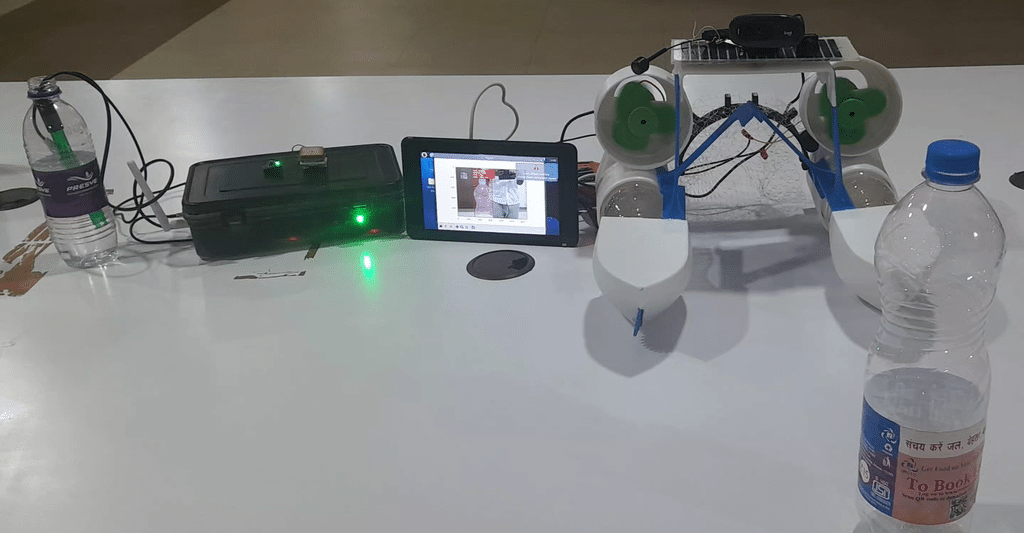
Fig 2. Author’s earlier physical prototype, showing the propulsion units, solar panel, pontoons, and net-based waste-collection assembly
Through an IoT communication network, AquaRobo shares its GPS location, live video feed, waste-detection data, collection quantity, and system health with a ground control station or mobile application, letting operators remotely monitor missions and recall the vessel in emergencies or adverse weather. The same geo-tagged images and sensor data can additionally support water-body monitoring and ecosystem assessment beyond waste collection. In its current prototype form the vessel weighs approximately 20–22 kg, runs for 1–2 days on solar and battery power, cleans a width of about 1 m per pass, and can cover an estimated 15–50 km per day, with dynamic speed control, AI-based obstacle avoidance, a two-way radio link, and onboard data/image logging.
Coding Explanation and Configuration
The AI vision pipeline — floating-waste detection, waste-density estimation, and path optimization — is developed in Python using OpenCV together with YOLO and TensorFlow/PyTorch, running on the Raspberry Pi 4. Navigation and control algorithms are first modelled and validated in MATLAB/Simulink to check propulsion control and overall system behaviour before hardware implementation. The Arduino Uno Q side is programmed in the Arduino IDE using C++ to acquire GPS and IMU data and drive the ESC/BLDC motors from commands issued by the Raspberry Pi. The ground control station and monitoring dashboard are built with HTML, CSS, and JavaScript on a WebSocket architecture, giving the operator real-time video streaming, GPS tracking, and system-status monitoring over standard internet communication protocols.
Mobile / Ground Control Application
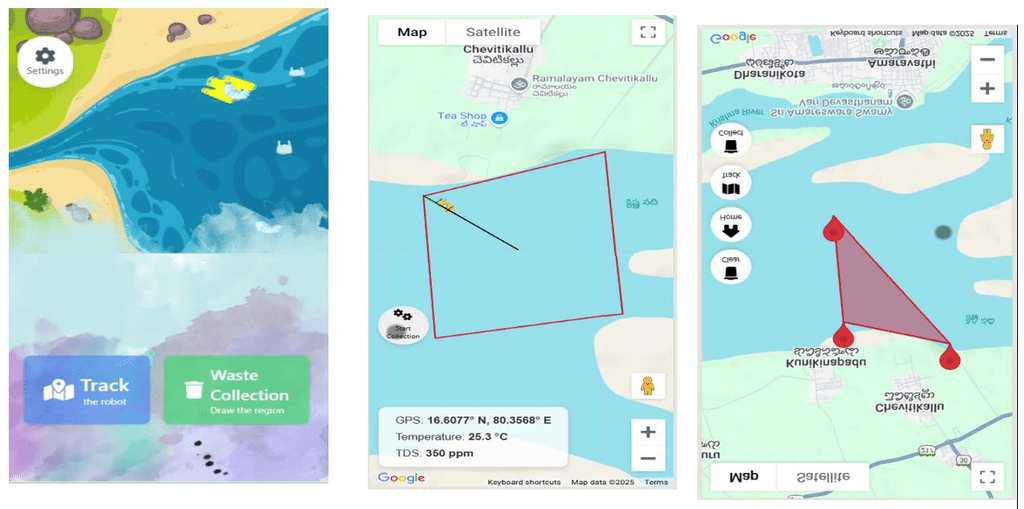
A companion mobile application serves as AquaRobo’s ground control interface. Its home screen shows the vessel’s assigned area of operation, and a live view lets the operator monitor GPS location and other telemetry as a mission progresses. The app supports the vehicle’s autonomous operation — surfacing AI waste-detection results, autonomous-navigation status, and manual override/recall controls for emergencies or adverse conditions.
Connection Explanation
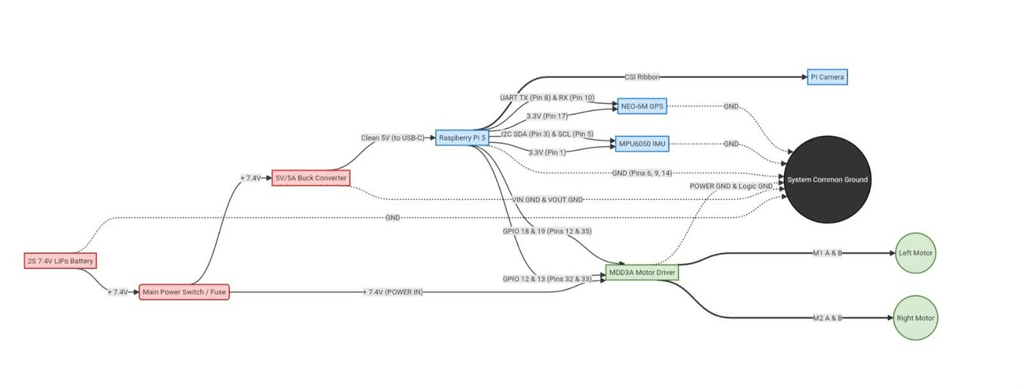
The Raspberry Pi 4 and Arduino Uno Q form a two-tier control architecture: the Raspberry Pi handles the camera feed and AI inference and passes navigation/motor commands to the Arduino Uno Q, which interfaces with the GPS module, IMU, ESCs, and the BLDC propulsion motors mounted above the waterline on either side of the hull. The ESCs regulate motor speed from PWM signals issued by the Arduino to steer and drive the vessel. Power is drawn from an onboard solar panel topping up a battery pack, feeding both electronics and motors. The trailing net-based collection assembly is mounted at the rear of the float, in the path of waste displaced during operation, so debris is retained without a separate pump or conveyor.
Testing
The complete system is validated through simulation, hardware-in-the-loop testing, and field trials — covering autonomous-navigation accuracy, AI waste-detection performance, propulsion/motor-control response, and overall system reliability, ahead of extended canal deployment.
Schematics