

A screen woven into clothing can display images, play videos, detect touch, respond to voice commands and measure body temperature after washing.
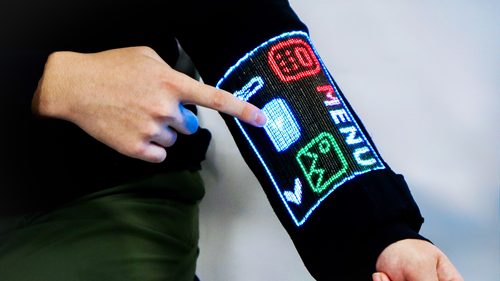
Researchers at the National University of Singapore (NUS) have developed a touchscreen that can be woven into clothing. The fabric can display images and videos, detect touch and respond to voice commands. The prototype uses 54 display fibres woven into a sleeve and can receive images wirelessly and measure body temperature.
The technology combines display pixels, touch sensors and electronic components inside fibres. The NUS team developed a method to integrate microchips along insulated wires. A laser exposes specific points on the wires, while controlled surface wetting directs molten solder to connect the chips. Using this process, the researchers integrated more than 5,000 chips through over 20,000 electrical connections.
The team combined interconnected digital light-emitting diodes (LEDs) with multiple material layers and used a thermal drawing process to form a fibre about one millimetre thick and 10 metres long. Each fibre contains display pixels and touch sensors. When someone presses it, the sensor layer completes an electrical circuit and identifies the touch location, allowing the nearest pixel to light up.
The sleeve contains 54 pixel fibres, each with 96 LEDs, forming a 168 mm × 105 mm display with a resolution of 96 × 54 pixels. It refreshes at 30 frames per second and supports 8-bit colour. Each fibre operates independently, and the sleeve can detect multiple touches. Additional fibres contain a microphone, speaker and sensors for movement, magnetic direction, temperature and ambient light. The sleeve can run a calculator, display photos, play videos, respond to voice commands, receive images over Bluetooth and adjust screen orientation and brightness. It can also measure and display body temperature.
The fabric retained its display and touch functions after 50 machine washes with detergent and 1,000 bends around a 5 mm radius, with little change in light output or touch response. It is as breathable as cotton, polyester and denim, and meets safety limits for skin contact.
The technology could be used in clothing that displays information, monitors health signs and provides touch-based feedback. The fabric can be knitted, woven or embroidered using standard industrial machines.
The researchers plan to use smaller microchips and thinner fibres to develop displays with higher resolution. Further work could combine display, touch, sensing and on-device artificial intelligence in one textile platform, allowing garments to interact with users and respond to their surroundings.