




Graphene-based energy harvesting converts magnetic fields around electrical wiring into usable power for ultra-low-power temperature sensors, reducing battery dependence and enabling longer-lasting autonomous monitoring systems across industries.

Researchers at the University of Arkansas and the University of Michigan have developed a graphene-based energy harvester that powers ultra-low-power temperature sensors using magnetic fields generated by electrical power lines. The technology could reduce battery replacement requirements in Internet of Things (IoT) devices used for environmental monitoring, logistics, agriculture and healthcare. The system collects energy from ambient electromagnetic fields and stores it in capacitors, allowing the sensor to continue operating without a conventional rechargeable battery.
The system uses a graphene inductor to capture energy associated with alternating current flowing through nearby electrical wiring. The researchers investigated inductors in two configurations: flat spirals and three-dimensional helices. Their experiments focused on the 60-hertz electrical frequency commonly used in the United States, demonstrating how otherwise unused electromagnetic energy can be converted into electrical power for low-energy electronics.
The harvested signal passes through a custom Cockcroft–Walton circuit, which rectifies the alternating-current (AC) signal into direct current (DC) and increases its voltage. The resulting electrical energy charges three storage capacitors to the voltage levels required by the temperature-sensing system. This arrangement replaces the conventional power-management integrated circuit and rechargeable battery, reducing the sensor’s overall power consumption.
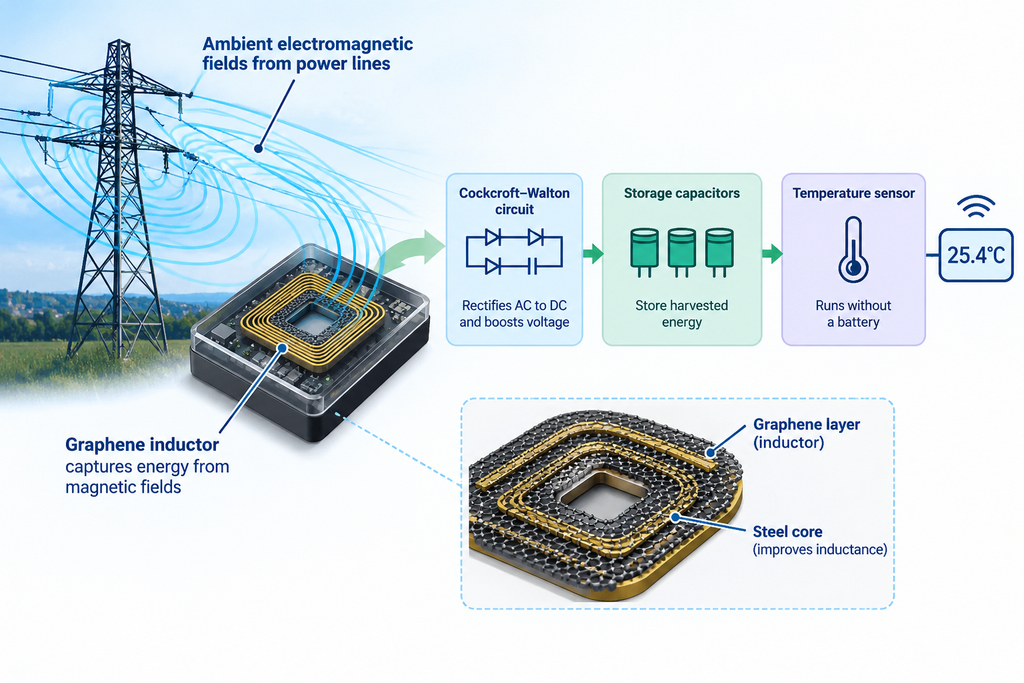
A graphene inductor incorporating an inner steel core generated sufficient voltage to activate the circuit. The capacitors accumulate charge faster than the sensor consumes it under the demonstrated operating conditions, allowing the system to maintain operation even when the harvested energy becomes temporarily unavailable. The researchers reported that the stored charge could sustain operation for at least 24 hours and potentially longer.
The work, published in the Journal of Vacuum Science and Technology B, builds on the team’s earlier demonstration of graphene-based solar cells powering temperature sensors. The latest research addresses the challenge of operating sensors at nanowatt-scale power levels while harvesting energy locally rather than relying on replaceable batteries.
Potential applications include soil monitoring, atmospheric sensing, product tracking, fleet management, wearable fitness devices and medical monitoring. Removing batteries could reduce maintenance costs, electronic waste and servicing requirements, particularly in distributed sensor networks where accessing individual devices is difficult.
The researchers ultimately aim to combine multiple energy sources, including solar, thermal, acoustic, kinetic and ambient electromagnetic energy, within autonomous sensor systems. Such multimodal harvesting could provide alternative power sources when one energy source becomes unavailable.
However, the demonstrated sensor required an initial capacitor-charging stage and processor programming; autonomous cold-start operation was not evaluated. Further development will be needed before the technology can support long-term, maintenance-free deployments at scale.

