




The new metal changes magnet states without magnets. It may help make phones, laptops, and data centers faster and use less power.
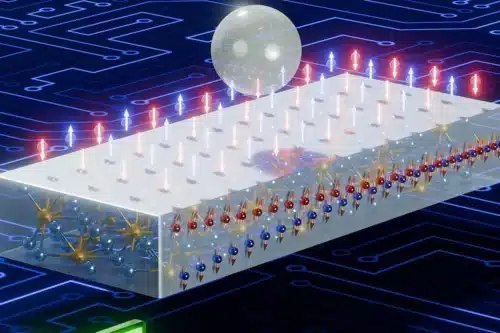
A new metal alloy, Ni₄W, developed by researchers at the University of Minnesota, can switch magnetic states without the need for external magnetic fields. This breakthrough opens the door to low-power, high-speed spintronic devices and could significantly reduce energy consumption in smartphones, smartwatches, and data centers.
The alloy generates spin currents in multiple directions, enabling a process called field-free switching—a major step forward in energy-efficient data storage and processing. High spin-orbit torque (SOT) efficiency was observed in Ni₄W both as a standalone material and when combined with tungsten, making it a strong candidate for next-generation memory and logic devices.
Unlike many exotic materials under investigation for spintronics, Ni₄W is composed of abundant elements—nickel and tungsten—and is compatible with standard semiconductor fabrication methods. This makes it both scalable and cost-effective for widespread industrial use.
The research team introduced this new way to control magnetization at the nanoscale using a low-symmetry alloy. Ni₄W’s strong SOT performance allows magnetization switching without relying on external magnets or high currents, reducing energy loss and system complexity.
As digital devices continue to grow in capability, the need for faster and more efficient memory technologies is also rising. Scientists are investigating new materials like Ni₄W to either enhance or replace existing solutions while minimizing power demands.
The next step in the research is to fabricate devices with Ni₄W that are even smaller than previous versions, pushing the limits of miniaturization while maintaining high performance. This could help accelerate the integration of spintronics into mainstream electronics, offering a sustainable path for future innovation.


