


What if the silent chips around us could think? By 2025, embedded systems have moved beyond executing code—they can now actively shape their environments. From wearables that predict heart conditions to self-healing factories, smart machines now learn and adapt in real time. This expanding capability brings new challenges in energy, safety, and design.
This article is based on a tech talk session at India Electronics Week (IEW), Bengaluru, by Mubeen Jukaku, Technology Head, Emertxe Information Technologies Pvt Ltd. It was transcribed and curated by Akanksha Sondhi Gaur, Sr Technical Journalist at EFY.
Embedded systems have long operated quietly, powering everything from printers and routers to factory machines. Earlier systems were largely deterministic and task-specific, compared with today’s adaptive and connected designs. They are now becoming smarter, more connected, and capable of adapting independently.
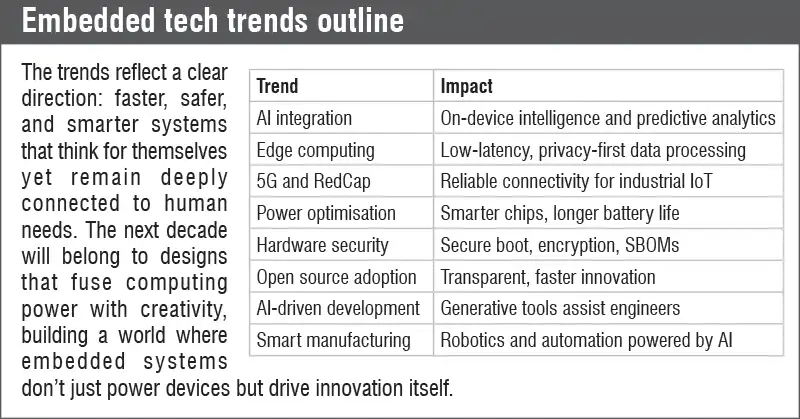
By 2025, embedded systems have moved beyond assistance to enable intelligent devices by integrating AI and the Internet of Things (IoT), making machines significantly more capable.
AI is no longer confined to applications like ChatGPT. In embedded systems, AI is built directly into devices, making them more intuitive, responsive, and autonomous. In the past, chips lacked the processing power to handle complex tasks.

Advances in processors now allow devices to integrate multiple sensors, run sophisticated algorithms, and execute AI workloads locally. A key innovation is the neural processing unit (NPU), a specialised chip designed for AI tasks. NPUs enable faster, local AI processing, enhancing autonomy across healthcare, industrial systems, and smart homes.

AI in healthcare: Wearables and health checks
AI-powered embedded systems are transforming healthcare. Previously, many medical conditions required hospitalisation and frequent manual monitoring. Today, intelligent devices can continuously track vital health metrics remotely.
Wearable devices monitor heart activity in real time and detect abnormalities early. AI-powered glucose monitors go beyond displaying sugar levels—they provide risk alerts, recommend actions, and securely share anonymised data with healthcare professionals to improve diagnosis and treatment outcomes.
Engineers must carefully balance device size, battery life, processing power, and connectivity. Devices are designed to remain compact and comfortable while retaining essential functionality. Processor performance can vary widely—from simple 200MHz chips to powerful multi-threaded units—depending on application demands. Unlike traditional digital watches that run for years on a single battery, smart wearables require frequent charging due to their advanced capabilities.
Energy efficiency remains critical. Continuous internet usage consumes significant power, making edge AI essential. By processing data locally, devices maintain efficient operation even without constant connectivity.
In the medical sphere, AI helps doctors make quicker decisions. MRI and CT scans produce massive amounts of information for humans to review. With AI, patterns can be quickly identified, issues can be detected, and possible diagnoses suggested, enabling faster patient care without relying solely on specialists.
Also read: Career paths, skill requirements, and growth opportunities in embedded systems.
Smarter connectivity: The 5G revolution