

A new reinforcement learning platform gives researchers more than 60 simulated environments to train, compare and transfer AI controllers for complex fluid flows more effectively.
MediaTek Research is among the organisations involved in an international research effort behind HydroGym, a reinforcement learning platform designed to train and compare AI systems for controlling complex fluid flows. The platform aims to make flow-control research more systematic by providing standardised environments for testing different approaches.

HydroGym addresses a major challenge in fluid dynamics: realistic flows involve large numbers of variables and complex interactions, making them difficult to predict and control directly. The platform uses reinforcement learning, allowing AI agents to interact with simulated environments and learn strategies for modifying fluid behaviour.
The researchers demonstrated that incorporating physics knowledge into training could reduce the trial and error needed to optimise reinforcement-learning control strategies by as much as 65%. The platform can be used to investigate methods for reducing drag, improving lift, limiting noise and managing heat. Potential applications include aircraft, wind turbines, jet engines and cooling systems.
Rather than relying solely on historical datasets, HydroGym can generate simulated data during training. It supports several approaches to modelling fluid behaviour, including lattice-Boltzmann, finite-volume, spectral-element and finite-element methods. Some supported solvers also enable automatic differentiation, allowing gradient-based and hybrid optimisation techniques to be explored alongside reinforcement learning.
The platform includes more than 60 testing environments covering different surfaces, flows and control strategies. It can also support distributed and multi-agent reinforcement learning, allowing separate controllers to manage different regions while coordinating their actions.
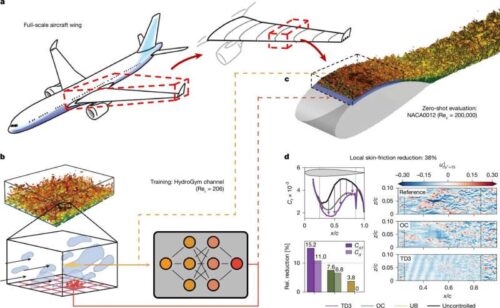
One demonstration showed that a strategy trained in a simpler environment could be transferred to a more realistic scenario, suggesting that learned control principles may extend beyond individual geometries.
The researchers say the open framework could encourage more consistent comparisons and collaboration in fluid-dynamics research, while helping develop AI controllers for increasingly complex engineering problems.