Researchers at Ferdinand-Braun-Institut (FBH), the University of Strathclyde, and the University of Cambridge have demonstrated 1.5Gbps wireless data transmission using far-UVC micro-LEDs, establishing a record for optical communication at wavelengths below 235nm. The demonstration points to ultraviolet light as a potential complement to radio-frequency links where spectrum congestion and solar interference create challenges.
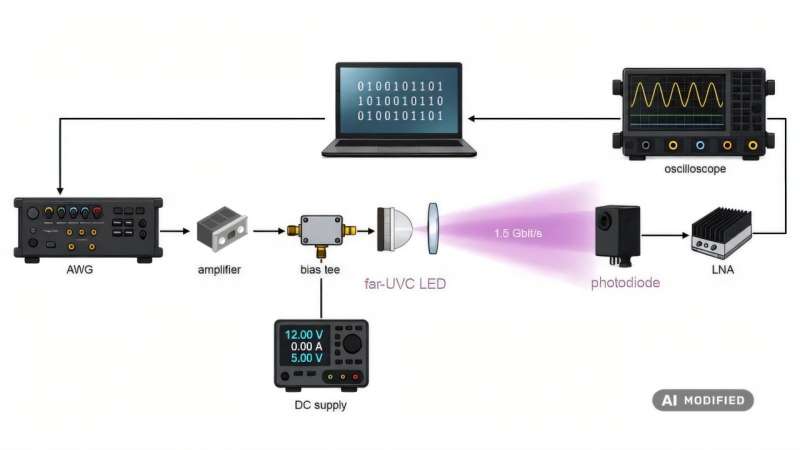
The experimental link transmitted data across 30cm using a direct line of sight, with the transmitter operating under ambient room lighting. The system used a modulated far-UVC LED at the transmitter and a photodiode at the receiver, with the received signal amplified and analysed using an oscilloscope.
A key advantage comes from the wavelength itself. Solar radiation below approximately 280nm is largely absorbed by Earth’s atmosphere, leaving very little solar background at the surface. This makes UVC-based optical communication less susceptible to sunlight interference than visible-light or infrared optical links. Such characteristics could be particularly useful for outdoor wireless systems where conventional optical communication can require precise beam alignment.
- Data rate of up to 1.5Gbps
- Far-UVC wavelength below 235nm
- 30cm demonstrated transmission distance
- Segmented LED emitting areas for higher modulation bandwidth
- Potential for solar-background-resistant optical wireless links
The researchers improved the LED architecture specifically for high-speed modulation. Instead of using a large continuous emitting area, the far-UVC LED’s emitting surface was divided into multiple smaller regions. This reduces junction capacitance while increasing current density, enabling greater modulation bandwidth and allowing the device to respond more rapidly to data signals.
The technology could complement RF connectivity in autonomous vehicles, drones, industrial machinery, robotics, and civil-protection systems. It may also be relevant to future 6G communication architectures that combine different wireless technologies according to operating conditions.
Another potential advantage is non-line-of-sight communication. At shorter wavelengths, Rayleigh scattering becomes stronger, causing some optical energy to scatter through the atmosphere. This could allow a receiver to detect part of a signal even when transmitter and receiver are not perfectly aligned.
The next development stage will focus on extending transmission distances, optimising both transmitter and receiver hardware, and evaluating how atmospheric conditions affect the link.