




A conductive metal-organic framework gate electrodes that work across multiple semiconductor materials, opening a potential route to adjustable transistor switching voltages and energy-efficient electronics.
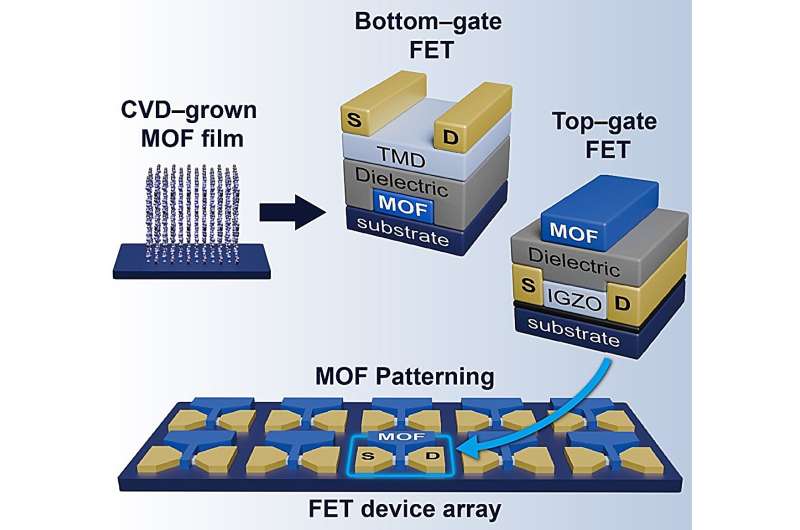
Researchers at the Korea Advanced Institute of Science and Technology (KAIST), working with collaborators from other South Korean universities, have developed tunable gate electrodes made from conductive metal-organic frameworks (MOFs) that could help enable lower-power semiconductor devices. The electrodes have been demonstrated in field-effect transistors (FETs) made from three semiconductor materials, with performance comparable to conventional metal gates in testing.
The approach addresses a limitation of conventional gate electrodes: metals have largely fixed electronic properties, restricting how precisely their characteristics can be matched to different semiconductor materials. Conductive MOFs combine metal ions with organic molecules in an ordered structure, allowing their electronic properties to be adjusted by changing their chemical composition.
A key property is the work function, which influences the voltage required to switch a transistor on. The researchers used a copper-based MOF, Cu₃(C₆O₆)₂, with a measured work function of 4.51 electronvolts (eV). Its value falls between those typical of n-type and p-type semiconductors, enabling the same electrode material to control both types of transistor channels.
To fabricate the electrodes, the team deposited uniform MOF thin films using chemical vapor deposition (CVD), followed by photolithography and etching to define precise patterns. A two-stage etching process, using ammonium persulfate followed by a brief chromium-based etch, helped remove unwanted material while preserving the film’s structure, chemical state and electrical conductivity.
The team tested the electrodes with n-type molybdenum disulfide (MoS₂), p-type molybdenum ditelluride (MoTe₂) and indium gallium zinc oxide (IGZO). In MoS₂ transistors, the MOF and conventional platinum gates demonstrated similar threshold voltages and field-effect mobility, indicating comparable switching control and charge transport.
Manufacturing feasibility was also demonstrated using an array of 23 IGZO transistors patterned on a single substrate. All devices functioned properly. An IGZO transistor maintained stable operation through 400 consecutive gate-voltage cycles, while a MoS₂ transistor retained its gate characteristics after approximately one year in ambient air.
The research establishes conductive MOFs as potential alternatives to conventional metal gate electrodes. Further work will assess whether their tunable properties can deliver actual power savings, alongside improvements in pattern precision, large-area uniformity, manufacturing reproducibility and long-term reliability.


