
A 100kWh semi-solid battery has entered production, with a claimed 6C charging rate, but the charging conditions behind its 500km range claim remain undisclosed.
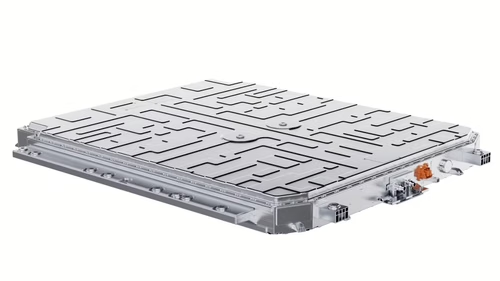
Svolt, an electric vehicle battery producer based in China, has begun manufacturing its 100 kilowatt-hour (kWh) semi-solid battery pack, asserting that the battery is capable of delivering about 500km of additional driving distance within 12 minutes. The Dragon Armor battery pack was unveiled on October 26, 2026, after being manufactured from a plant in Changzhou, Jiangsu province.
The battery is based on semi-solid cells that have both solid and liquid electrolytes compared to the battery having a purely liquid electrolyte. Svolt claims that it employs the separator transfer printing technique for its cells to enhance safety and charging capacity. The pack operates at 900V and supports a 6C charging rate. It also incorporates liquid cooling on both sides and six layers of underbody protection, which the company claims provide three times the impact resistance required by China’s national standard.
A 6C charging rate theoretically allows a battery to charge at six times its rated capacity per hour. If we consider a battery pack size of 100 kWh, then the maximum power required for charging is about 600 kW. This is a calculated figure rather than a charging-power specification independently confirmed by Svolt. Actual charging power will also depend on the vehicle’s charging system, battery temperature and charging curve.
According to Svolt, the battery can be charged more than 3,000 times and the driving range of which theoretically exceeds one million kilometers. First generation cells are claimed to have an energy density of 300 Wh/kg, while second generation cells will target 360 Wh/kg. The company has not provided detailed independent test results to establish these performance figures.
The charging requirement also poses some questions regarding the infrastructural requirement to implement such a feat. The charging station that will have a power output of 600kW will be more powerful compared to most of the existing public charging stations. In India, most of the public charging stations are DC fast chargers that have outputs ranging from 30kW to 150kW. Even with the highest power available from the charger being 150kW and operating continuously for 12 minutes, the total output will be about 30kWh, disregarding any charging losses.
Production of the first battery packs has begun, but Svolt has not disclosed the initial production volume. Chairman Yang Hongxin said several vehicle manufacturers had nominated the battery for their upcoming models, with vehicle announcements expected later. The company has not identified these manufacturers. An earlier report linked the pack to a future Mini model, but this has not been confirmed by the automaker. Svolt has also not announced pricing, although it previously indicated that semi-solid cell production costs could approach those of conventional lithium-ion batteries.
Svolt ranked ninth globally in electric vehicle battery installations between January and August 2026, with a reported market share of 2.6 per cent. Its position in China was tenth in September, with a 1.97 per cent share. Yang expects semi-solid batteries to become more widely adopted over time, while fully solid-state batteries remain some distance from mass production.
For India, the practical challenge is not only the availability of higher-energy-density batteries but also the charging infrastructure required to support them. The country’s public charging network is expanding, supported by government initiatives such as the PM E-DRIVE scheme, which has allocated approximately Rs 2,000 crore towards charging infrastructure. However, a network capable of consistently supplying charging power in the 600kW range is not yet widely available.
Domestic battery manufacturing is also developing. Amara Raja Energy & Mobility is establishing a lithium-ion cell manufacturing facility in Telangana, with an initial planned capacity of 4GWh and an announced investment of approximately Rs 9,500 crore. The facility’s initial production was targeted for the second or third quarter of FY27.
Svolt has not announced plans to introduce its semi-solid battery packs in India. For now, the key questions are whether the claimed charging performance can be independently demonstrated, which vehicle manufacturers will adopt the technology and whether the charging infrastructure can support its full capabilities.
For more information, click here.