




AIoT-Based Digital Twin for Predictive Maintenance of Elevator Induction Motors is a low-cost intelligent monitoring platform designed to improve the reliability, operational visibility, and maintenance planning of three-phase induction motors used in elevator systems. The proposed system integrates multiparameter sensing, edge computing, and a browser-based digital-twin dashboard using an Arduino UNO Q with 2 GB RAM. Electrical, thermal, mechanical, and acoustic parameters are acquired from the physical motor, processed locally, and represented digitally to provide a real-time view of its operating condition.
The monitoring system tracks key electrical parameters, including voltage, current, power, energy, frequency, and power factor, alongside rotor speed, vibration, temperature, humidity, and sound levels. Live measurements and historical trends are displayed through the digital-twin dashboard, enabling operators to observe performance changes and investigate deviations from established operating patterns. A proposed predictive-maintenance layer uses these measurements to derive machine-health indicators, identify abnormal behavior, and generate warnings when predefined thresholds or abnormal trends are detected. The architecture also provides a foundation for future machine-learning-based fault classification and condition-based maintenance.
An additional adaptive-control framework is proposed to use the motor’s operating state and health indicators to inform adjustments to an external motor-drive command. This capability requires a suitable isolated variable-frequency drive (VFD) interface, appropriate control logic, and validation of the motor’s safe operating limits before implementation. By combining real-time monitoring, historical analysis, and extensible edge intelligence, the system aims to support early fault identification, reduce unexpected downtime, and improve maintenance decisions for elevator motor installations. The prototype serves as a foundation for developing more advanced digital-twin systems for industrial motor monitoring, with predictive accuracy and control effectiveness to be established through systematic testing under representative operating conditions.
Project Members:
| Sr. No. | Name | Role / Contribution | Contact (Optional) |
| 1. | Dr. Rajanikant A. Metri | Control Systems & Integration | 9637256949 |
| 2. | Mr. Prathmesh B. Admile | AI & Digital Twin Modeling | 8855848705 |
| 3. | Prof. Sachin S. Kumbhar | Embedded Systems & Communication | 9284228266 |
| 4. | Dr. Chandrakant L. Bhattar | Hardware & Data Acquisition | 9096270827 |
List of Components
The hardware subsystem consists of the Arduino UNO Q, three-phase induction motor used at the elevator, electrical energy meter, temperature, speed, acoustic and humidity sensors, LCD display, and regulated power supply. These components work together to acquire and process the key operating parameters of the motor in real time. The sensors provide complementary information about the motor’s electrical, mechanical, thermal, and environmental conditions, enabling comprehensive condition monitoring. The Arduino UNO Q serves as the central edge-computing unit for sensor interfacing, data processing, local communication, and integration with the digital-twin dashboard. The following table presents the major hardware components used in the developed prototype along with their ratings and quantities.
| Sr. No. | Particulars | Rating | Quantity |
| 1. | Arduino UNO Q Single Board Computer Model 2GB ABX00162 | STM32U585, 2GB/16GB, Wi-Fi 5, BT 5.1 | 1 |
| 2. | 3-phase Induction Motor | AC Supply, 50Hz, 3-phase | 1 |
| 3. | PZEM-004T AC Multi-function Electric Energy Metering Power Monitor | 80-260VAC, 100A | 1 |
| 4. | Humidity Detection Sensor Module | 3.3-5V, 20 ~ 95%RH | 1 |
| 5. | LJC18A3-B-Z/BX Sensor NPN NO Inductive Proximity | DC 6–36V, 300mA, Detection Range 1–10 mm | 1 |
| 6. | DS18B20 Water Proof Temperature Probe – Black (1m) | DS18B20, 1m | 1 |
| 7. | Analog Sound Sensor Microphone Module for Arduino | Signal amplitude VCC/2 | 1 |
| 8. | IIC/I2C Serial Interface Adapter Module | 5V, Serial I2C control | 1 |
| 9. | 20X4 Character Y-B LCD Display Module – Golden Morning | 20X4 Character, SPLC780D | 1 |
| 10. | Hi Link 5V/10W Switch Power Supply Module HLK-10M05 | AC Input: 100 ~ 240V, DC Output 5V; Power: 10W | 1 |
Detailed Project Description
Project Overview
This project presents an artificial Internet of Things (AioT)-enabled condition-monitoring and digital-twin prototype for a three-phase induction motor which is used for the lift (elevator system). The physical motor is instrumented with electrical, thermal, speed, vibration, acoustic and temperature sensors. Sensor data are acquired by an Arduino UNO Q 2GB, processed locally, and presented through a browser-based digital-twin dashboard. The dashboard provides live measurements and historical trends for voltage, current, power, energy, frequency, power factor, rotor speed, temperature, humidity and sound/noise.
The proposed predictive-maintenance layer converts these measurements into machine-health indicators, detects deviations from normal operating behaviour, and can generate warnings or maintenance actions before a severe fault develops. The adaptive-control layer can use the same health and operating-state information to modify an external motor-drive command when a suitable isolated VFD/drive interface is added.
Objectives
The objectives of the proposed system are listed as:
- Develop a low-cost AIoT architecture for industrial induction-motor monitoring.
- Acquire electrical and non-electrical condition parameters in real time.
- Create a digital representation of the motor operating state through a browser dashboard.
- Track trends and identify abnormal changes in electrical, thermal, speed and acoustic behavior.
- Provide a logic framework for predictive-maintenance alerts and adaptive operating decisions.
- Provide a platform that can later be extended with machine-learning fault classification.
System Architecture
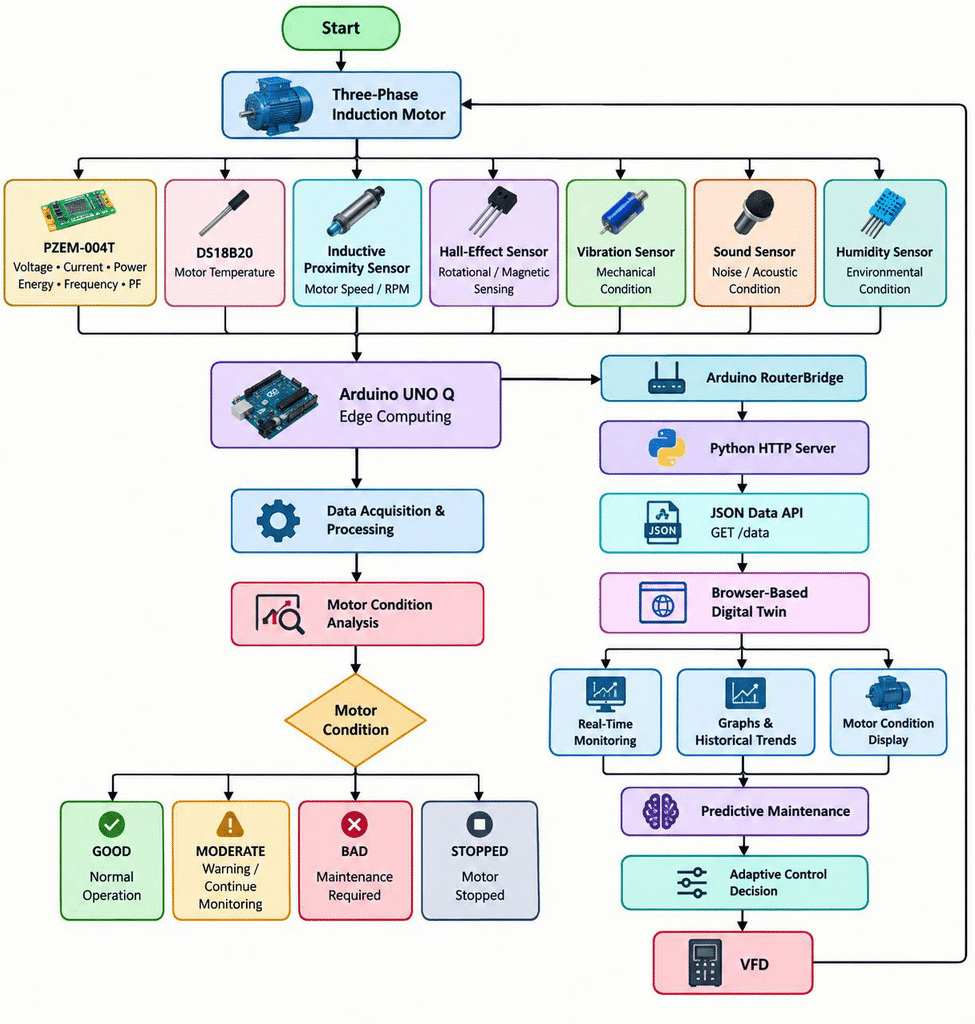
The proposed system architecture integrates the physical elevators’ induction motor, multi-parameter sensing unit, Arduino UNO Q edge-computing platform and digital-twin monitoring interface into a unified AIoT framework. Electrical, thermal, speed, acoustic, and environmental parameters are acquired from the motor and surrounding conditions through dedicated sensors. The Arduino UNO Q processes the acquired data and communicates the motor’s operating condition to the digital-twin dashboard for real-time visualization and analysis. The collected data can be further used for condition assessment, anomaly detection, predictive maintenance, and adaptive control decisions. Thus, the architecture establishes a continuous link between the physical motor and its digital representation.
Schematics
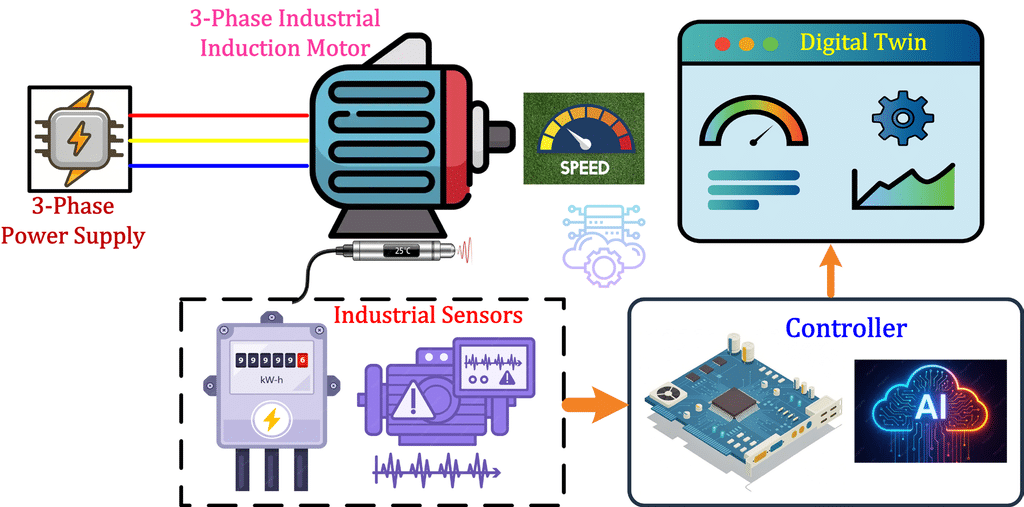
Working
- Electrical monitoring: The PZEM-004T measures electrical operating variables such as supply voltage, current, active power, accumulated energy and frequency. Power factor can also be monitored when the measurement configuration supports it.
- Rotor-speed measurement: The inductive proximity sensor detects a rotating metallic target and generates pulses. The controller converts pulse frequency into rotor speed.
- Temperature monitoring: The DS18B20 probe measures motor temperature. A rising temperature trend can indicate overload, inadequate cooling, bearing/friction problems or other abnormal operating conditions.
- Acoustic monitoring: The analogue sound sensor supplies a signal that can be converted into a noise-level indicator. Changes in the baseline can be used as an early warning feature for mechanical or electromagnetic abnormalities.
- Ambient monitoring: The humidity sensor provides an additional environmental variable that can help interpret changes in motor behaviour.
- Local display and IoT interface: The 20×4 LCD can provide local status information, while the UNO Q publishes data to the local browser-based dashboard through its networking capability.
Digital Twin
The digital twin in this prototype is a software representation of the motor’s present operating state. It receives the sensor stream, maintains the latest values, plots trends and presents the information in a form that can be compared with expected operating behavior. This creates a direct link between the physical machine and its software representation.
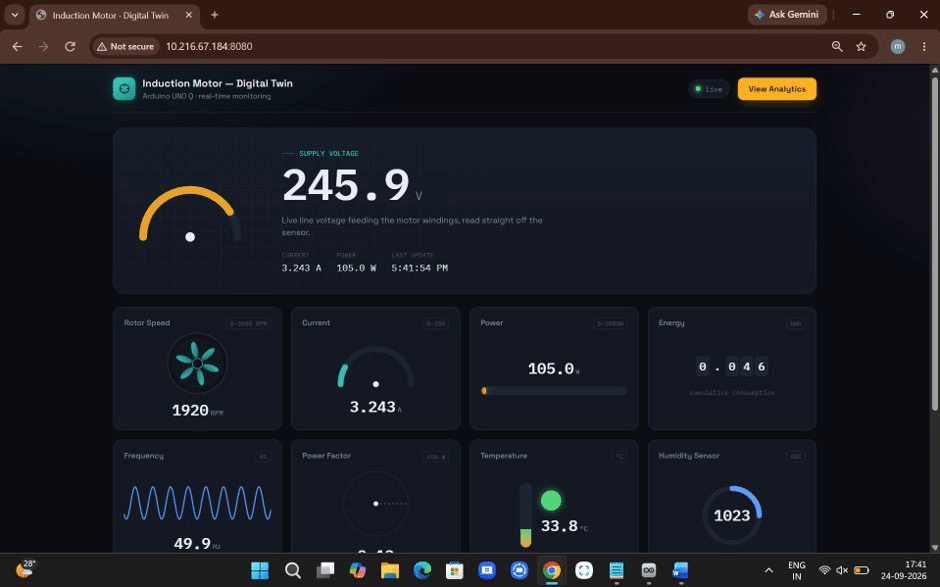
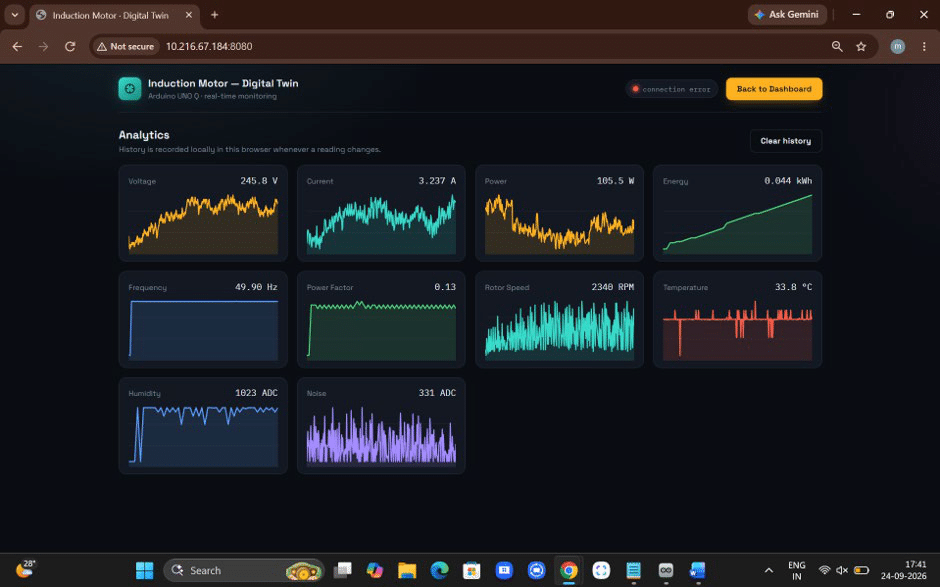
Code
Algorithm
The algorithm of the proposed system implemented with the help of the following step-by-step logic:
- Initialise the UNO Q, sensor interfaces, local storage/network services and dashboard.
- Acquire synchronised electrical, thermal, speed, acoustic and ambient data.
- Validate the samples and apply filtering such as a moving average or median filter to reduce noise.
- Calculate derived quantities such as speed, power trend, temperature rise and rate of change.
- Update the digital-twin state and store time-stamped measurements.
- Compare current features with a learned or predefined healthy baseline.
- Generate a health index or anomaly score using weighted deviations.
- If the score remains within the normal band, continue monitoring. If it crosses a warning threshold, issue an alert and increase sampling/logging priority.
- If a severe or persistent abnormality is detected, issue a fault/maintenance notification and, where a safe drive interface exists, reduce load/speed or command a controlled shutdown.
- Repeat the cycle continuously.
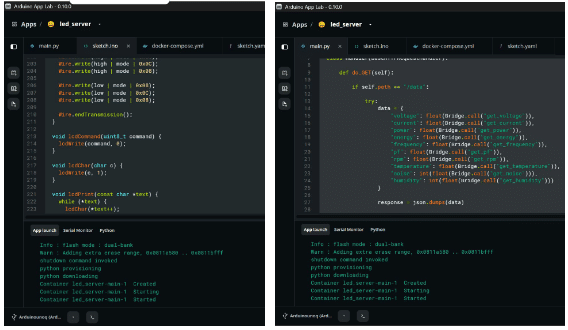
Predictive-Maintenance Logic
A practical first implementation can use a normalised health index rather than immediately requiring a large machine-learning dataset. For each parameter x, define a baseline μ and an acceptable variation σ or engineering limit. A normalized deviation can be expressed as: dᵢ = |xᵢ − μᵢ| / (σᵢ + ε)
A weighted health/anomaly score may then be formed as H = Σ wᵢ dᵢ, where the weights wᵢ reflect the importance and reliability of each feature. Temperature rise, abnormal current, speed deviation and increasing acoustic/noise level can be assigned higher weights when they are validated experimentally. Thresholds should be established from healthy-machine data and fault-condition experiments rather than arbitrary values. For a later AI/ML implementation, time-window features such as RMS current, current variance, temperature slope, speed fluctuation, acoustic RMS/FFT features, power-factor trend and energy consumption can be used as inputs to an anomaly detector or supervised fault-classification model.
The adaptive-control concept uses the digital-twin state to modify the desired operating condition according to machine health. For example, if the temperature rises progressively while load is high, the supervisory layer can request a lower speed or load; if the machine returns to a healthy state, the operating command can be restored gradually. A practical industrial implementation should place an electrically isolated VFD/drive or approved control interface between the controller and the elevators’ induction motor. The sensor/controller prototype should not be connected directly to mains switching without appropriate protection and isolation. In the supplied component list, a VFD or motor-drive power stage is not listed. Therefore, the report treats the adaptive-control output as a supervisory/control command interface rather than claiming direct mains-level speed control by the UNO Q.
PCB Design
Controller Implementation on PCB Schematic
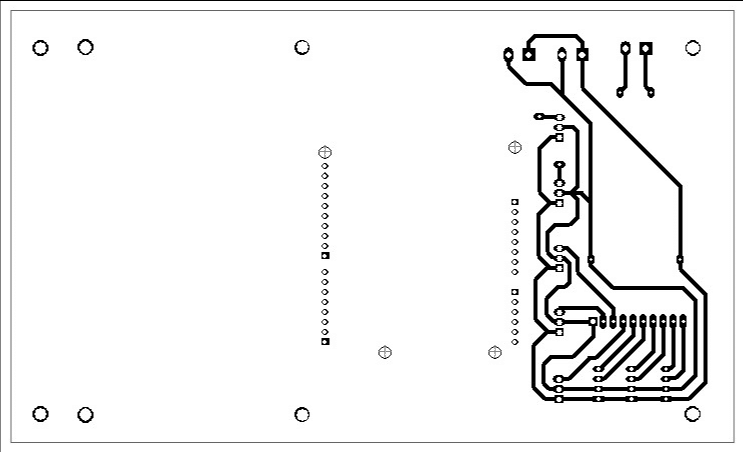
The PCB provides a compact interconnection platform for the controller, display, sensor interfaces and associated signal-conditioning/power connections. The final production version should include clearly labelled connectors, protection, isolation where required, fusing, reverse-polarity protection and suitable enclosure/strain relief.
Experimental Set-up
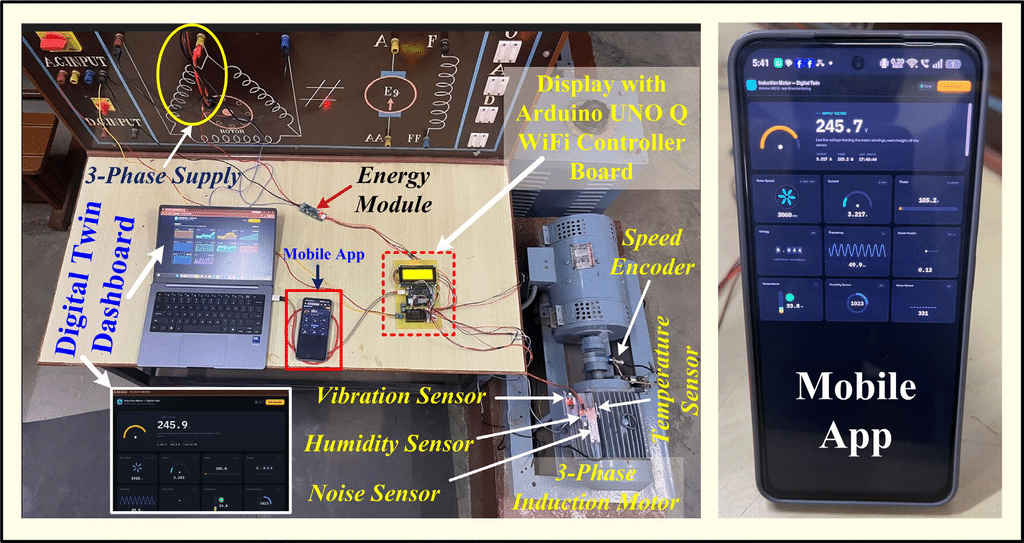
The experimental setup was developed to demonstrate the real-time condition monitoring and digital-twin-based analysis of a three-phase induction motor which is used for the lift/elevator. The motor is interfaced with the Arduino UNO Q controller through electrical, thermal, speed, acoustic, and environmental sensing units. The PZEM-004T measures electrical parameters, while the DS18B20, proximity sensor, sound sensor, and humidity sensor provide complementary operating-condition data. The Arduino UNO Q acquires and processes the sensor data and communicates the relevant parameters to the digital-twin dashboard. The dashboard provides real-time visualization of the motor’s operating condition and supports condition assessment and predictive-maintenance analysis. The complete experimental arrangement, including the motor, sensors, controller, power supply, display, and monitoring interface, is shown in the following Figure.
Advantages
- Combines edge computing, real-time sensing and IoT connectivity in a single prototype.
- Provides a live software representation of the motor rather than isolated sensor readings.
- Supports simultaneous electrical and mechanical/thermal condition indicators.
- Allows local monitoring through a browser dashboard and historical trend analysis.
- Provides a path from rule-based anomaly detection to machine-learning-based predictive maintenance.
- Can be expanded with VFD feedback, vibration sensors, current signature analysis and cloud/edge data storage.
Limitations and Safety Considerations
- An analog sound sensor is a proxy for acoustic/mechanical condition and is not equivalent to an industrial accelerometer-based vibration measurement.
- The humidity channel is displayed as an ADC value in the supplied dashboard; calibration is required before converting it to %RH.
- Any automatic shutdown or speed-reduction function should be fail-safe and should not depend on an unverified software-only decision.
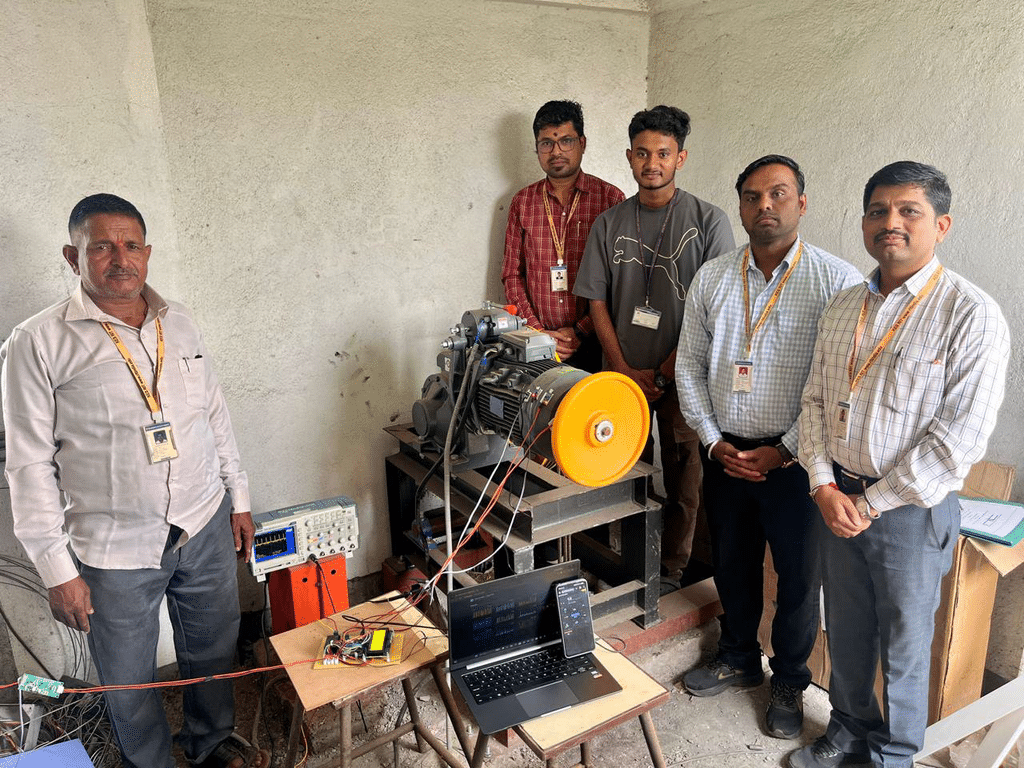
Real-Time Implementation – Elevators’ Induction Motor
Applications
- Industrial induction-motor condition monitoring
- Pump, fan and compressor monitoring
- Manufacturing-machine maintenance systems
- Energy monitoring and motor efficiency studies
- Laboratory teaching and demonstration of AIoT, IoT, digital twins and predictive maintenance
- Future smart-factory and Industry 4.0 testbeds
Conclusion
The developed prototype demonstrates the feasibility of an AIoT-based predictive maintenance and digital twin approach for a three-phase induction motor used for a lift or elevator system. By integrating electrical, speed, temperature, acoustic, and environmental sensing with the Arduino UNO Q edge-computing platform, the system enables real-time acquisition, processing, visualization, and condition monitoring of motor operating parameters. The browser-based digital twin provides a virtual representation of the physical motor and establishes a foundation for anomaly detection, predictive-maintenance assessment, and adaptive supervisory control. The prototype therefore provides a practical platform for further development and validation under different healthy and fault operating conditions.
The future scope includes integrating a three-axis industrial accelerometer for vibration-based bearing and fault diagnosis and developing healthy/fault datasets for anomaly detection and classification models. FFT and motor-current-signature features can be incorporated for improved electrical and mechanical fault identification. An isolated VFD communication interface can further enable closed-loop adaptive speed and load control, while automatic maintenance scheduling can be based on accumulated health degradation. For industrial deployment, MQTT/OPC UA communication, SCADA integration, secure user authentication, continuous data logging, alarm management, and alarm acknowledgement can also be incorporated to enhance the scalability, reliability, and industrial applicability of the proposed system.
