
Many IoT (the Internet of Things) devices require a reliable secondary power backup. If the primary supply or battery is depleted or suddenly disconnected, the device must still complete critical last-minute operations—such as saving configuration data, sending a final status update to a remote server, or logging essential information before shutdown.
Conventional IoT designs rely on rechargeable batteries for backup power. However, batteries have inherent limitations, particularly in charge–discharge cycle life. Repeated cycling gradually reduces capacity, affecting reliability and increasing maintenance requirements.
POC Video Tutorial
To overcome these limitations, this system adopts supercapacitors as a batteryless backup source. The traditional battery is eliminated and replaced with a supercapacitor-based power bank. The stored energy supports brief operation, enabling the device to complete essential shutdown tasks and preserve critical data.
The system delivers 5V to 25V DC backup power, depending on requirements, making it suitable for a wide range of IoT and embedded applications needing short-term emergency support. Beyond standalone use, it can also operate as a secondary backup module.
In this configuration, the circuit continuously monitors the primary power source and automatically supplies energy if the main system or battery fails. This ensures sufficient time for the connected device to complete final tasks—saving settings, storing operational data, or sending a last message to the cloud before shutdown. In effect, the system functions as a batteryless emergency power bank, delivering the final burst of energy required for a secure and reliable shutdown.
The system uses a lithium-ion supercapacitor (LIC) as the primary energy storage element. LICs are closely related to electrical double-layer capacitors (EDLCs), commonly known as supercapacitors, and are often referred to as hybrid supercapacitors.
Unlike batteries, which store energy through electrochemical reactions, supercapacitors store energy electrostatically. This allows them to achieve very high capacitance while maintaining fast charge and discharge characteristics.
Supercapacitors offer several advantages over conventional batteries. Since EDLCs store energy electrostatically, they exhibit lower energy losses during power delivery. They also have an exceptionally long operational lifetime, often exceeding 100,000 charge-discharge cycles. In comparison, a typical lithium-polymer battery supports only 300-500 cycles before noticeable degradation.
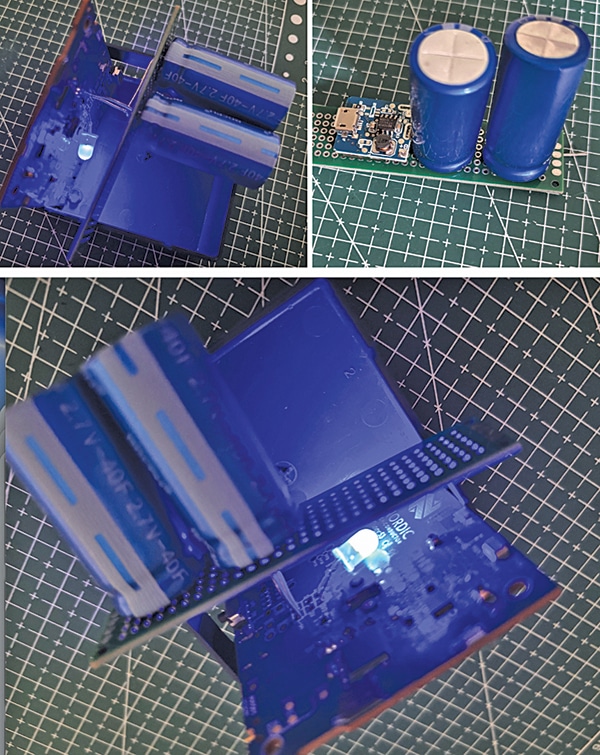
Lithium-ion capacitors represent a specialised category of supercapacitors. In these devices, one electrode behaves similarly to a lithium battery electrode, creating a hybrid structure. This enables LICs to combine high power delivery with improved energy density, making them well-suited for short-term backup applications in IoT systems. Fig. 1 presents the assembled prototype of the supercapacitor-based backup power module. The top-left image shows the prototype powering an IoT device without a conventional battery. The internal view highlights a stacked perfboard structure with two large supercapacitors mounted above the main PCB and a blue LED indicating power status. The top-right image shows a simple power bank design using a hybrid lithium-ion supercapacitor, where a compact micro-USB charging module charges the supercapacitors and manages the backup power system.
The system utilises lithium-ion supercapacitors (hybrid supercapacitors), which can store charge and exhibit very low self-discharge compared to conventional capacitors.
The components required to build this system are listed in the Bill of Materials table.
| Bill Of Materials | |||
| Name | Designator | Quantity | Manufacturer |
| 3.7V, 40F Li-ion supercapacitor | C1, C2, C3 | 3 | |
| 2.7V, 40F Li-ion supercapacitor | C4, C5 | 2 | |
| 1µF | C6 | 1 | Samsung |
| 2.2µFcitor | C7, C8 | 2 | Samsung |
| 22µF | C9, C10 | 2 | Samsung |
| SS34FA | D1 | 1 | Onsemi |
| 10µH | L1 | 1 | Sxn |
| 10kΩ | R1 | 1 | Yageo |
| 10kΩ (potmeter) | R2 | 1 | Amphenol |
| 1kΩ | R3 | 1 | Yageo |
| Load connector | U1 | 1 | |
| TP4056 module | U2 | 1 | ADI |
| MT3608 | U3, U6 | 2 | |
| Power 2-pin | U4 | 1 | |
| LTC3225EDDB | U5 | 1 | |
| Out pin | U7 | 1 | |
| IoT out pin | U8 | 1 | |
| MAX40200 | U9 | 1 | |
Batteryless Power Bank Circuit Design
The system includes two circuit implementations of a supercapacitor-based power bank for short-duration backup power. These circuits enable electronic devices to complete critical operations such as saving data, transmitting final information, or executing safe shutdown procedures.