




Rygar Sentinel: Unified Edge Appliance for Secure AIoT Infrastructure Management is an integrated edge-computing platform designed to centralise infrastructure monitoring, access control, environmental sensing, surveillance, and intelligent anomaly detection. The system uses a Raspberry Pi 5 as the Sentinel Core, coordinating distributed embedded nodes that collect physical and operational data from multiple locations. An Entrance Access-Control Node combines an Arduino UNO, keypad, reed switch, servo motor, buzzer, and ESP32 communication module to provide PIN-based access control and door-state monitoring. An Edge Sensor Node integrates gas and smoke detection, air-quality monitoring, temperature and humidity measurement, flame detection, water-leak sensing, and occupancy detection to observe environmental and security conditions. Data from these nodes is transmitted to the central edge layer for processing, correlation, visualisation, and AI-assisted anomaly detection. The platform is designed to identify unusual conditions, provide understandable alerts, trigger appropriate physical responses, and maintain local records for auditing and analysis. By integrating heterogeneous sensors, embedded controllers, wireless communication, local computing, and intelligent monitoring into a unified architecture, Rygar Sentinel aims to improve operational visibility, security, and responsiveness while reducing dependence on isolated IoT systems and continuous cloud connectivity.
Component List (Bill of Materials)
| S.No. | Component Name | Manufacturer Part Number | DigiKey Part Number | Qty |
|---|---|---|---|---|
| 1 | Arduino UNO Q, 2GB RAM, 16GB eMMC | ABX00162 | 1050-ABX00162-ND | 1 |
| 2 | Raspberry Pi 5, 8GB RAM | SC1432 | 2648-SC1432-ND | 1 |
| 3 | Pironman 5 Mini PC Case | CN0446D | 4411-CN0446D-ND | 1 |
| 4 | Raspberry Pi 27W USB-C Power Supply | SC1158 | 2648-SC1158-ND | 1 |
| 5 | 32GB MicroSD Card, Class 10 | COM-19041 | 1568-COM-19041-ND | 1 |
| 6 | 128GB M.2 NVMe SSD | IM2P41E8-128GCTB5 | 4670-IM2P41E8-128GC TB5-ND | 1 |
| 7 | DHT11 Temperature & Humidity Sensor | SNS-DH11 | 1188-SNS-DHT11-ND | 2 |
| 8 | RC522 RFID Module | CN0090 | 4411-CN0090-ND | 1 |
| 9 | HC-SR501 PIR Motion Sensor | ST0012 | 4411-ST0012-ND | 2 |
| 10 | 12-Key Numeric Keypad | 419 | 1528-1136-ND | 1 |
| 11 | ACS712 20A Current Sensor | ACS712ELCTR-20A-T | 620-1190-1-ND | 1 |
| 12 | Arduino UNO R3 | A000066 | 1050-1024-ND | 1 |
| 13 | ESP32-WROOM-32EDevelopment Board | ESP32-DEVKITC-32E | 1965-ESP32-DEVKITC-3 2E-ND | 2 |
| 14 | 0.96″ OLED Graphic Display | 326 | 1528-1220-ND | 1 |
| 15 | 16×2 Character LCD with I²C | AMC1602AR-B-Y6WF DY-I2C | 5491-AMC1602AR-B-Y6 WFDY-I2C-ND | 1 |
| 16 | MQ135 Air Quality Sensor | SNS-MQ135 | 1188-SNS-MQ135-ND | 1 |
| 17 | MQ-2 Gas Sensor Module | ST0252 | 4411-ST0252-ND | 1 |
| 18 | Analog Flame Sensor | DFR0076 | 1738-1091-ND | 1 |
| 19 | IR Obstacle Avoidance Sensor | ST0050 | 4411-ST0050-ND | 2 |
| 20 | Reed Switch | MK04-1A66B-500W | 374-1115-ND | 1 |
| 21 | 5V Magnetic Buzzer | WT-1205 | 433-1028-ND | 1 |
| 22 | 4-Channel Relay Module | TS0011 | 4411-TS0011-ND | 1 |
| 23 | Grove Water Sensor | 101020018 | 1597-1127-ND | 2 |
| 24 | 40×10mm 12V DC Cooling Fan | HA40101V4-1000U-A 99 | 259-1790-ND | 1 |
| 25 | Male-to-Male Jumper Wires, 6″ | 1957 | 1528-1967-ND | 1 |
| 26 | Male-to-Female Jumper Wires, 6″ | 1954 | 1528-1964-ND | 1 |
| 27 | General-PurposeBreadboard | 1609 | 1528-1195-ND | 1 |
| 28 | RC Servo Motor, 4.8V | SER0006 | 1738-1385-ND | 1 |
Software Layer:
| Software Layer | Component Name | Technical Purpose & Functionality |
|---|---|---|
| Firmware | Arduino IDE / C++ | Embedded control logic, sensor/actuator interfacing, hardware control, and serial data transmission. |
| Communication | Eclipse Mosquitto MQTT | Lightweight publish/subscribe messaging broker used for transferring unified system state between the Arduino UNO Q and Raspberry Pi 5. |
| Edge Compute | Python 3.x Runtime | Execution environment for Flask services, MQTT bridging, data |
| processing, dashboard services, and AI inference on the edge systems. | ||
| Web Service | Flask Web Framework | Lightweight HTTP server providing REST-style endpoints for node communication, system state, and the web dashboard. |
| Computer Vision | OpenCV | Webcam capture and video-frame processing for the prototype CCTV stream. |
| Analytics & AI | NumPy, Pandas, Scikit-Learn | Sensor-data processing, feature preparation, normalization/scaling, and Isolation Forest-based anomaly detection. |
| Model Persistence | Joblib | Serialization and loading of the trained machine-learning preprocessing/model components for local inference. |
| Private Storage | Nextcloud / SQLite | Nextcloud provides private local file/data storage, while SQLite can be used for local event/telemetry persistence. |
| Remote Access | Tailscale | Private encrypted overlay networking for remote access to the locally hosted dashboard and services without exposing them directly to the public Internet. |
Introduction & Problem Statement
The rapid adoption of connected devices, sensors, surveillance systems, access-control systems, and automated infrastructure has transformed modern offices, schools, homes, and small facilities into increasingly complex cyber-physical environments. However, these technologies are often deployed as separate systems, with individual devices collecting and processing information independently. This creates fragmented infrastructure in which security, environmental monitoring, occupancy, safety, automation, data storage, and surveillance are not always able to operate as a unified system.
Rygar Sentinel is proposed as a Unified Edge Appliance for AIoT Infrastructure Management that brings these distributed functions together at the local edge. Instead of treating each sensor or subsystem as an independent application, the platform provides a common architecture through which different devices can collect information, communicate system states, identify unusual conditions, and support appropriate responses.
The prototype combines embedded controllers, wireless sensor nodes, edge computing, MQTT communication, local data processing, machine-learning-based anomaly detection, physical actuators, CCTV streaming, private storage, and secure remote access. An Arduino UNO Q acts as the central edge coordinator for the distributed embedded nodes, while a Raspberry Pi 5 serves as the Sentinel Core responsible for higher-level processing, MQTT messaging, dashboard services, AI inference, and integration of the different subsystems.
The system monitors multiple aspects of a physical environment, including access events, door status, temperature, humidity, gas and air-quality conditions, water presence, flame conditions, occupancy, parking status, electrical load activity, and controllable devices such as lighting and a DC fan. These inputs are brought together into a unified system state that can be viewed through a centralised dashboard.
A key aspect of Rygar Sentinel is its local-first architecture. Core monitoring and safety functions are designed to operate within the local infrastructure rather than depending entirely on cloud services. Critical hardware-level responses, such as activating a buzzer when a flame condition is detected, remain local to the sensor node. At the same time, the Raspberry Pi provides machine-learning-based anomaly detection that examines combinations of system-state features to identify conditions that deviate from the learned normal operating baseline.
The platform also integrates a prototype CCTV stream and provides secure remote access through Tailscale, allowing authorized users to access the locally hosted monitoring interface without directly exposing the system to the public Internet. Private local storage and supporting services can further extend the appliance into a broader edge infrastructure platform.
Therefore, Rygar Sentinel is not designed as a single-purpose automation device. It demonstrates a modular AIoT edge architecture in which sensing, communication, computation, monitoring, physical control, anomaly detection, surveillance, storage, and remote access can operate as parts of a common system. The prototype provides a foundation that can be adapted for environments such as small offices, educational institutions, clinics, homes, small businesses, and remote facilities, where locally managed and integrated infrastructure can be valuable.
Absolutely bro. For the Detailed Project Description, we should go deeper than the introduction and describe the entire working system, not just the entrance subsystem.
Detailed Project Description
Rygar Sentinel is a Unified Edge Appliance for Secure AIoT Infrastructure Management designed to integrate heterogeneous sensors, embedded controllers, physical actuators, surveillance, local computing, artificial intelligence, data management, and secure remote access into a single edge-oriented platform.
The system is designed around the principle of:
Connect → Observe → Collect → Correlate → Detect → Explain → Act → Store
Rather than operating individual IoT devices as isolated systems, Rygar Sentinal creates a common infrastructure in which distributed nodes collect information from the physical environment and forward their system states to an edge coordination layer. The collected information is subsequently processed by the Raspberry Pi 5 Sentinel Core, where monitoring, communication, AI-based anomaly detection, and visualisation are performed.
Distributed Sensing and Control
The physical environment is divided into multiple functional nodes. The prototype contains an Entrance Access-Control Node and an Edge Sensor Node, allowing different categories of infrastructure information to be collected simultaneously.
The Entrance Node combines an Arduino UNO, keypad, reed switch, servo motor, buzzer, and ESP32 communication module. It provides PIN-based access control while also monitoring the physical state of the door. Access events such as successful authentication, failed authentication, door opening, and door closing are transmitted from the embedded controller to the wireless communication layer.
The Edge Sensor Node provides broader environmental and infrastructure monitoring. It combines an Arduino UNO with multiple sensors and actuators, including:
- MQ-2 gas/smoke sensor
- MQ-135 air-quality sensor
- DHT11 temperature and humidity sensor
- Flame sensor
- Water sensor
- PIR occupancy sensors
- IR-based parking detection
- ACS712 current sensor
- Buzzer
- Relay-controlled lighting
- 12V DC fan
This allows the system to observe different dimensions of the physical environment rather than relying on a single sensor category.
Wireless Edge Communication
The distributed embedded nodes use ESP32-based wireless communication to transfer their collected information to the Arduino UNO Q.
The architecture separates physical sensing from higher-level coordination. The Arduino UNO controllers handle direct sensor and actuator interaction, while the ESP32/Heltec communication layer provides wireless connectivity.
The UNO Q therefore acts as the central coordinator for the distributed embedded nodes. It receives information from the entrance and edge sensor subsystems and provides a unified system state to the Raspberry Pi 5.
Arduino UNO Q Edge Coordinator
The Arduino UNO Q forms the intermediate edge-coordination layer of Rygar Sentinel.
Its role is to bridge the distributed embedded nodes and the Raspberry Pi 5 Sentinel Core. The UNO Q receives the system information generated by the connected nodes, maintains the current system state, and provides a central interface for the connected infrastructure.
A 16×2 I²C LCD connected to the UNO Q provides a local display for system information. This allows important system states to be presented locally without requiring the user to access the web dashboard.
The UNO Q also exposes HTTP endpoints through its local Flask-based service for receiving information from the wireless nodes. The resulting state is subsequently bridged to the Raspberry Pi using MQTT.
Raspberry Pi 5 Sentinel Core
The Raspberry Pi 5 functions as the main computing and integration platform of the system.
It provides the higher-level services required by Rygar Sentinal, including:
- MQTT messaging
- System-state processing
- Web dashboard
- AI anomaly detection
- CCTV integration
- Local data services
- Remote-access integration
The Raspberry Pi therefore acts as the Sentinel Core, while the Arduino UNO Q remains responsible for coordinating the distributed embedded nodes.
This separation allows resource-intensive software functions to run on the Raspberry Pi without placing unnecessary computational requirements on the microcontroller nodes.
MQTT-Based System Communication
Eclipse Mosquitto is used as the MQTT broker on the Raspberry Pi.
The unified state generated through the UNO Q is published through MQTT using the Rygar Sentinal system topic. The Raspberry Pi dashboard and AI engine can subscribe to this common state stream.
This provides a lightweight publish/subscribe communication mechanism between the different software components.
The resulting logical data path is:
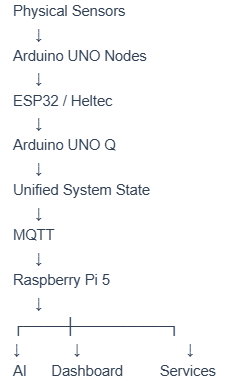
Centralised Monitoring Dashboard
Rygar Sentinel provides a web-based monitoring dashboard hosted on the Raspberry Pi 5.
The dashboard provides a centralised view of the distributed infrastructure, allowing the operator to observe information such as:
- Temperature
- Humidity
- Gas sensor readings
- Air-quality sensor readings
- Water sensor status
- Flame/fire status
- Door status
- Access events
- Occupancy status
- Parking sensor status
- Lighting status
- Fan status
- Current-sensor readings
- CCTV stream
This transforms individual sensor readings into a unified operational view of the monitored environment.
Local AI-Based Anomaly Detection
An important component of Rygar Sentinel is the integration of machine-learning-based anomaly detection.
Instead of using AI to replace deterministic safety controls, the system uses AI to analyse combinations of system-state variables and identify conditions that differ from the learned normal operating pattern.
The current implementation uses:
- NumPy
- Pandas
- Scikit-learn
- StandardScaler
- Isolation Forest
- Joblib
A baseline dataset is collected from normal system operation. The collected sensor-state features are then processed and used to train an Isolation Forest model.
During operation, incoming system states are passed through the same preprocessing pipeline and evaluated by the trained model.
The output provides an indication such as:
NORMAL
or
ANOMALY DETECTED
The AI therefore provides an additional layer of situational awareness over the distributed infrastructure.
Local Safety and Physical Response
Rygar Sentinel maintains a distinction between AI-based anomaly detection and deterministic safety responses.
Critical safety responses are implemented directly at the embedded node. For example, when the flame sensor detects a fire condition, the Arduino UNO can activate the local buzzer without waiting for the Raspberry Pi, cloud services, or AI inference.
Similarly, sensor conditions can be used to control physical devices through the relay module. The prototype demonstrates relay-based control of room lighting and a low-voltage 12V DC fan.
This architecture reduces dependence on network availability for basic local safety functions.
CCTV Integration
A laptop webcam is used as the prototype CCTV source.
The camera is accessed through OpenCV, while a lightweight Flask service provides the video stream to the Rygar Sentinal dashboard.
The CCTV component provides visual monitoring alongside the sensor-based infrastructure data.
In the current prototype, CCTV is primarily a visual monitoring subsystem. The machine-learning anomaly detector operates on the structured sensor/system-state data rather than claiming computer-vision-based AI detection.
Private Data and Remote Access
The platform can be extended with local/private data services such as Nextcloud for locally managed storage.
Remote access is implemented through Tailscale, allowing authorised devices to access the locally hosted dashboard through a private encrypted network rather than exposing the dashboard directly to the public Internet.
This enables the operator to access the system from a mobile device while maintaining the local-first architecture.
Unified Operating Concept
The major objective of Rygar Sentinal is not simply to connect more sensors. The platform demonstrates how different infrastructure functions can participate in a common edge-computing architecture.
For example, the system can simultaneously observe:
Access Event
+
Door State
+
Occupancy
+
Environmental Conditions
+
Safety Sensors
+
Infrastructure Loads
+
CCTV
↓
Unified System State
↓
Local Processing
↓
AI Anomaly Detection
↓
Operator Awareness
+
Local Physical Response
This architecture allows the prototype to demonstrate a pathway from individual sensors and embedded controllers to an integrated AIoT edge appliance.
Prototype Scope
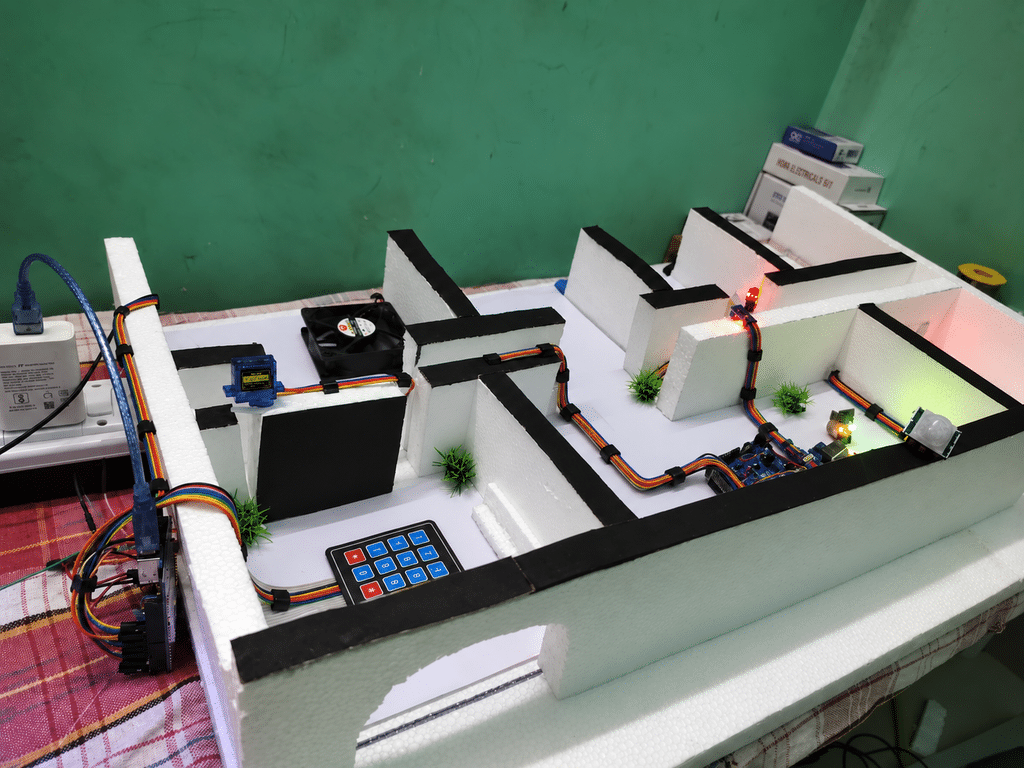
The current implementation is a functional prototype intended to demonstrate the architecture, integration, and feasibility of the concept. It is not presented as a production-certified building-management or safety system.
The prototype demonstrates the integration of:
Embedded sensing + wireless communication + edge coordination + MQTT + Raspberry Pi computing + centralized monitoring + local AI anomaly detection + physical actuation + CCTV + secure remote access.
This modular architecture allows additional sensors, nodes, applications, and AI models to be incorporated in future versions without fundamentally changing the core Sentinel architecture.
Yes bro — for the Schematics section, don’t just write “see attached schematic.” The report should explain what each schematic represents and how the circuits relate to the overall architecture.
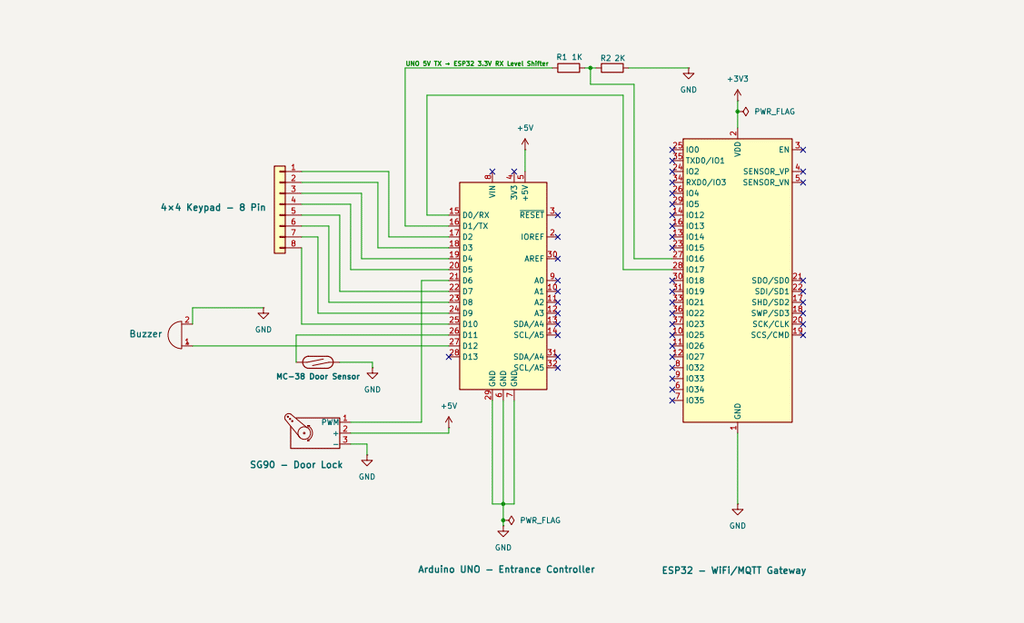
Since the actual two schematic PDFs are the source, we should preserve what they show rather than inventing additional circuitry. SENTINAL – ENTRANCE node 2
Schematics
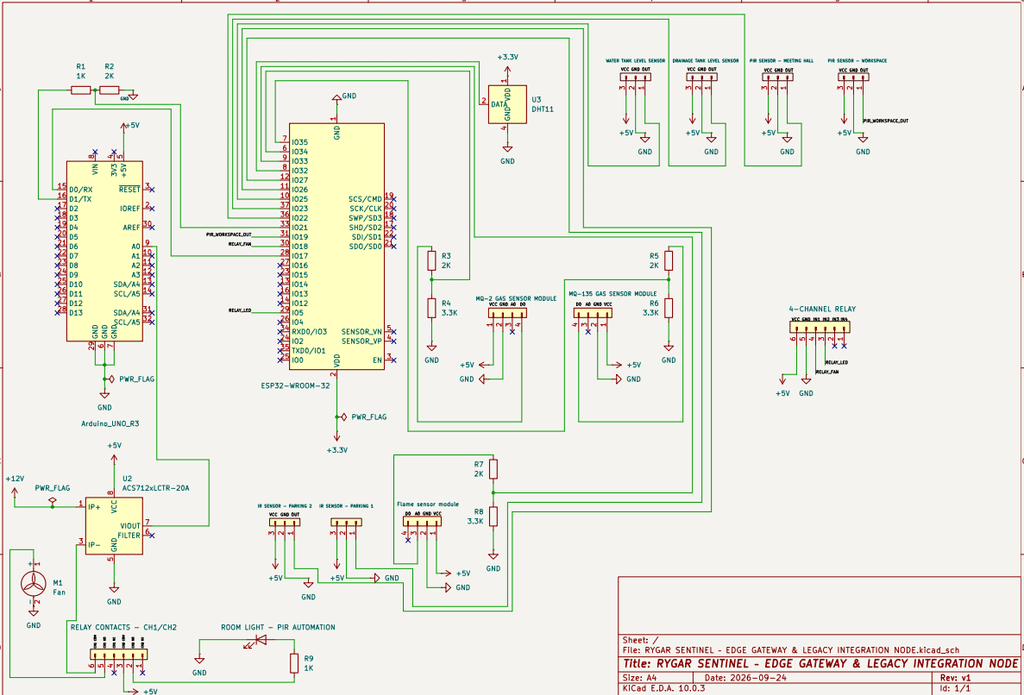
The hardware design of Rygar Sentinal is divided into two principal embedded subsystems: the Entrance Access-Control Node and the Edge Sensor Node. The corresponding electrical schematics define the controller interfaces, sensor connections, actuator connections, communication interfaces, and power connections used in the prototype.
Entrance Access-Control Schematic
The Entrance Access-Control schematic contains an Arduino UNO, 4×4 keypad, MC-38 reed switch, SG90 servo motor, buzzer, and an ESP32 wireless communication module. The circuit is designed to provide both access authentication and physical door-state monitoring. SENTINEL – ENTRANCE
The Arduino UNO performs the local access-control operations. The keypad provides the user input for PIN authentication, while the SG90 servo is used as the physical locking mechanism. The MC-38 reed switch provides feedback regarding the physical door state, allowing the controller to distinguish between door-open and door-closed conditions.
The buzzer provides local audible feedback for access and alarm-related events.
The Arduino UNO communicates with the ESP32 through a UART interface. Because the Arduino UNO operates at a 5 V logic level while the ESP32 uses 3.3 V logic, the schematic includes a 1 kΩ / 2 kΩ resistor voltage-divider interface on the UNO transmit line to provide a suitable logic level for the ESP32 receiver.
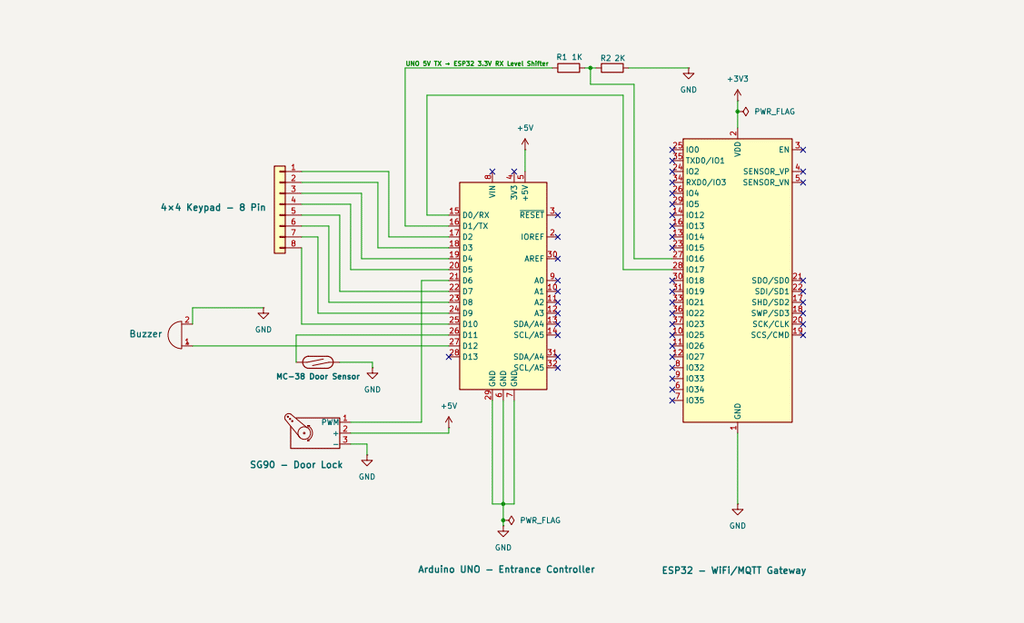
The schematic therefore represents the physical access-control and communication boundary of the Entrance Node.
Edge Sensor Node Schematic
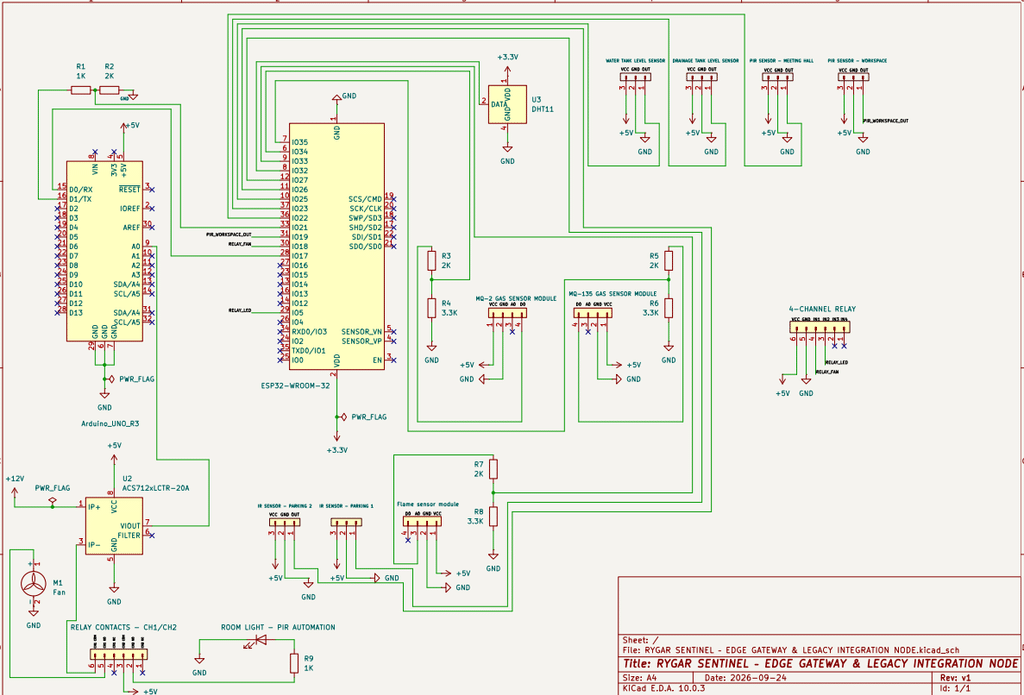
The Edge Sensor Node schematic contains an Arduino UNO R3 connected to multiple environmental, occupancy, safety, infrastructure-monitoring, and actuator components. The schematic also includes an ESP32-WROOM-32 communication interface and a DHT11 temperature/humidity sensor. node 2
The analogue sensing section includes:
- MQ-2 gas/smoke sensor
- MQ-135 air-quality sensor
- ACS712 current sensor
- Water sensor
Digital sensing includes:
- PIR motion sensors
- IR sensors for parking detection
- Flame sensor
The actuator section contains:
- Buzzer
- 4-channel relay module
- 12 V DC fan
- Lighting load
The Arduino UNO reads the sensor inputs and controls the connected actuators according to the programmed operating logic.The ACS712 is positioned in the low-voltage DC load path to provide an electrical-load/current observation for the prototype. The 12 V DC fan is used as the demonstration load rather than connecting the system directly to mains electricity.
The logical structure of the Edge Sensor Node is:
Controller-to-Communication Interface
Both embedded nodes use a separation between local hardware control and wireless communication.
The Arduino UNO is responsible for direct interaction with sensors and actuators, while the ESP32-based communication layer transfers the resulting system information wirelessly to the Arduino UNO Q.
This separation allows the sensor/actuator circuitry to remain relatively independent from the higher-level network architecture.
Electrical Design Considerations
The schematics also establish several important electrical design considerations:
1. Logic-level compatibility
The UART connection between the 5 V Arduino UNO and 3.3 V ESP32 uses a resistor-divider interface on the UNO transmit path.
2. Common ground reference
The connected communication and peripheral circuits require an appropriate common ground reference.
3. Low-voltage actuator operation
The prototype uses a 12 V DC fan as the demonstrated load and does not directly switch 230 V mains equipment.
4. Relay isolation
The relay module provides the switching interface between the controller logic and the low-voltage demonstration loads.
5. Local safety response
The flame-detection path is connected to the Arduino control logic so that the buzzer can be activated locally.
Schematic-to-System Relationship
The two schematics represent the physical hardware layer of Rygar Sentinal. They are connected to the higher-level software architecture as follows:
Operational Logic Cycle (SENSE to STORE)
SENSE: Physical sensors such as the DHT11, MQ-2, MQ-135, PIR sensors, water sensor, flame sensor, IR sensors, ACS712, and magnetic door switch capture physical conditions.
CONNECT: Arduino UNO controllers process the connected sensors and actuators. The ESP32/Heltec communication nodes receive structured data from the UNO controllers and transmit the information wirelessly to the Arduino UNO Q.
COORDINATE: The Arduino UNO Q receives information from the distributed nodes, maintains the current unified system state, and provides the state to the Raspberry Pi 5 through the MQTT bridge.
ANALYZE: The Raspberry Pi 5 receives the unified system state through MQTT. The AI engine processes selected system-state features using a trained Isolation Forest anomaly-detection model.
DECIDE: Deterministic safety logic remains at the embedded node. For example, flame detection activates the local buzzer. The AI layer separately identifies unusual combinations of system-state values.
ACT: Local embedded controllers operate the buzzer, servo lock, lighting relay, and low-voltage fan relay according to the implemented control logic.
MONITOR: The unified system state is presented through the Raspberry Pi dashboard, while the AI training dataset and trained model are maintained locally during prototype development.
Practical Implementation Scenario: The Intelligent Office
- Zone A — Entrance
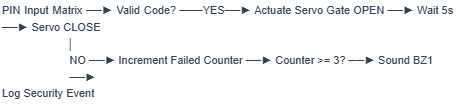
A user enters a PIN through the keypad. A valid PIN causes the SG90 servo to unlock the door temporarily, while an invalid PIN generates an access-denied event and buzzer feedback. The magnetic reed switch independently monitors the physical door state.
- Zone B — Occupancy and Lighting
PIR sensors monitor activity in the monitored rooms. When motion is detected, the Arduino controller activates the lighting relay. The current prototype uses this mechanism to demonstrate occupancy-based lighting control.
- Zone C — Environmental and Safety Monitoring
The Edge Sensor Node continuously monitors gas, air-quality, temperature, humidity, water, and flame-related sensor states. Flame detection can directly activate the local buzzer without requiring the Raspberry Pi or cloud connectivity.
- Infrastructure Load Monitoring
The ACS712 is used to observe the electrical load associated with the low-voltage demonstration fan. The prototype treats the sensor output as a current/load observation rather than a calibrated energy-metering system.
- Core Compute
The Arduino UNO Q coordinates the distributed embedded nodes, while the Raspberry Pi 5 provides MQTT messaging, centralized monitoring, AI inference, CCTV integration, and remote dashboard access.
Integrated Automation Decision Trees
[Occupancy Automation]
PIR Motion Triggered ──► Room State = OCCUPIED ──► Relay 1 ON (Lights) ──► Start 300s Timeout Timer
No Motion Detected ──► Timer Expired ──► Relay 1 OFF (Energy Saving Mode) [Safety Intervention]
Gas / Flame Sensor HIGH ──► Trip Isolation Relay OFF ──► Sound Siren BZ2 ──► Push Urgent Dashboard Alert
[Entrance Security Pipeline]
Why This Represents Genuine Edge AIoT
Standard commercial IoT devices simply forward sensor data to a third-party cloud server where processing occurs, introducing network latency, security vulnerabilities, and reliance on active internet connectivity.
Rygar Sentinel executes true local AIoT architecture:
- On-Device Feature Extraction: Multi-sensor feature scaling happens locally at the edge.
- Rygar Sentinel demonstrates an edge-oriented AIoT architecture by combining distributed embedded sensing, local communication, edge coordination, centralised local computing, and machine-learning-based anomaly detection without requiring cloud-based processing for the core prototype workflow.
- Local Data Processing: Sensor information is collected by distributed embedded nodes and transferred through the Arduino UNO Q to the Raspberry Pi 5.
- Local AI Inference: The Raspberry Pi 5 runs the trained Isolation Forest anomaly-detection model locally using incoming system-state data.
- Deterministic Local Safety: Critical hardware-level responses, such as flame detection activating the local buzzer, remain within the embedded node and do not depend on AI inference or Internet connectivity.
Code
The Rygar Sentinal software is implemented as a distributed set of embedded firmware and Python-based edge applications. The code is divided according to the functional responsibilities of each hardware and software layer.
The implementation follows the system architecture in which the Arduino-based nodes handle direct sensor and actuator operations, ESP32-based controllers provide wireless communication, the Arduino UNO Q coordinates the distributed nodes, and the Raspberry Pi 5 provides higher-level services such as MQTT communication, dashboard visualization, CCTV integration, and AI-based anomaly detection.
Firmware Architecture
The embedded firmware is developed using Arduino C/C++. Each controller has a dedicated program according to its role in the system.
| Source File | Platform | Purpose |
|---|---|---|
| entrance_uno.i no | Arduino UNO | Keypad-based access control, servo door lock, reed-switch monitoring, and buzzer control |
| entrance_esp32.ino | ESP32 | Receives entrance events from the Arduino UNO and forwards them wirelessly to the UNO Q |
| edge_node_uno. ino | Arduino UNO | Reads environmental, occupancy, safety, parking, and current-sensing inputs and controls local actuators |
| heltec_v1.ino | Heltec WiFi LoRa 32 V1 | Receives edge-node data, reads DHT11 data, and transfers the combined information to the UNO Q |
| node2_server.p y | Arduino UNO Q | Provides the central HTTP service for receiving node data and maintaining the unified system state |
Entrance Controller
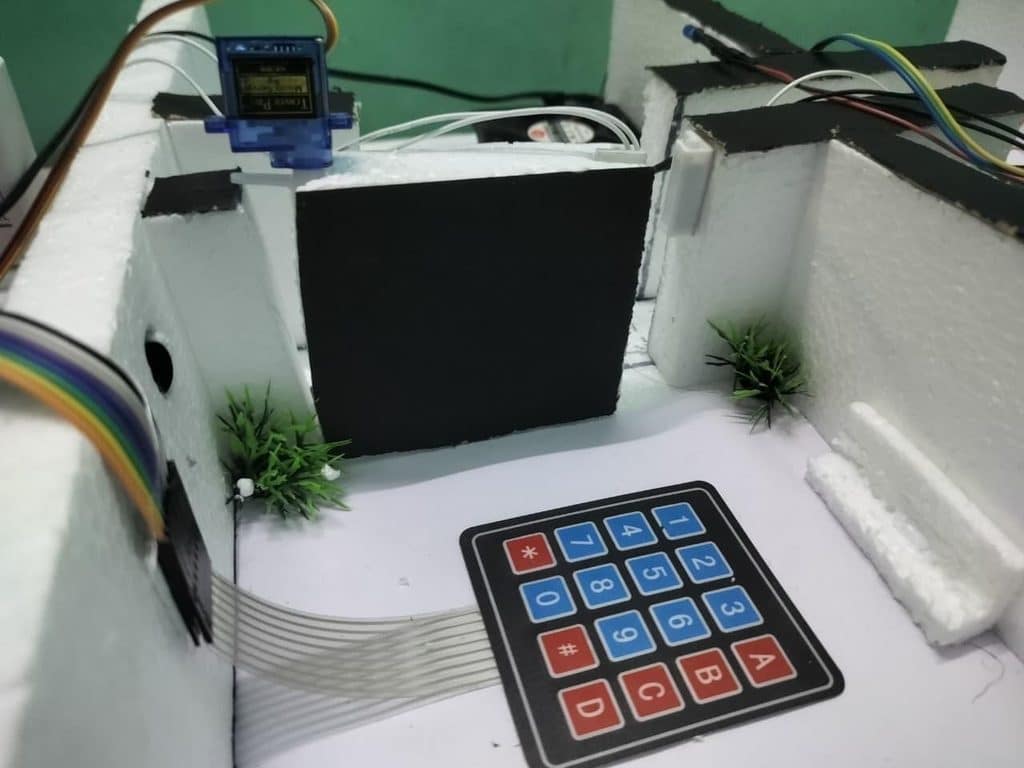
The Entrance Arduino firmware implements:
- 4×4 keypad scanning
- PIN authentication
- Servo-based door locking
- Reed-switch door-state monitoring
- Buzzer feedback
- Serial event transmission
The firmware generates events such as:
ENTRANCE_ONLINE
ACCESS_GRANTED
ACCESS_DENIED
DOOR_OPEN
DOOR_CLOSED
These events are transferred to the ESP32 communication layer.
Entrance ESP32
The Entrance ESP32 firmware provides the wireless communication layer between the Entrance Arduino UNO and the Arduino UNO Q.
The program:
1. Initializes the UART interface.
2. Connects to the local Wi-Fi network.
3. Reads events transmitted by the Arduino UNO.
4. Converts the event into a JSON message.
5. Sends the message to the UNO Q HTTP endpoint.
The logical flow is:
Arduino UNO
↓
UART
↓
ESP32
↓
Wi-Fi
↓
UNO Q /entrance
Edge Sensor Node Firmware
The Edge Sensor Node Arduino firmware is responsible for acquiring multiple sensor readings and controlling local outputs.
The firmware reads:
- MQ-2
- MQ-135
- ACS712
- Water sensor
- PIR sensors
- Parking IR sensors
- Flame sensor
It also controls:
- Buzzer
- Room lighting relay
- Fan relay
The node periodically generates a structured data record containing the sensor and actuator states.
Example:
NODE2,MQ2=66,ACS=517,WATER=90,MQ135=73,
PIR1=0,PIR2=0,PARK1=1,PARK2=1,
FLAME=1,FIRE=0,BUZZER=0,FAN=0,LIGHT=0
This information is transmitted through the UART interface to the Heltec/ESP32 communication layer.
Heltec V1 Communication Firmware
The Heltec WiFi LoRa 32 V1 acts as the wireless communication controller for the Edge Sensor Node.
In addition to forwarding the Arduino UNO sensor data, it reads the DHT11 temperature and humidity sensor.
The resulting data is packaged into a JSON structure containing:
- Node identification
- Temperature
- Humidity
- Arduino sensor-state data
The data is then transmitted over Wi-Fi to the UNO Q.
Edge Arduino UNO
↓
UART
↓
Heltec V1
│
├── DHT1
│
↓
Wi-Fi
↓
UNO Q
Arduino UNO Q Software
The Arduino UNO Q provides the central coordination layer between the distributed wireless nodes and the Raspberry Pi 5.
The Python-based Flask service provides endpoints including:
/node2
/entrance
/state
/
The /entrance endpoint receives entrance events, while /node2 receives environmental and infrastructure information.
The /state endpoint provides the current unified system state to downstream services.
The UNO Q also interfaces with the centralized 16×2 I²C LCD, allowing system information to be displayed locally.
MQTT Communication
The Raspberry Pi 5 runs the Mosquitto MQTT broker.
The unified system state from the UNO Q is published to:
rygar/state
The MQTT architecture allows multiple services to consume the same system-state stream without requiring each service to communicate directly with the embedded nodes.
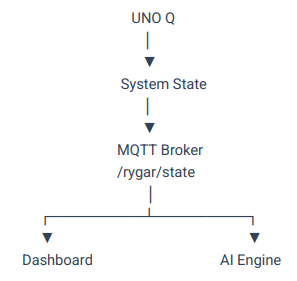
The MQTT bridge periodically retrieves the UNO Q state and publishes it to the Raspberry Pi MQTT broker.
Web Dashboard
The dashboard is implemented using Python Flask and provides a centralised interface for monitoring the Rygar Sentinel system.
The dashboard receives system-state information through MQTT and presents the information in a browser-based interface.
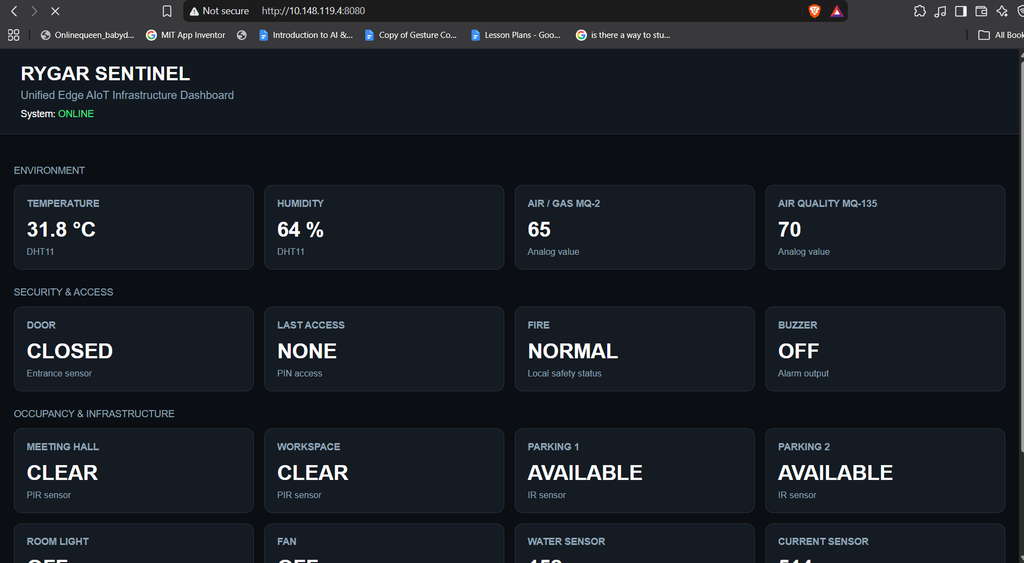
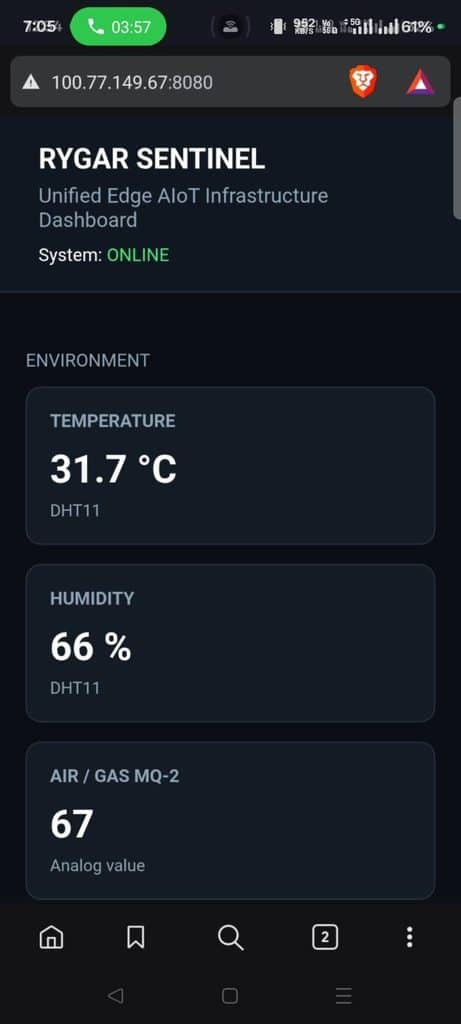
The interface includes monitoring information such as:
- Temperature
- Humidity
- MQ-2
- MQ-135
- Water level
- Door state
- Access events
- Flame/fire state
- Occupancy
- Parking
- Lighting
- Fan
- Current-sensor readings
- CCTV stream
The dashboard therefore provides a single operational view of the distributed system.
CCTV Software
The prototype CCTV service is implemented using Python and OpenCV.
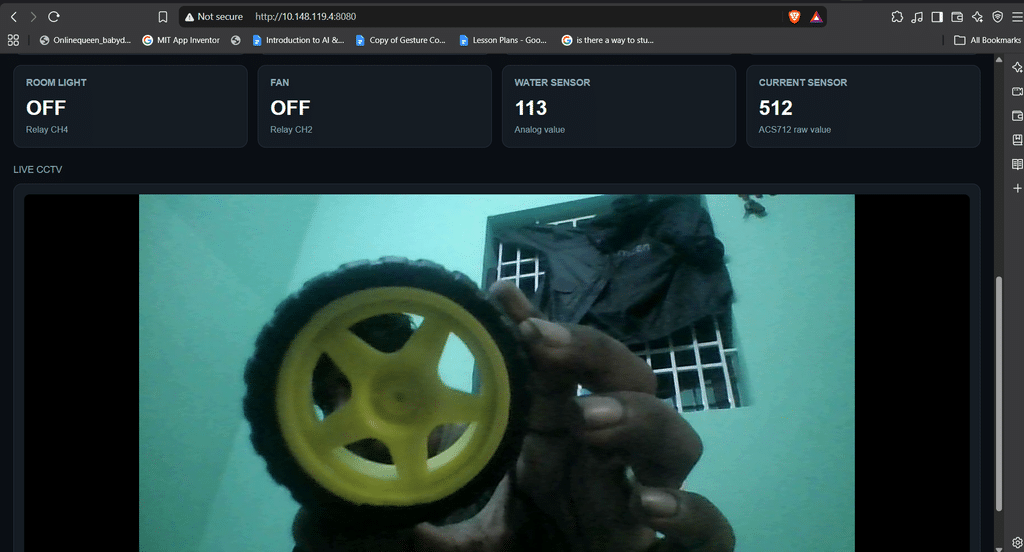
The program:
1. Opens the laptop webcam.
2. Continuously captures frames.
3. Encodes frames as JPEG images.
4. Provides an MJPEG stream through Flask.
5. Embeds the stream into the Rygar Sentinel dashboard.
The CCTV implementation is used for visual monitoring. It is not represented as the source of the project’s machine-learning anomaly detection.
AI and Machine Learning Code
The AI component is implemented on the Raspberry Pi 5 using:
- NumPy
- Pandas
- Scikit-learn
- Joblib
The AI implementation is divided into three stages.
Data Collection
ai_collector.py subscribes to the MQTT system-state stream and records normal operating conditions.
MQTT State
↓
Feature Extraction
↓
Normal Dataset
Model Training
train_model.py prepares the collected data and trains an Isolation Forest anomaly-detection model.
The preprocessing pipeline includes feature scaling before model training.
Normal Dataset
↓
Feature Preparation
↓
StandardScaler
↓
Isolation Forest
↓
Trained Model
Live Inference
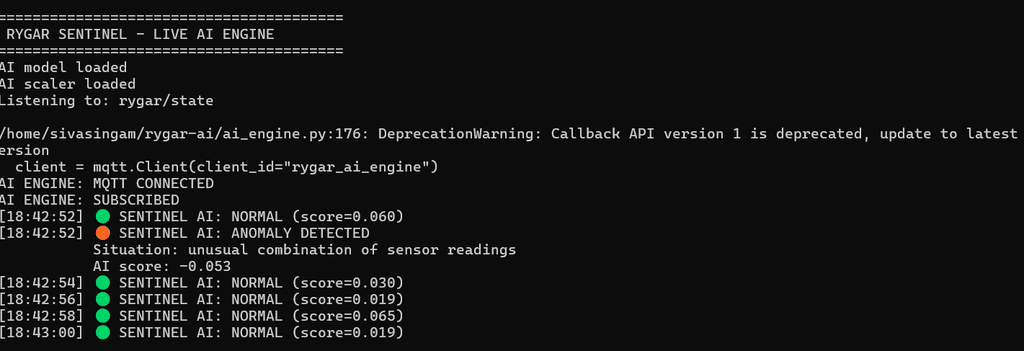
ai_engine.py subscribes to the live MQTT state and applies the trained model to incoming system states.
The inference result is reported as either:
NORMAL
or:
ANOMALY DETECTED
The AI therefore evaluates the combined system state, rather than treating one sensor reading as an independent AI decision.
Software Repository Organisation
All source code is maintained in the project GitHub repository and organised according to the hardware and software architecture.
firmware/
├── entrance_uno/
├── entrance_esp32/
├── edge_node_uno/
├── heltec_v1/
└── uno_q/
raspberry_pi/
├── mqtt/
├── dashboard/
└── cctv/
ai/
├── collector/
├── training/
└── inference/
This organisation separates embedded firmware from edge-computing services and AI software, making the system easier to maintain and extend.
Code Availability
The complete source code used for the prototype is maintained in the project’s GitHub repository:
RYGAR SENTINAL – AIoT Design Challenge 2026
The repository contains the embedded firmware, Raspberry Pi services, AI implementation, hardware documentation, schematics, and project documentation.
Code Implementation and Configuration
The complete prototype source code is maintained in the project GitHub repository and is organized according to the system architecture.
The embedded firmware consists of separate programs for the Entrance Arduino UNO, Entrance ESP32, Edge Sensor Arduino UNO, and Heltec V1 communication node. These programs handle sensor acquisition, actuator control, local safety logic, serial communication, and wireless communication.
The Arduino UNO entrance controller uses the keypad, servo, reed switch, and buzzer to implement local access-control functionality. The Edge Sensor Arduino reads the environmental, safety, occupancy, parking, water, and current-sensing inputs and controls the connected relay and buzzer outputs.
The ESP32 and Heltec V1 programs provide wireless communication between the embedded nodes and the Arduino UNO Q.
The UNO Q runs the central Flask-based state service and exposes endpoints for receiving entrance and sensor-node data. A separate MQTT bridge publishes the unified state to the Mosquitto broker running on the Raspberry Pi 5.
The Raspberry Pi software contains separate applications for MQTT communication, dashboard visualization, CCTV streaming, AI data collection, model training, and live anomaly inference.
For security, Wi-Fi credentials, passwords, and other private configuration values are not included in the public source repository.
Connection Explanation & Circuit Interfaces
Node A: Entrance Access Control Sub-System (Arduino Uno R3)
| Component | Arduino UNO Pin | Function |
|---|---|---|
| Keypad Row 1 | D2 | Keypad input |
| Keypad Row 2 | D3 | Keypad input |
| Keypad Row 3 | D4 | Keypad input |
| Keypad Row 4 | D5 | Keypad input |
| SG90 Servo | D6 | Door-lock control |
| KeypadColumn 1 | D7 | Keypad interface |
| KeypadColumn 2 | D8 | Keypad interface |
| KeypadColumn 3 | D9 | Keypad interface |
| KeypadColumn 4 | D10 | Keypad interface |
| Reed Switch | D11 | Door-state monitoring |
| Buzzer | D12 | Audible indication |
| UART TX | D1 | Communication to ESP32 through level shifting |
| UART RX | D0 | Optional / not relied upon in current communication flow |
Node B: Environmental, Safety & Power Automation (Arduino Uno R3)
| Component | Arduino UNO Pin | Function |
|---|---|---|
| MQ-2 Gas Sensor | A0 | Gas/smoke sensing |
| ACS712 | A1 | Current/load observation |
| Water Sensor | A2 | Water detection |
| MQ-135 | A3 | Air-quality sensing |
| PIR — Meeting Hall | D2 | Occupancy detection |
| PIR — Workspace | D3 | Occupancy detection |
| Parking IR 1 | D4 | Parking detection |
| Parking IR 2 | D5 | Parking detection |
| Flame Sensor | D6 | Flame detection |
| Buzzer | D7 | Local safety alarm |
| Relay CH4 | D12 | Lighting control |
| Relay CH2 | D13 | 12 V fan control |
| UART TX | D1 | Communication to Heltec V1 |
Circuit Schematics & Electrical Layout
The electrical design is documented through separate schematics for the Entrance Access-Control Node and Edge Sensor Node.
The prototype uses low-voltage electrical interfaces for the demonstrated loads. The 12 V DC fan is used as the demonstration load through the relay module, and the system does not directly switch 230 V mains equipment.
The UART interfaces between the 5 V Arduino UNO and 3.3 V ESP32/Heltec devices use the resistor-divider level-shifting arrangement documented in the schematics.
The complete schematics and pin mappings are included in the project repository under:
hardware/
├── bom/
├── pin_maps/
└── schematics/
Project Video Demonstration Structure
VIDEO DEMONSTRATION AND EXPLANATION LINK
Project Video Demonstration Structure
The submitted demonstration video follows the major functional layers of the prototype:
1. Architectural Overview
Display of the physical model-office structure showing the Entrance Node, Edge Sensor Node, Arduino UNO Q, Raspberry Pi 5, and camera setup.
2. Access Control Walkthrough
Live demonstration of valid PIN entry triggering the servo lock, invalid PIN feedback, and magnetic door-state monitoring.
3. Environmental and Safety Monitoring
Demonstration of the Edge Sensor Node, including gas, air-quality, temperature/humidity, water, occupancy, parking, flame, and current/load sensing.
4. Centralized Monitoring
Demonstration of the UNO Q coordinating node information and the Raspberry Pi dashboard displaying the unified system state.
5. Edge AI Anomaly Detection
Demonstration of the Raspberry Pi AI engine processing combined system-state data and identifying anomalous operating patterns.
6. CCTV and Remote Access
Demonstration of the webcam stream in the dashboard and remote dashboard access through the private Tailscale network.
Full Source Code Repository & Firmware Structure
RYGAR-SENTINAL-FOR-AIOT-DESIGN-CHALLENGE-2026/
├── firmware/
├── raspberry_pi/
├── ai/
├── hardware/
├── docs/
└── images/
GitHub Source Code Repository
Repository: click here
GitHub Source Code Repository Link
- Public GitHub Repository: GITHUB LINK
Summary & Conclusion
Summary
Rygar Sentinal is a prototype Unified Edge Appliance for Secure AIoT Infrastructure Management that integrates distributed sensing, access control, physical actuation, edge computing, centralized monitoring, CCTV, local AI-based anomaly detection, private storage, and secure remote access within a common architecture.
The prototype combines Arduino UNO-based embedded nodes, ESP32 wireless communication, an Arduino UNO Q edge coordinator, and a Raspberry Pi 5 Sentinel Core. The distributed nodes collect information from the physical environment and transfer their states through the UNO Q to the Raspberry Pi, where the information can be monitored and analyzed centrally.
The implemented prototype demonstrates multiple infrastructure-monitoring functions, including:
- PIN-based entrance access control
- Door-state monitoring
- Temperature and humidity monitoring
- Gas and air-quality sensing
- Water sensing
- Flame detection
- Occupancy monitoring
- Parking detection
- Current/load observation
- Relay-based lighting and fan control
- Local buzzer-based safety response
- Centralised web dashboard
- CCTV streaming
- MQTT-based system-state communication
- Machine-learning-based anomaly detection
- Secure remote dashboard access through Tailscale
The system follows a local-first edge architecture, where core sensing, communication, monitoring, and selected safety functions can operate within the local infrastructure without making cloud connectivity a fundamental requirement.
The AI component provides an additional layer of system intelligence by learning a baseline of normal operating conditions and using an Isolation Forest model to identify unusual combinations of system-state parameters. This allows the platform to move beyond simple individual sensor monitoring toward broader infrastructure-state analysis.
Conclusion
The development of Rygar Sentinal demonstrates the feasibility of integrating heterogeneous embedded systems and infrastructure-monitoring functions into a unified AIoT edge platform.
The project establishes a complete flow from physical sensing and control to wireless communication, edge coordination, centralized processing, visualization, and local AI-based anomaly detection. The use of the Arduino UNO Q as an intermediate edge coordinator and the Raspberry Pi 5 as the Sentinel Core provides a modular separation between embedded hardware control and higher-level computing services.
A significant design principle of the prototype is the separation between deterministic local safety actions and AI-based anomaly detection. Safety-critical responses such as flame-triggered buzzer activation remain within the local embedded system, while the AI layer provides additional situational awareness by identifying unusual system-state patterns.
The prototype also demonstrates that an edge appliance can combine several traditionally separate functions—such as access control, environmental sensing, occupancy monitoring, surveillance, automation, and remote monitoring—within a common infrastructure.
Although the current implementation is a prototype and requires further development for production deployment, it provides a foundation for future expansion into environments such as offices, schools, clinics, homes, small businesses, and remote facilities. Future versions could incorporate additional sensor nodes, stronger authentication, improved data persistence, more advanced AI models, industrial-grade hardware, improved fault tolerance, and professionally engineered enclosures and power systems.
Overall, Rygar Sentinel demonstrates a practical approach to building a modular, local-first AIoT infrastructure platform in which connected devices are not treated as isolated components, but as coordinated elements of a unified edge system.