Practical Ways Artificial Intelligence Can Improve FPGA Engineering Workflows
In many field-programmable gate array (FPGA) development teams today, artificial intelligence (AI) is quietly becoming part of daily engineering activity. Most engineers initially explore AI for generating right-to-left (RTL) or tool command language (TCL) scripts, but practical experience quickly shows that its usefulness extends far beyond code generation.
In real FPGA projects involving timing closure, verification, automation, documentation, and legacy RTL maintenance, AI can act as an effective engineering assistant that helps reduce repetitive effort and accelerates technical analysis.
This article discusses practical areas where AI can genuinely improve FPGA engineering productivity while still keeping engineering judgement and implementation expertise at the centre of the design process.
The discussion intentionally remains tool-agnostic and focuses on engineering methodology rather than any specific AI platform or FPGA vendor flow. Figure 1 depicts the FPGA design flow involving AI.
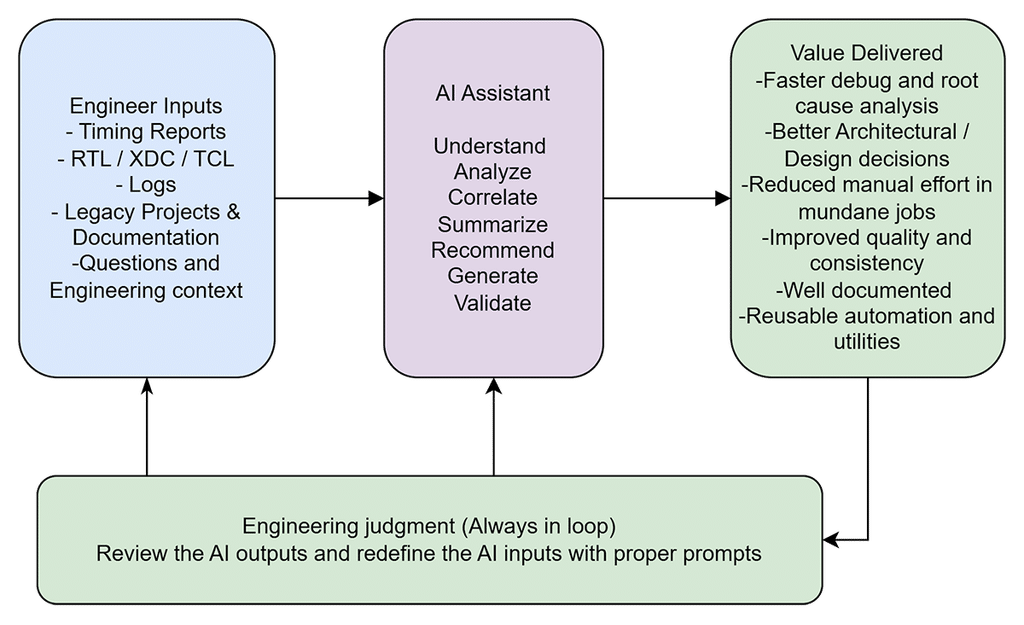
Using AI Beyond Code Generation
Many FPGA engineers initially start using AI for generating RTL, TCL, or Python scripts. While this can save time, blindly using generated code in complex projects can create additional debugging effort later.
A more effective approach is to use AI as:
- A technical assistant for report analysis
- A helper for documentation generation
- A scripting and automation assistant
- A brainstorming partner during architecture discussions
- A first-pass reviewer for logs and constraints
The highest productivity gains usually come from reducing repetitive engineering effort rather than generating entire designs automatically.
Experienced FPGA engineers still need to provide architectural understanding, timing-closure intuition, verification discipline, correctness review, and system-level trade-off decisions.
When AI is combined with engineering experience in the right way, it can significantly improve development efficiency.
The following use cases illustrate the potential applications of AI in FPGA design, highlighting areas where intelligent assistance can streamline processes and improve efficiency:

1. Timing Closure Assistance
Timing closure analysis is one of the areas where AI can provide immediate value. Modern FPGA timing reports are extremely large, and manually reviewing them consumes considerable engineering time.
Instead of manually scanning hundreds of timing paths, engineers can provide:
- Timing summary reports
- Critical-path snippets
- Congestion reports
- Utilisation reports
- Screenshots of failing paths
AI can help classify timing problems into:
- Routing-dominated paths
- Logic-heavy paths
- High-fanout issues
- Constraint-related issues
- CDC-related paths
It can also suggest possible pipelining opportunities, hierarchy cleanup areas, or potential duplication strategies.
Practical example:
An engineer debugging a failing high-frequency datapath can upload a timing report and ask AI to classify whether the violation is primarily routing-related or logic-related. Instead of manually analysing dozens of paths, the engineer immediately gets a categorised summary along with possible corrective actions such as pipelining, register duplication, or hierarchy restructuring.
Although final timing decisions still require implementation knowledge and FPGA experience, AI can significantly reduce the initial analysis effort.
2. Legacy RTL Understanding
Many organisations continue maintaining FPGA projects that were developed several years ago. Understanding such designs often takes considerable time, especially when documentation is incomplete.
AI is particularly useful in this area because it can quickly:
- Summarise module functionality
- Explain hierarchy structures
- Identify interfaces and dependencies
- Detect clock and reset domains
- Highlight FSM behaviour
- Generate high-level architectural summaries
For onboarding activities or Subversion (SVN)-to-Git migration projects, this becomes highly valuable. Even experienced engineers can save time by using AI to generate first-pass design understanding before deep manual analysis.
3. Architecture Brainstorming
AI can also support early-stage architecture discussions. During initial design phases, engineers often evaluate multiple implementation approaches before selecting the final architecture.