A new power paradigm is taking shape in automotive design, unlocking higher efficiency and simpler architectures while raising a fundamental question: Is the 12V system still relevant?
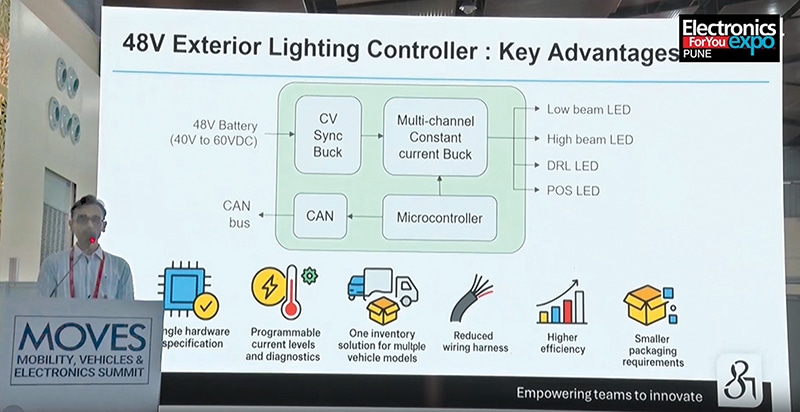
It is genuinely exciting to witness the pace at which India’s semiconductor and electronics ecosystem is evolving. Across recent exhibitions, one trend has stood out clearly: the shrinking turnaround time from prototype to production. This signals more than faster execution; it reflects a maturing ecosystem that is learning from neighbouring markets, particularly China, whose remarkable pace offers lessons that can be thoughtfully adapted to the Indian context.
Rethinking the 12V legacy
As the ecosystem evolves rapidly, it is equally important for our hardware to keep pace with these shifts. The automotive sector is a good example. Vehicles once ran on 6V systems, then moved to 12V lead-acid batteries as electrical loads increased, and this eventually became the standard. Today, there is a clear shift towards 48V systems. Modern two-wheelers and three-wheelers are already moving to 48V, and even mild hybrid cars are adopting 48V batteries.

But are we really transitioning everything to 48V? The answer is no. Most systems still carry both 12V and 48V. That is where I start to question this approach. With the semiconductor solutions available today, do we really need both battery systems in the same vehicle? To me, this also means we need to challenge the long-held assumption that 12V must always be retained. That is no longer necessarily true.
If I look at the system level, the challenges are quite clear:
- Reducing cost, weight, and overall system size
- Simplifying connectors and wiring harnesses
- Improving efficiency and reliability
- Ensuring designs are truly future-ready
In a typical 12V system, as more features are added, battery load keeps increasing, driving higher circuit complexity. Higher current demand increases cost, weight, and size, which are primary limitations of the existing architecture. Connector design further compounds this. Currents in the range of 3 to 5 amps require larger pins and copper-heavy wiring harnesses, adding both weight and cost. Efficiency suffers, heating increases, and reliability becomes a concern. Wherever there is scope to improve reliability, it should be actively considered.
This brings me to a broader question: Are our designs really future-ready? As battery systems evolve, the rest of the vehicle architecture should evolve with them. In modern electric vehicles, especially two-wheelers and three-wheelers, the traction or motor controller is already predominantly powered by 48V. This is true for most scooters and three-wheelers on Indian roads today. Even in cars, systems like H-boxes or ISG are moving to 48V. Yet, despite this shift, the 12V battery continues to remain in the system.
Lighting losses: The 12V bottleneck