As communication networks evolve, 6G research is exploring how drones, satellites, and underwater systems can work together across previously disconnected environments.

I have been researching on drone technologies and modern communication systems for many years, with a focus on bridging conventional Wi-Fi technologies with terrestrial and non-terrestrial communication networks.
We will explore sustainable 6G networks and how they can unify the Internet of Things (IoT), the Internet of Drones (IoD), and the Internet of Underwater Things (IoUT) into a single communication ecosystem. These interconnected domains form the foundation of my research and today’s discussion.
Drones Evolving Into Networked Systems
To begin, we first need to understand what a drone actually is. Today, drones are used across a wide range of applications, from agriculture to surveillance, and have become especially prominent in modern warfare, including Operation Sindoor, highlighting how rapidly the technology is evolving.
A drone is essentially an unmanned vehicle. Although we usually think of aerial drones, unmanned systems also include ground and underwater vehicles. As aerial drone technology advances, unmanned underwater vehicles are evolving alongside it.
The market reflects this growth. The global drone industry is projected to reach nearly US$260 billion by 2030, while the US agricultural drone market is expected to grow at a CAGR of 22.8%. These trends suggest that the future of the Internet of Things (IoT) will increasingly converge with drone technologies and drone networks. Drones are broadly classified into three categories.
- Fixed-wing drones: Used for long-range missions, particularly in military and surveillance applications.
- Multicopter drones: Preferred for operations requiring vertical take-off and landing (VTOL) capabilities.
- Hybrid drones: Combine the long-range advantages of fixed-wing aircraft with the flexibility of VTOL systems.
Ultimately, the choice of drone depends on the application, mission requirements and the type of network needed for the operation.
The backbone of autonomous, mission-ready drones is their autopilot hardware and software ecosystem. Much of this is built on open-source autopilot platforms, which are widely used in commercial-grade drones and, to some extent, in military systems. Military platforms, however, are not openly discussed because of obvious security restrictions.
We are now in the era of open-source technology. Open-source hardware architectures, development boards and software allow users to customise and build their own drone platforms with relative ease. These platforms make it possible to integrate the hardware needed to develop a complete drone system.
Equally important is the availability of open-source mission-planning software. It enables users to design autonomous missions, deploy drones to execute predefined tasks, and have them return automatically to their launch point. These tools are commercially available and have made autonomous drone development far more accessible.
Inside Drones and the Internet of Drones Ecosystem
Moving from individual drones to drone networks takes us a step further. A standalone drone typically relies on one-way or two-way communication with its ground control station. In a drone network, however, the ecosystem becomes much more complex.
Besides drones, the network may include satellites, high-altitude platforms (HAPs), and quasi-stationary aerial platforms that extend communication coverage and enable drone control over much larger areas. In some cases, a drone can even act as a communication platform itself, providing network or Internet coverage as part of the overall system.
Consider two geographically separated locations. Using high-altitude platforms and low-latency satellite links, drones operating in these areas can exchange critical information, coordinate their missions, and work as a connected network.
This is the concept of a Flying Ad Hoc Network (FANET), a practical architecture that is already finding increasing use in real-world applications. Such architectures can significantly extend Internet connectivity beyond conventional terrestrial networks.
There have already been several practical efforts in this direction. One example is Google’s Project Loon, which used high-altitude balloons to expand Internet coverage. Although the project was decommissioned, the research behind it continues to influence work on ad hoc, terrestrial and non-terrestrial communication networks.
Another example is Facebook’s Project Aquila, which explored the use of high-altitude unmanned aircraft to extend Internet connectivity. While this project has also been discontinued, it demonstrated the potential of aerial platforms for providing wider network coverage.
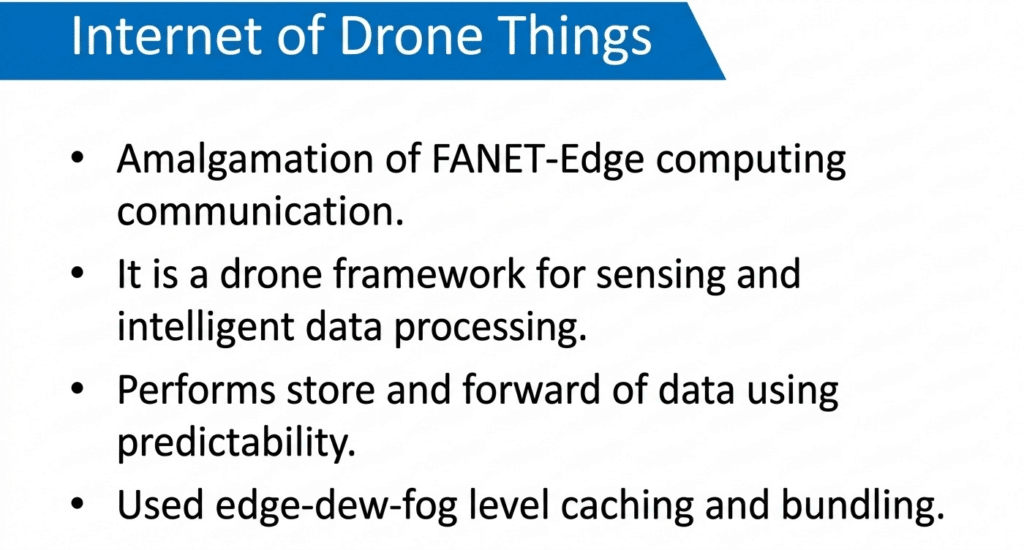
At its core, the Internet of Drones brings together drone networks, ad hoc networking, edge and fog computing, and opportunistic networking. Connectivity alone is not enough; processing data onboard the drone is equally important when designing these intelligent network infrastructures.
An IoD platform follows a hybrid sensing and communication model. It must collect data, communicate it reliably, process it onboard, and forward it with minimal latency. Edge and fog-level caching further improve the efficiency and responsiveness of the network.
The key objective of an Internet of Drones ecosystem is to enable fast, reliable data transmission between nodes, allowing missions and autonomous actions to be executed with minimum delay.
Solving the Connectivity Challenges of Future Networks
Building an Internet of Drones ecosystem also brings significant networking challenges. Integrating aerial, ground and underwater networks is one of the biggest. Aerial and ground communications typically operate in the GHz frequency range, whereas underwater communication relies on entirely different transmission methods. Ensuring interoperability between these diverse network infrastructures is therefore a critical challenge.
Message routing is another key issue. Drone and underwater networks are often sparse, much like deep-space networks, where nodes are widely distributed. In such environments, opportunistic communication and store-and-forward message routing become essential for reliable data delivery. Deploying edge-based intelligence is equally important to process and route data efficiently.
Realistic mobility models also play a vital role, particularly in ad hoc networks where most nodes are mobile. How these nodes move and interact directly affects routing decisions and the successful delivery of messages from source to destination.
Let us now look at the 5G and 6G landscape. The focus is not only on extending network coverage and increasing bandwidth, but also on using available resources more efficiently. A key concept here is Software-Defined Networking (SDN), where network management is driven by software rather than fixed hardware.
Although network hardware may have abundant resources, they are often either underutilised or overloaded. SDN addresses this by optimising resource allocation, ensuring that available network capacity is shared efficiently based on application requirements.
This is particularly important for drone networks. Different drone services have different priorities, for example, an emergency response mission requires higher priority than a routine surveillance task. With SDN, network resources can be dynamically allocated based on service priority, network demand and mission requirements.
As a result, the 5G and 6G ecosystem enables network slicing, where dedicated virtual network resources are assigned to different services, making drone networks more efficient, flexible and responsive.
Enabling Intelligent Drone Networks Through SDN and Network Slicing