

The addition of a cutting-edge tool to Cornell’s arsenal of lab tools has helped the university become a global leader in the study of gallium oxide, which is frequently regarded as the likely successor to silicon carbide and gallium nitride as the preferred semiconductor for many power electronics applications.
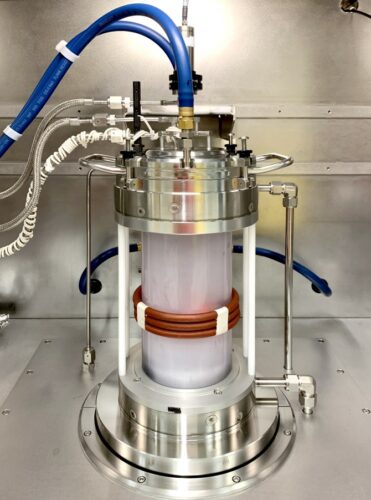
In Hari Nair’s Duffield Hall lab, an Agnitron Agilis 100 metal organic chemical vapour deposition (MOCVD) system went into operation in June 2022. Nair is an assistant research professor of materials science and engineering. Gallium oxide is a semiconductor material sought for its capacity to withstand high voltages, power densities, and frequencies. It has been particularly calibrated to produce thin layers of this material. These characteristics make it a perfect material for several applications, including 5G communications, renewable energy sources, and electric cars.
“Another key advantage of gallium oxide is the ability to grow single crystals of this material from its molten form,” Nair said, “which will be key for scaling up the substrate size. This capability to scaling up is very important for industry adoption of electronic devices made using new semiconductor materials.”
A metal-organic gallium precursor is sprayed onto a heated single crystalline semiconductor substrate in gallium oxide MOCVD systems. A high-quality crystalline layer of gallium oxide is created when gallium atoms link with oxygen atoms on the surface of the wafer as a result of the precursor’s breakdown caused by the heat.
Compound semiconductors like group III-arsenides, group III-phosphides, and group III-nitrides play a significant role in optical and mobile communications as well as solid-state lighting, among other applications. MOCVD is the industry standard for producing epitaxial thin films of these compound semiconductors. The grade of gallium oxide produced by MOCVD has continuously increased over the last five years.
“With this system, we can grow thin films on up to 2-inch-diameter substrates under widely tunable oxidation chemical potentials,” said Nair. “It also has a very high substrate temperature capability and we can heat the substrate up to 1,500 degrees Celsius. High substrate temperatures yield better quality films which is key for pushing the performance of electronic devices.” Nair expects that the MOCVD device will contribute to Cornell’s illustrious legacy in materials science.