

A technology uses data from five spacecraft to automate simulations and predict when solar particles will arrive and their intensity.
Fujitsu Limited, Nagoya University, the Tokai National Higher Education and Research System, the Japan Agency for Marine-Earth Science and Technology (JAMSTEC), and the National Institute of Information and Communications Technology (NICT), along with research partners in Japan and Portugal, have developed a technology that automatically sets parameters for simulations predicting the arrival of solar energetic particles (SEPs). The technology uses observational data from five spacecraft to improve prediction accuracy. SEPs can expose astronauts to radiation and cause satellite malfunctions.
The technology could help reduce satellite failures, improve the use of satellite data, and lower radiation risks for astronauts. It could also support future industries linked to lunar base activities.
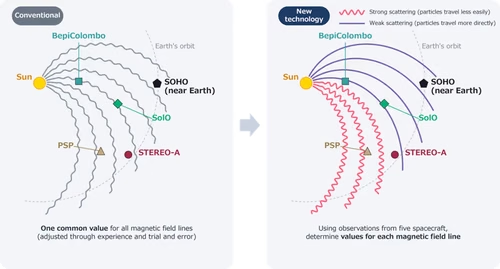
SEPs are electrically charged particles that travel along magnetic field lines extending from the Sun. Their movement and scattering make it difficult to predict when they will reach a destination. Previously, researchers set simulation parameters through experience and trial and error, adjusting values until the results matched observations from past events. This approach made it difficult to justify the selected values objectively and reproduce the results using the same process.
To address this, the research team used black-box optimisation to automate parameter selection. The system automatically set 19 parameters in a physical simulation that calculates SEP intensity and arrival time. It reduced differences between simulation results and observations from five spacecraft, including BepiColombo, a Mercury exploration mission jointly conducted by Europe and Japan.
The technology uses Fujitsu’s Solar Energetic Particle Intelligent Tuning and Evaluation Network (SEITEN). It connects SUSANOO, a magnetohydrodynamic simulation developed by Nagoya University’s Institute for Space-Earth Environmental Research and operated by NICT, with SEPIF, a model developed by JAMSTEC to simulate particle acceleration and transport. Black-box optimisation automatically determines parameters related to these processes. The team also used interplanetary scintillation observational data from Nagoya University’s Institute for Space-Earth Environmental Research to select settings for the magnetohydrodynamic simulation.
By combining observations from multiple spacecraft, the technology automates the complex task of setting parameters such as the strength of particle scattering. It can also estimate how these parameters vary across space. The development marks a step towards practical systems for predicting SEP intensity and arrival times more accurately.