

This advancement enables more efficient study of 2D materials, with applications in transistors, quantum computing, and optical devices.
In 2018, researchers discovered that ultra-thin carbon, arranged in two slightly misaligned layers, could act as a superconductor, sparking a new field called “twistronics.” This discovery allowed scientists to manipulate electrical properties by changing the twist angle between the layers. The lead author of the foundational study, Yuan Cao, was then a graduate student at MIT. Working with Harvard physicists Amir Yacoby, Eric Mazur, and others, Cao has now developed a device that simplifies the process of twisting materials for study. A recent paper published in *Nature* details a new device, roughly the size of a fingernail, that can twist thin materials easily, replacing the previous labor-intensive method of fabricating each twisted device individually.
This advancement enables researchers to study and manipulate two-dimensional (2D) materials with greater efficiency, which has potential applications in transistors, optical devices, and quantum computing. The researchers explained that this new tool allows scientists to control both the electron density and twist angle in 2D materials, significantly expanding the possibilities for discovery. They first encountered the challenges of working with twisted materials during their time at MIT, where the process of replicating twisted bilayer graphene was difficult and time-consuming.
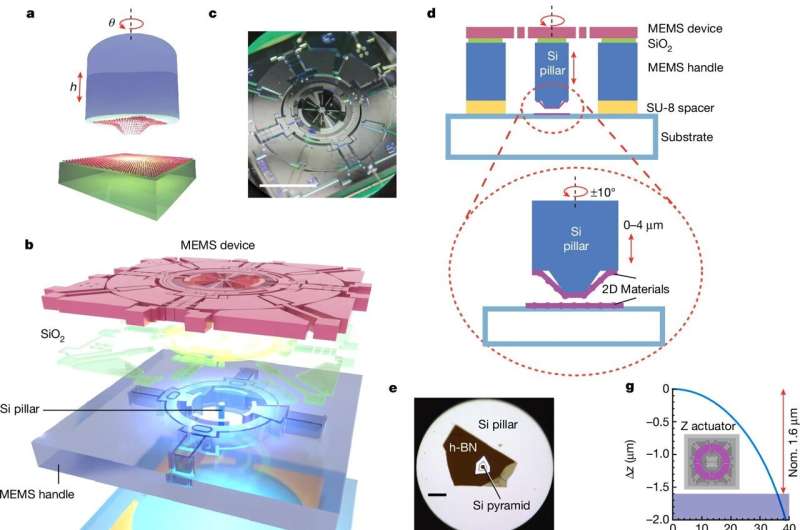
To address this,they developed a micro-electromechanical system (MEMS)-based platform, called MEGA2D, that can twist two layers of material with ease. The Yacoby and Mazur labs collaborated on the design, which is adaptable for use with various materials beyond graphene. The team demonstrated their device’s effectiveness by studying two layers of hexagonal boron nitride, finding evidence of quasiparticles with useful properties for optical communications. This system could lead to breakthroughs in the field of twistronics and benefit other researchers.