





Have you ever wondered how RF devices power the wireless world? From filters and couplers to antennas, see the components that make smartphones and IoT work.
We know the challenge of transmitting information over long distances without wires. That challenge led to the development of Radio Frequency (RF) devices. Early forms of communication made use of wired connections that were both limited in reach and flexibility. RF devices changed that, as they allowed the sending and receiving of signals through the air, thereby laying the bedrock for wireless communication, radar, and sensing systems. Today, these devices cover a broad spectrum, usually from 3 kHz to 300 GHz, and find their application in our smartphones, Wi-Fi, satellite communication, and RFID systems.
To understand how RF systems perform, engineers use S-parameters (Scattering parameters). These describe the way energy flows through a network and show reflection, transmission, and other characteristics. Voltage standing wave ratio (VSWR), return loss, insertion loss, and gain are some of the things that can be checked from these measurements. This ensures reliable operation in high-frequency networks.
RF devices basically are of two types. One is active RF devices, and the other is passive RF devices. As we all know, active devices in electronics means the one that can generate, amplify or control electrical signals, for example, amplifiers, oscillators, etc. Active devices use transistors to do so. On the other hand, passive devices are the one that do not add energy to the signal, which means they only guide, filter and split signals just like filters, couplers, antennas, and multiplexers. These signals are carried by transmission lines such as coaxial cables, microstrip lines, and waveguides, and careful design helps in managing the losses, which at higher frequency increase owing to their shorter wavelength.
TAIYO YUDEN has a diverse portfolio involving mainly passive RF devices, meeting various demands for different customers. Their lineup includes multiplexers, filters (HPF, BPF, LPF), antennas, duplexers, and couplers. They have also added dividers (splitters) to the portfolio. You can check their full range of RF devices here. To understand more about the RF device line-up watch a video given below.
RF device line-up|Video Library
By solving the challenge of wireless transmission, RF devices, combined with TAIYO YUDEN’s solutions, have transformed communication, enabling the fast, reliable, and everywhere-on connectivity we rely on today.
LTCC Devices
Ceramic materials are used in RF filters because their high dielectric constant lets the filters be small while keeping precise frequency selection. Many ceramics are piezoelectric, so they form circuits that pass only specific frequencies. These filters work in the range of hundreds of megahertz to several gigahertz. They find wide applications in wireless communication, RFID, mobile devices, and satellites. Ceramics don’t alter their properties with conditions, which provides stability in operation. This is the reason RF ceramic filters find applications in mobile phones, satellites, wireless networks, defense systems, and automotive technologies for ADAS, V2X, keyless entry, and infotainment.
Ceramic materials allow RF filters to be compact and high-Q. Multilayer ceramic structures improve repeatability and simplify mass production. TAIYO YUDEN offers a range of ceramic Band Pass Filters which can be a good fit where size, stability, and low loss matter, for example in wireless modules, front-end modules, and compact transceivers.
Low Pass Filters reject high frequencies while passing the lower ones, thus protecting receivers and rejecting spurious signals. The small resonant elements made by the use of high-permittivity material allow for compact surface mount filters without complex tuning networks. TAIYO YUDEN provides an excellent lineup of ceramic Low Pass Filters. Click here to check.
High Pass Filters made of ceramic allow high-frequency signals to pass while restricting those of lower frequencies. They make use of ceramic materials with a high dielectric constant, hence their dimensions can remain small while still offering stable performances. These filters are used in many RF circuits in wireless communication, signal processing, and other applications that require precise frequency selection. The TSH1N18D2G49LS0FBT from TAIYO YUDEN is a tiny electronic component utilized in LTE devices to allow high-frequency signals in the range of 2300-2690 MHz to pass through while rejecting lower ones such as 1710-1880 MHz. It works with 50 ohm circuits, has low signal loss, and comes in a very tiny size.
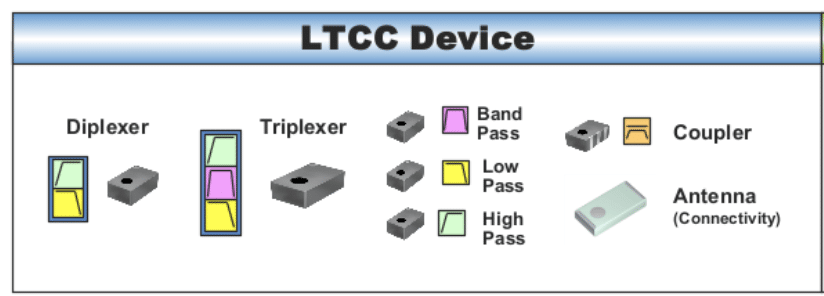
High-frequency ceramic diplexers split or combine two signals in one small part, keeping them clear with low loss and good separation. They are used in cars, IoT devices, home gadgets, wearables, and cell towers, and their small size saves space on circuit boards. A diplexer lets a device send and receive signals at the same time using one antenna. TAIYO YUDEN’s ceramic diplexers use LTCC device technology to split or combine two frequency bands in a single compact package, providing good isolation between them while maintaining low insertion loss. They help design engineers minimize the use of printed circuit board space and component count while enabling wideband front-end operation. Thus, they are suited for compact modules, mobile devices, and IoT systems in which size, cost, and RF performance are critical.
The Ceramic Triplexers allow three different frequency bands to share a single antenna. They provide low insertion loss, high isolation, and compact SMD packages to save PCB space. These devices are tested for reliability and used in demanding wireless environments.
TAIYO YUDEN also provides multilayer triplexers in various series that are compact in size. These devices use high-dielectric-constant ceramic materials for smaller size, higher Q, and lower insertion loss, meeting the demands of 5G, IoT, and wireless communication modules.
Ceramic RF couplers are in fact passive radio-frequency devices that use a ceramic substrate to detect a small amount of power from a main transmission line. This extracted signal can be used to monitor power levels, measure forward and reflected power for VSWR calculations, or act in a feedback loop for power control. They do this while keeping the main signal path undisturbed, making them valuable in RF systems that require accurate monitoring and control.
TAIYO YUDEN offers two compact ceramic RF couplers suitable for wideband wireless systems. The TSC1N18D1G68NC0AAT covers 698–2690 MHz with a minimum coupling, maximum insertion loss making it suitable for multi‑band mobile and IoT devices where stable performance and moderate branch coupling are needed. The TSC4N18F1G69NS0B1T also spans 699–2690 MHz but offers slightly lower insertion loss, better VSWR, a minimum coupling of 17.1 dB, directivity of 18 dB, and a thinner profile of 0.5 mm, making it more suitable for compact, high‑performance RF front‑end modules where low loss and precise branch isolation are critical.
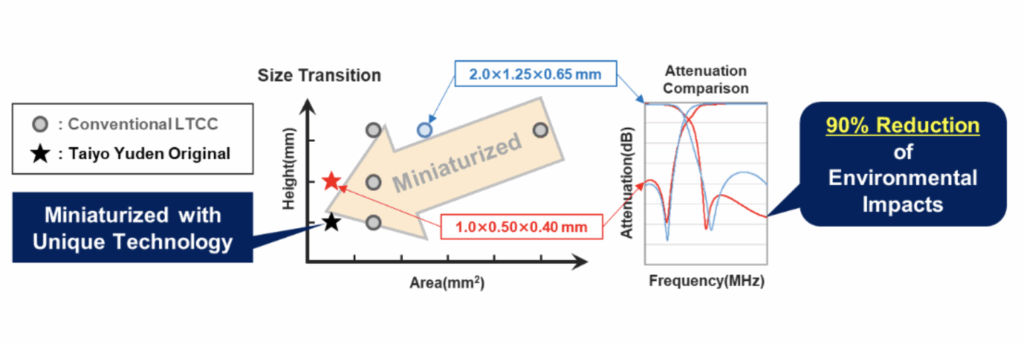
Miniaturization is a challenge because 5G needs more antennas, making circuits more complex, and smaller smartphones with bigger batteries leave less space. Compared to 4G, 5G circuits need smaller, low-profile parts. TAIYO YUDEN’s technology reduces LTCC filter size by almost 90% without losing performance, while conventional products are up to eight times larger, making this technology suitable for complex 5G circuits. These chip antennas work reliably across many wireless standards and are easy to mount while staying mechanically strong and consistent.
Hybrid Device
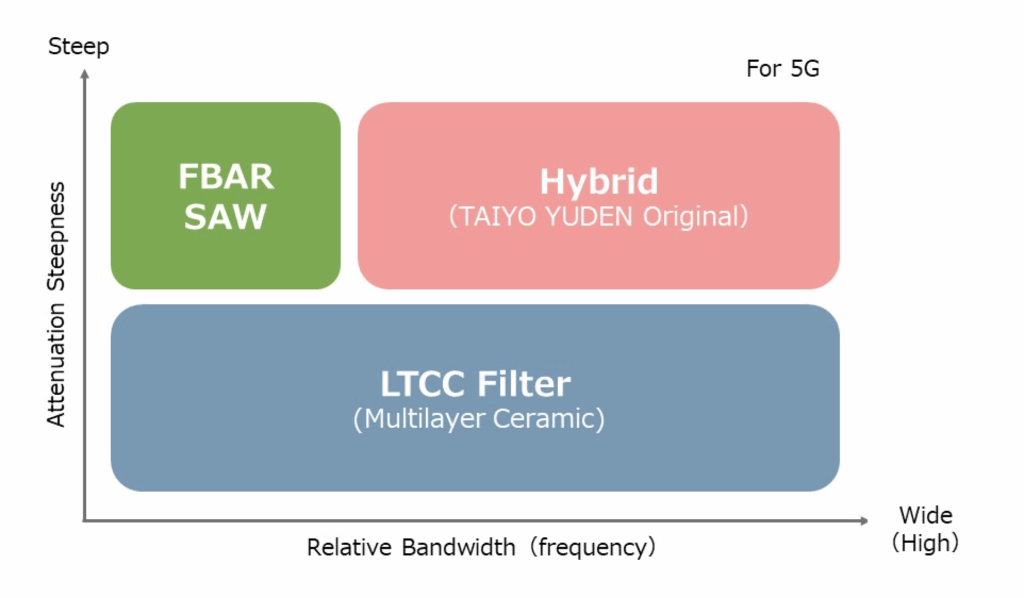
Conventional FBAR and SAWdevices struggle to meet the wide bandwidth demands of 5G, while multi-layer ceramic devices often fall short due to gentle attenuation. To address this, TAIYO YUDEN has developed a hybrid device combining multiple conventional process technologies. This solution delivers wider bandwidth with steeper attenuation, making TAIYO YUDEN the only supplier with all three essential process technologies for 5G applications.
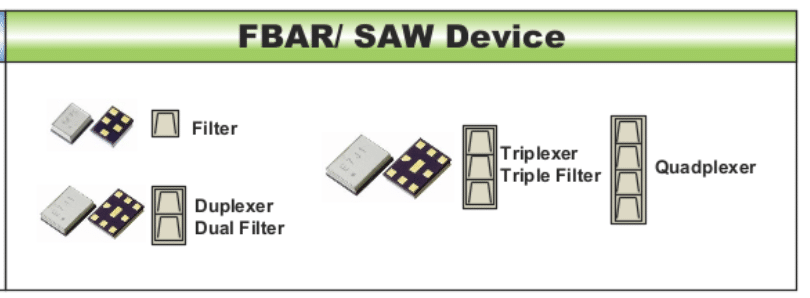
FBAR and SAW filters extract specific wavelengths from electric signals using piezoelectric properties, removing unwanted noise and improving the clarity of transmitted information. FBAR devices operate with bulk acoustic waves in thin piezoelectric films at higher frequency bands than SAW devices. They find applications in mobile phones, IoT devices, base stations, and automotive due to their function as filters, duplexers, or multiplexers. Their small size, low insertion loss, high isolation, and stable performance make them suitable for compact, high-performance systems.
Each FBAR/SAW Device has a code indicating type, size, series, quality grade, operating temperature, and input power. Sizes vary from 0.9×0.7mm up to 2.5×2.0 mm, thickness from 0.35mm up to 0.80mm, and frequencies range from hundreds of megahertz up to several gigahertz. Devices are packed in reels of 3,000 to 15,000 pieces with polystyrene and PET/polyethylene tape according to EIAJ standards.
To ensure reliability, products are exposed to mechanical shock, terminal bending, vibration, temperature cycling from –40°C to +100°C, drop tests, humidity stress and solderability tests. With these technologies, SAW and FBAR devices provide compact, high-performance, and reliable solutions for advanced 5G and wireless communication systems. To find out the complete range of TAIYO YUDEN’s FBAR/SAW Devices, click here.
Communications Chip Antennas
An antenna is nothing but a specialized transducer that converts signals coming from an electronic transmission line into electromagnetic (EM) waves that propagate through space, and vice versa. The antennas transfer energy between a guided wave in a conductor and an unguided EM wave in free space.
When in transmit mode, it converts an electric signal, high current signal from a transmission line into an electromagnetic field that breaks free from the antenna and travels through space as a radio wave. The incoming electromagnetic waves, in the receiving mode, induce voltage and current in the antenna feeding the electronic receiver circuitry.
RF antennas are mission-critical components in modern communication systems, facilitating the transmission and reception of RF signals across an extremely broad range of devices and applications. They can be designed to mate with RF connector interfaces or mounted directly on a printed circuit board, and they come in various internal and external configurations.
A firm foundation in RF antennas for a wireless communications professional requires knowledge in the functionality, design principles, types, and applications of an antenna. Antennas represent the basis of wireless systems in order to support continuous data exchange over distances without physical connections.
TAIYO YUDEN provides a wide range of chip antennas for general electronic equipment, designed for consumer applications. Available in monopole, dual, and inverted F types, these antennas support multiple frequencies including GPS, Bluetooth, Wi-Fi, ZigBee, UWB, and WiMAX. Their compact ceramic construction allows sizes ranging from 1.6×0.8 mm up to 10×4 mm, with thicknesses from 0.5 mm to 1.0 mm. These antennas feature external electrodes and are supplied in standard quantities suitable for mass production.
The backbone of modern wireless communication is formed with the inclusion of couplers and filters to antennas, including SAW/FBAR components. These devices help signals to be transmitted over a very wide range of frequencies, enabling Wi-Fi, smartphones, IoT and 5G networks. These RF devices ensure efficient performance in a lot of applications with compact form factors, reliable design and use of advanced materials.

