

Enables engineers to capture design decisions, simulations, and optimisation workflows on an executable whiteboard, helping teams preserve expertise, automate processes, and prepare workflows for AI-driven development.
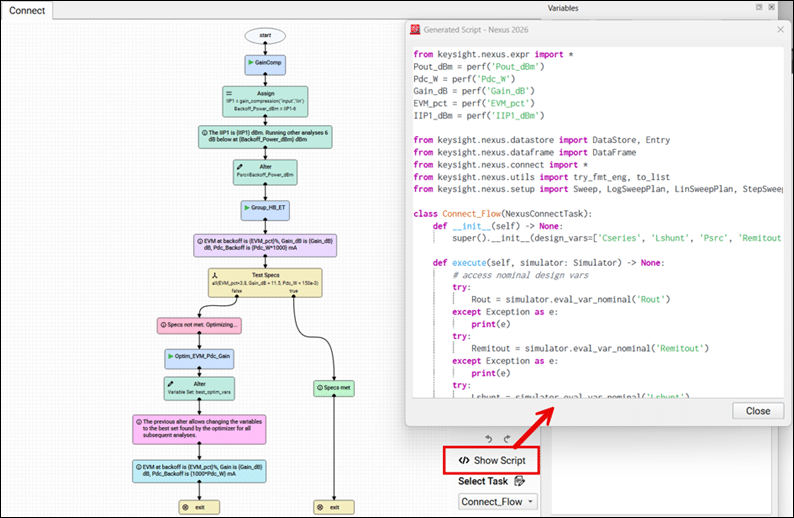
The semiconductor industry’s growing talent shortage is putting increasing pressure on engineering teams, particularly in specialised areas such as radio frequency (RF) design. Addressing this challenge, a new enhancement to RF circuit simulation software by Keysight Technologies enables engineers to document and execute their design methodologies in an interactive whiteboard environment, converting engineering decisions into reusable, AI-ready workflows.
The capability captures the complete RF design process, including simulations, optimisations, parameter selections, and decision trees. Rather than relying on static documentation, engineers can build executable workflows that mirror the reasoning and steps used during circuit development. Each action automatically generates editable Python code, enabling teams to save, modify, share, and redeploy workflows across multiple electronic design automation (EDA) environments.
The key features are:
- Executable visual whiteboard for RF design workflows
- Automatic generation of editable Python scripts
- Captures simulations, optimisations, and decision logic
- Supports workflow reuse across multiple EDA platforms
- Produces structured data suitable for AI/ML-driven design automation
The launch comes as the semiconductor sector faces a significant skills gap. Industry forecasts indicate demand for tens of thousands of additional engineers in the coming years, while RF design expertise remains difficult to replace due to the complexity of simulation methodologies spanning multiple physics domains. Organisations often struggle to retain and transfer critical knowledge when experienced engineers leave.
By transforming engineering processes into structured and repeatable workflows, the new tool aims to reduce dependence on individual expertise while improving collaboration across design teams. Engineers can execute simulations and optimization tasks sequentially, incorporate decision-based loops, and automate parameter adjustments without manually rebuilding processes for every project iteration.
The generated workflows can be reused across projects, shared among teams, and leveraged as structured data sources for future AI and machine learning applications. Automation also extends to design review and tapeout preparation, reducing repetitive setup tasks and helping accelerate development cycles.
The capability reflects a broader industry trend toward workflow automation and AI-assisted engineering. By converting expert knowledge into executable processes and Python-based workflows, organizations gain a practical method to preserve institutional knowledge while creating a foundation for more autonomous RF design environments in the future.
Click here for the original announcement.