




What if utility poles could be stronger, lighter, and virtually maintenance-free?
In an exclusive interaction with EFY’s Nitisha Dubey, Rahul Bandaru from Helipole outlines how the company is redefining infrastructure using corrosion-resistant, durable composite poles for street lighting, telecom, and smart city applications.

Q. What is Helipole, and what does your company do?
A. Helipole is a brand developed by CNC Technics, a machine manufacturing company focused on advanced composites. The company was incorporated in 1986 and entered the composites space in 2000 with the development of India’s first CNC filament winding machine, inaugurated by A P J Abdul Kalam. Helipole, launched in 2018, applies aerospace-grade composite technology to infrastructure by manufacturing high-performance utility poles.
Q. What exactly is your product, and what innovation does it bring?
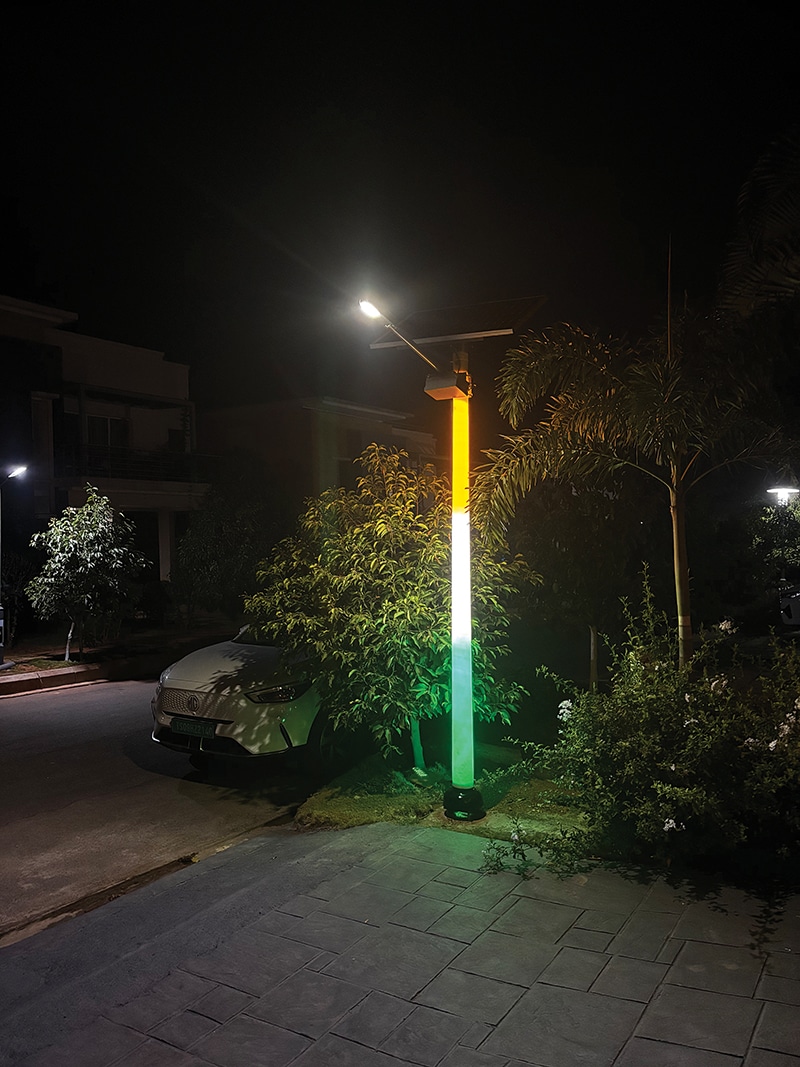
A. Helipole is a composite utility pole made from glass fibre and resin. It is designed to support applications such as street lighting, telecom towers, smart poles, and electrical distribution. The innovation lies in its lightweight, corrosion-resistant, and non-conductive properties, as well as the ability to customise material characteristics for specific use cases.
Q. How would you explain Helipole in simple terms to a non-technical audience?
A. It can be understood as wrapping strong threads around a pipe, where these threads are industrial glass fibres soaked in resin. They are wound at precise angles using machines to create a hollow pole that is extremely strong yet weighs only one-third as much as steel. Unlike traditional poles, it does not rust, crack, or require frequent maintenance.
Q. How is Helipole different from steel and concrete poles?
A. Steel poles are prone to corrosion and require regular repainting, especially in coastal areas. Concrete poles can crack, exposing internal steel that rusts and weakens the structure. In terms of total cost of ownership, including installation, maintenance, and replacement over 40 years, Helipole is significantly more economical than steel or concrete, despite a higher upfront cost.
Helipole poles weigh approximately one-third as much as steel equivalents, allowing installation by two to three workers without heavy lifting equipment such as cranes. This significantly reduces installation cost and time.
Q. Who are your target customers?
A. The target audience includes sectors requiring high durability and safety, such as NHAI, highway infrastructure, coastal and marine projects, municipalities, smart cities, oil and gas facilities, airports, railways, and premium commercial properties.
Q. What materials and science go into making Helipole?
A. Helipole is based on FRP (fibre-reinforced plastic), where resin acts as the matrix and glass fibre as reinforcement. Depending on the application, the combination of fibres and resins is customised to achieve properties such as fire resistance, insulation, or high wind resistance.
Q. Can you walk us through the manufacturing process?
A. Glass fibre and resin are sourced, mostly locally. Fibres are dipped in resin and wound around a rotating mandrel using CNC filament winding machines. Multiple layers are built at specific angles and then cured using heat. The hardened pole is extracted, finished through grinding and painting, and customised with fittings before final quality checks and dispatch.
Q. Where are your manufacturing facilities located?
A. The company has facilities in Visakhapatnam and Hyderabad, with its headquarters in Hyderabad.
Q. What kind of team and machinery do you have?
A. The company is engineering-focused, with around 50 engineers and technicians. All machines, including CNC filament winding machines, curing systems, and extractors, are designed and built in-house.
Q. How many units have you sold so far?
A. Orders have been received for thousands of poles across telecom, smart cities, railways, municipalities, and coastal applications. Demand is growing steadily across sectors.
Q. Is your product made in India?
A. Yes, Helipole is completely developed and manufactured in India, with most raw materials sourced locally.
Q. Where have Helipole poles been deployed, and how have they performed in demanding environments?
A. Helipole poles have been deployed at the Shapoorji Pallonji Group coastal infrastructure project in Visakhapatnam, where they have operated for over seven years with zero maintenance despite harsh coastal conditions. The company also supplies to airports and is currently working with the East Coast Railway of Indian Railways.
Q. Are you looking for partners or expansion opportunities?
A. Expansion is underway through distribution partnerships, government projects, and international markets such as the Middle East. The company is also collaborating with major lighting companies to scale distribution.
Q. What are your future plans?
A. Work is ongoing on advanced composite applications such as hydrogen and CNG storage vessels, alongside continued contributions to aerospace programmes. The goal is to become a leading advanced composites company across infrastructure, energy, and aerospace.
Q. What challenges did you face while developing this product?
A. Initially, there were no Indian standards for composite poles, and material costs were high. The company relied on international standards and focused on educating the market about the technology’s benefits.
Q. Do you hold any patents?
A. The company’s competitive advantage lies in proprietary process know-how developed over nearly four decades, including work with organisations such as ISRO. This institutional knowledge in composite design and manufacturing is not easily replicable.
Q. How do you ensure quality and testing?
A. Raw material testing, in-process quality checks, and batch-wise failure testing are conducted. Certified laboratories are also engaged to validate wind resistance and structural performance.
Q. How do you handle customisation requests?
A. Customisation is offered in terms of wind load capacity, dimensions, aesthetics, coatings, and fittings such as CCTV cameras, solar panels, and lighting systems. Each pole is engineered based on the specific application.
Q. How do you ensure performance in extreme wind conditions?
A. Poles are designed with high safety factors and validated through in-house and third-party testing, including bend and load tests as per certified standards.
Q. What makes Helipole stand out from competitors?
A. Helipole offers superior durability, safety, low maintenance, lightweight installation, and long-term cost savings compared to traditional poles. It is designed as a fit-and-forget solution.
Q. How scalable is your production?
A. Excess production capacity is maintained, with the ability to scale manufacturing within six months to meet increased demand.
Q. How dependent are you on imports?
A. The company relies primarily on local sourcing. While some resin components are linked to global oil prices, the overall product is largely manufactured using Indian materials and supply chains.


