Hybrid capacitors help power steering, ADAS, and other vehicle systems by reducing electrical noise and stabilizing power supply.
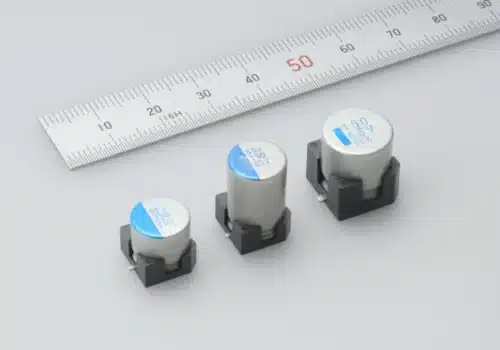
TAIYO YUDEN has introduced two new series of conductive polymer hybrid aluminum electrolytic capacitors, the HVX (-K) and HTX (-K), designed for automotive power supply circuits. The capacitors meet the AEC-Q200 stress test qualification standard for passive components and are built for applications such as electric power steering, advanced driver assistance systems (ADAS), and other vehicle control and safety functions.
The series improves capacitance performance compared to the company’s earlier HVX and HTX products. The lineup includes 46 capacitor models in seven case sizes, ranging from 6.3 × 7.7 mm to 12.5 × 16.5 mm. One of the highest-rated models supports an 80V operating voltage with a ripple current rating of 3,900mArms at 135°C.
The capacitors use both a conductive polymer and an electrolyte solution. This design combines the low equivalent series resistance (ESR) of conductive polymers with the self-repairing properties of aluminum electrolytic capacitors, helping improve both electrical performance and long-term reliability.
The demand for higher-voltage automotive components has increased as more vehicles adopt 48V electrical systems to improve power efficiency. At the same time, the growing number of electronic control units in ADAS, electric vehicles (EVs), and other electrified vehicles has increased the need for capacitors that can handle higher voltages and larger currents while reducing electrical noise and smoothing power delivery.
To address these requirements, the company optimized the materials used in the new capacitor series, enabling operation at up to 80V with a maximum operating temperature of 135°C.
The HVX (-K) and HTX (-K) capacitors can be used by automotive electronics manufacturers and system designers to suppress electrical noise and stabilize power in power supply circuits for electric power steering, ADAS, and other vehicle control and safety systems.
Click here for the original announcement.