
Texas Instruments introduced a gallium nitride reference design enabling compact, efficient 3.6kW residential solar inverters with integrated wireless connectivity and simplified development.
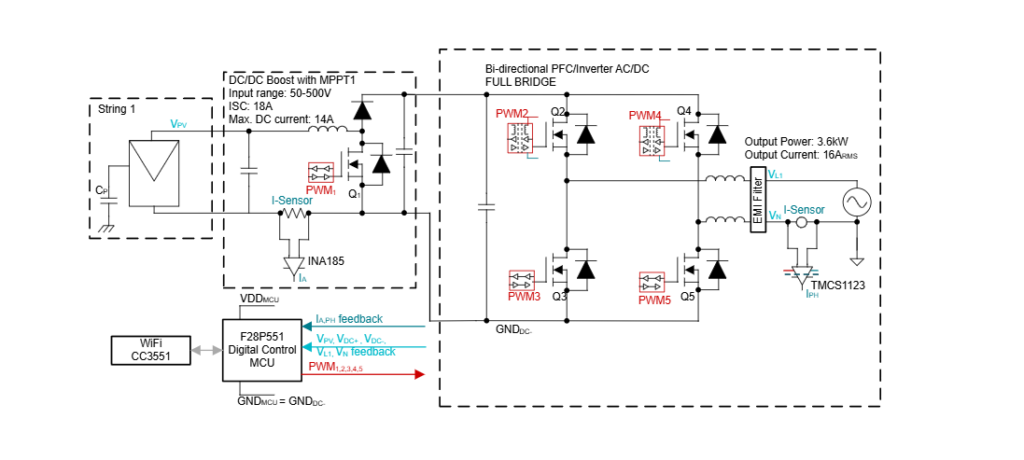
Texas Instruments has introduced the TIDA-011008 reference design, a 3.6kW gallium nitride (GaN)-based single-phase string inverter platform intended to accelerate the development of residential solar power systems. The design combines high switching frequency, compact construction and integrated wireless connectivity to help engineers build efficient photovoltaic inverters with reduced design complexity.
The reference design supports a single photovoltaic string comprising up to 10 solar panels connected in series, delivering up to 3.6kW of rated output power at 230V alternating current (AC). Operating at a switching frequency of 100kHz, the GaN-based architecture enables smaller magnetic components and filtering elements, resulting in a lighter, more compact inverter than conventional silicon or IGBT-based alternatives.
Texas Instruments uses a full-bridge bipolar modulation topology while digital control is handled by a single microcontroller. The platform also incorporates integrated Wi-Fi 6 and Bluetooth Low Energy connectivity, allowing remote monitoring and system management without requiring additional communication hardware.
According to the reference design documentation, the inverter achieves current total harmonic distortion below 1.23 per cent under high-load conditions when tested with a grid emulator. It also supports a photovoltaic input voltage range of 50V to 500V, maximum input current of 18A and operation across ambient temperatures from –40°C to +60°C.
The hardware integrates both the DC/DC boost converter for maximum power point tracking and the DC/AC inverter stage onto a single 205mm × 205mm board. This consolidated layout is intended to simplify development while reducing the overall bill of materials through the use of high-frequency GaN switching devices.
The reference design is aimed at engineers developing residential string inverters and power conversion systems, providing design files, documentation and tested hardware to shorten development cycles and reduce the risks associated with creating high-efficiency solar energy products.
Click here to review original reference design.