


A reconfigurable AI semiconductor that independently controls long-term and short-term memory using surface acoustic waves, enabling energy-efficient neuromorphic computing with improved reliability and learning performance.
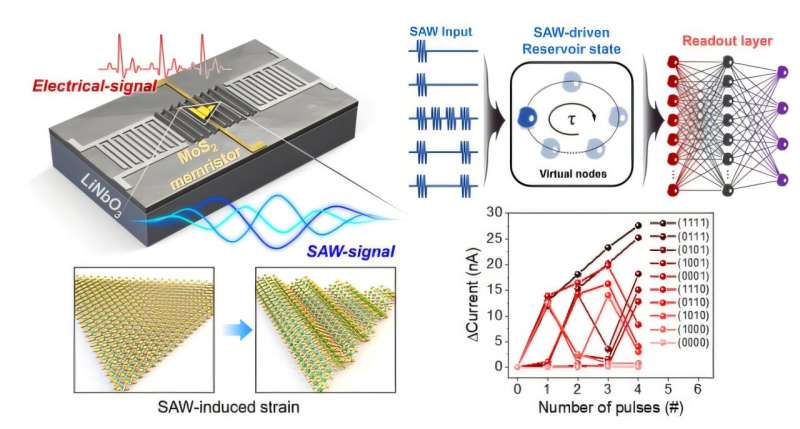
A research team has developed a reconfigurable artificial intelligence semiconductor that independently manages long-term and short-term memory within a single device, overcoming a major limitation of conventional neuromorphic hardware. By combining electrical programming with surface acoustic waves (SAWs), the new device enables selective memory control while reducing wear caused by repeated electrical stimulation, paving the way for more energy-efficient AI processors.

Developed by researchers at Sungkyunkwan University, the technology integrates a monolayer molybdenum disulfide (MoS₂) memristor with a surface acoustic wave device on the same platform. Unlike conventional memristors, where both memory functions rely solely on electrical pulses, the new architecture separates the two operations. Electrical signals create and retain long-term memory, while contactless acoustic waves generate and erase short-term memory without disturbing previously stored information. This approach creates a reconfigurable artificial synapse that more closely mimics biological neural behavior.
Neuromorphic computing aims to process and store information simultaneously, similar to the human brain, significantly reducing the energy consumed by data movement in traditional computing architectures. However, existing artificial synapses often suffer from reliability issues because repeated electrical programming gradually degrades device performance. The newly developed platform addresses this challenge by shifting short-term memory control to acoustic signals, preserving the integrity of electrically programmed long-term memory.
The researchers demonstrated precise control over biological-like synaptic plasticity by adjusting the intensity, duration and interval of the surface acoustic wave pulses. Short-term memory could be repeatedly written and erased while maintaining stable long-term memory, enabling flexible learning behaviour. The device also operated reliably for more than 10,000 seconds of repeated switching without measurable performance degradation.
To evaluate practical AI capability, the team implemented the device in a reservoir computing system for character recognition. The neuromorphic processor achieved a classification accuracy of 96.1%, highlighting its potential for low-power edge AI applications where efficient pattern recognition and adaptive learning are critical.
The researchers believe the architecture could accelerate the development of next-generation AI semiconductors by combining large-area device integration with wide-frequency acoustic-wave control. Beyond neuromorphic processors, the technology could benefit intelligent sensors, robotics, edge computing platforms and Internet of Things devices requiring fast, adaptive learning with minimal power consumption.