

Cornell researchers developed a microwave brain chip that learns its own signal language, compressing satellite data eightfold while enabling faster, efficient wireless communications.
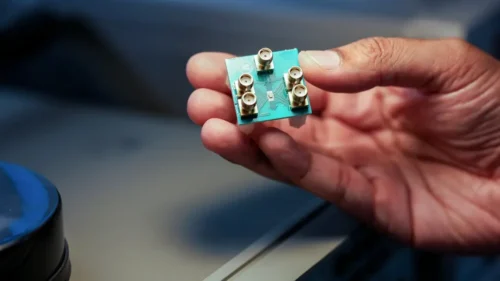
Researchers at Cornell University have developed what they describe as the world’s first ‘microwave brain’ chip, a low-power microchip capable of processing ultrafast data and wireless communication signals while learning its own language. The innovation could significantly improve data transmission for satellites, drones and edge computing devices by reducing the amount of information that needs to be transmitted.
The chip consumes less than 200 milliwatts of power and performs both high-speed data processing and wireless signal computation directly in the microwave domain. Unlike conventional systems that repeatedly convert signals between analog and digital formats, the new approach processes information almost immediately, reducing computational overhead, energy consumption and communication latency.
Developed by scientists in the laboratory of Cornell engineering professor Alyssa Apsel, the technology introduces microwave token embeddings, inspired by the token-based architecture used in large language models. Instead of transmitting long streams of digital instructions, the chip represents information as a small number of microwave pulse tokens that preserve relationships between pieces of data while dramatically compressing transmissions.
Researchers demonstrated the technology by reconstructing a satellite image of a tropical storm while transmitting only about one-eighth of the original data. The reconstructed image retained the storm’s essential features, highlighting the chip’s potential for small satellites that face strict bandwidth and power limitations when sending information back to Earth.
The team also showed that the chip naturally generates probabilistic bits, making it suitable for probabilistic computing and advanced artificial intelligence applications. According to the researchers, the microwave-domain processing approach could establish a new foundation for hardware-based cybersecurity by allowing microwave neural networks to interpret encoded pulse sequences directly.
The researchers have filed a patent application and are advancing the technology toward commercialisation through Cornell University’s ignite innovation acceleration program. The findings have been published in the journal Nature Communications.