




Can discarded smartphone components keep connected vehicles running? A Belgian startup puts this idea on the road with a remotely driven electric car.
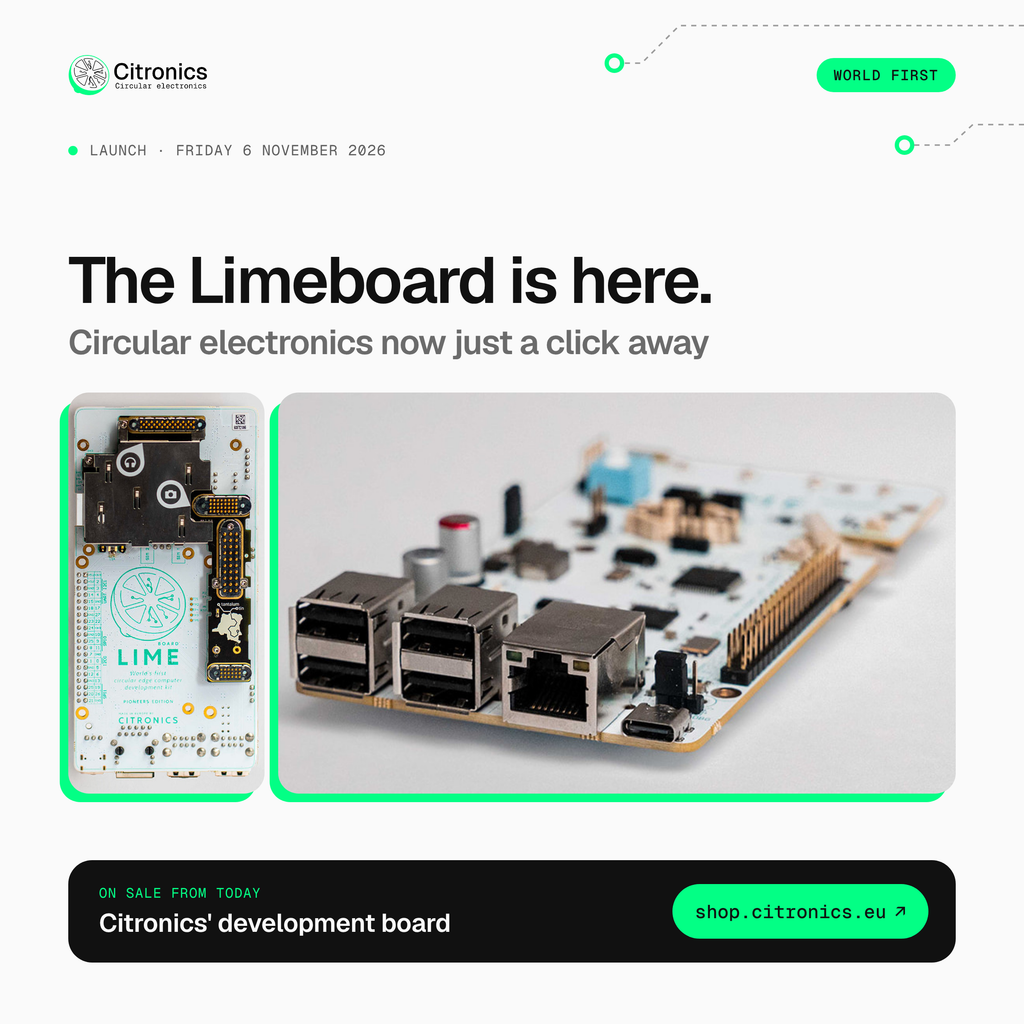
Belgian start-up Citronics and engineering company Spin42 have demonstrated a remotely driven electric car that uses Citronics’ Limeboard, a computing board built around a repurposed smartphone mainboard, for connectivity, software updates and remote monitoring. The demonstration addresses a growing challenge in connected electronics by keeping computing hardware in use beyond its original product lifecycle while providing connectivity for connected vehicles.

During their demonstration, in 2007, Volkswagen Polo was modified into an electric vehicle. Steering, braking and acceleration were controlled remotely via Spin42’s open source platform known as Open Vehicle Control System (OVCS). Connectivity to provide over the air (OTA) updates and remote monitoring was provided by Citronics’ Limeboard. Using second life smartphone hardware in this way to provide connectivity within a driverless vehicle was demonstrated for the first time.
The Limeboard is built around Citronics’ CiSoM (Circular System on Module). The module is a certified smartphone system-on-module that has been re-flashed with Linux. It enables second life smartphone processors to be used as embedded computing solutions for connected devices, including vehicles, industrial gateways, energy systems and building infrastructure.
The reference configuration combines a quad-core Qualcomm Krait 400 processor running at up to 2.26GHz with an STM32F401 microcontroller for real-time input/output operations. It also includes 2GB RAM, 32GB eMMC storage, 4G LTE connectivity, Wi-Fi, Bluetooth, GNSS and Ethernet. The board supports 5–60V power input and typically consumes 2–20W.
Jean-Brieuc Feron, Founder and CEO at Citronics says, “No region of the world is doomed to depend forever on a few chipmaking powers. Other paths are possible, particularly in how electronic components are produced and consumed.”
