






Can light be controlled through time instead of space? A photonic breakthrough could reshape terahertz technologies and ultrafast optical systems.
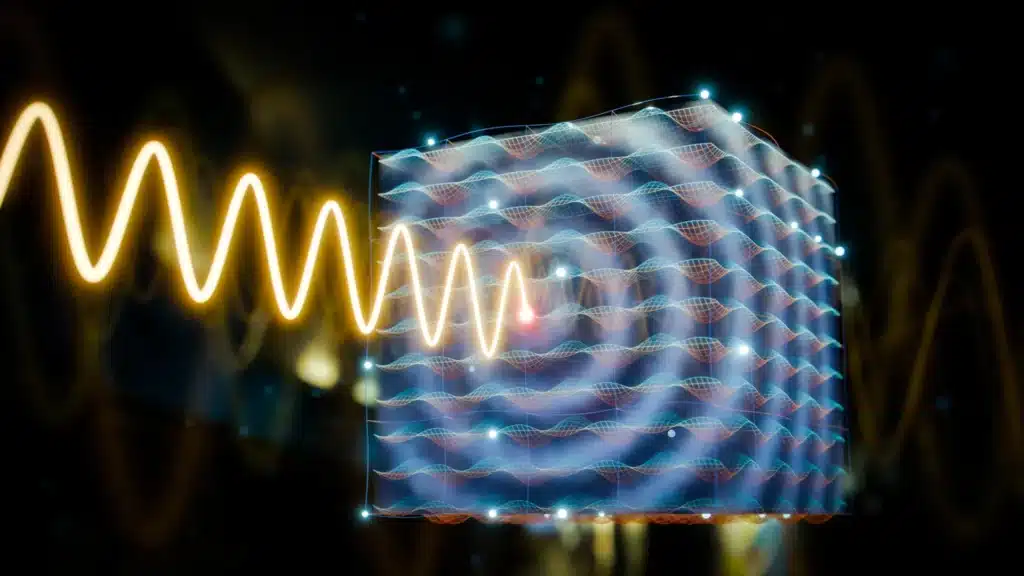
An international team of researchers has experimentally demonstrated the first all-optical photonic time crystal (PTC), a material whose optical properties change rapidly and periodically over time rather than remaining fixed. Developed by scientists from École Polytechnique, Collège de France and Helmholtz-Zentrum Dresden-Rossendorf (HZDR), the achievement could enable advances in ultrafast computing, adaptive communication systems and highly tunable terahertz lasers.

Unlike conventional photonic crystals, which control light using repeating structures arranged in space, the photonic time crystal introduces a periodic structure in time. This allows researchers to dynamically modify properties such as reflectivity and resonance frequency on picosecond timescales, close to the oscillation speed of light itself. The approach offers a way to manipulate terahertz waves, a relatively underutilised part of the electromagnetic spectrum positioned between electronics and photonics.
To realise the device, the team built a plasmonic metamaterial comprising micrometre-scale gold structures separated from an indium-antimony semiconductor by an insulating layer. Exciting the semiconductor generated surface plasmons that confined light within microscopic cavities, while high-field terahertz pulses from HZDR’s TELBE facility rapidly altered the material’s optical response. The researchers also developed a theoretical model that reproduced the experimental observations and showed that temporal modulation reduced photon dissipation by nearly half, improving the confinement of light within the structure.
The researchers believe further reducing photon losses and increasing light amplification could lead to highly adaptable terahertz lasers and support future optical computing, imaging and communication technologies. The work also establishes a platform for studying light-matter interactions that were previously inaccessible.
“By extending photonic crystals from space to time, we open a new dimension for light control and a novel path toward amplification and lasing. That could be a game-changer for optical technologies at terahertz frequencies and beyond,” concludes Tingwen Guo, PhD Student at École Polytechnique and lead author of the study.



