




Can lasers be made without complex fabrication? A fully solution-processed device shows how light and matter can work together.
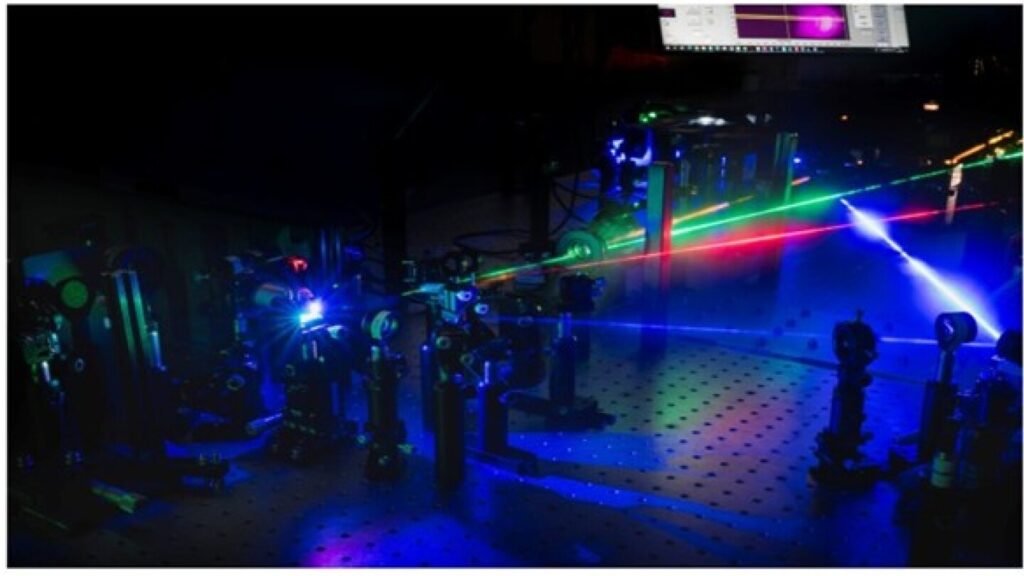
Researchers at the University of Turku in Finland have demonstrated a solid-state organic laser microcavity fabricated entirely through solution processing. The device operates in the strong light–matter coupling regime, where photons and molecules form hybrid states known as polaritons, enabling polariton lasing from a solid-state structure.
The approach could simplify fabrication of organic laser devices by replacing conventional vacuum-based deposition with liquid-based coating processes. This may make such devices more accessible for research while supporting simpler and potentially scalable manufacturing of photonic structures.
The device uses solution processing for both its optical mirrors and organic light-emitting layer. The researchers used spin coating to fabricate the individual layers and achieved a microcavity with sufficient optical quality to reach strong light–matter coupling. Under these conditions, the coupled light and molecular states behave as polaritons.
The resulting polariton laser produces laser-like emission through the collective behaviour of light and matter. The platform also provides a way to investigate nonlinear interactions between polaritons, which could be relevant to future photonic devices.
The researchers observed another effect when the laser was driven at higher intensity. Instead of remaining concentrated at the centre of the excited region, the emitted light redistributed outward to form a ring-like pattern. The effect could be reversed and controlled by modifying the optical design of the cavity, providing a way to study polariton interactions through changes in the emitted light.
The team says the platform could support further research into organic lasers and polariton systems, including efforts towards electrically driven organic lasers. “Our main result is that we can make a complete solid-state laser microcavity using only solution processing,” says Konstantinos Daskalakis, associate professor at the University of Turku.


