A platform puts flight logs, maps, images, notes, reports, and AI tools in one place to help teams find and review issues.
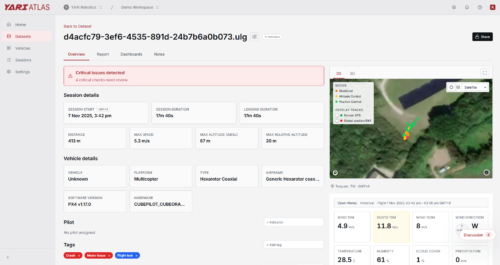
YARI Robotics has launched Atlas, a data platform that brings PX4, ArduPilot, and ROS 2 MCAP data into a single workflow for reviewing and investigating small unmanned vehicle operations.
The platform is built around the idea that a flight log is only part of an investigation. A failed test, tuning problem, sensor issue, navigation warning, or mission anomaly may require engineers to look at screenshots, images, videos, parameter snapshots, weather data, field notes, discussions, and reports alongside the original log.
Atlas brings these records together around the same vehicle session. Teams can review the original data, add findings, discuss issues, and create reports without moving the evidence between separate tools.
Each processed session provides an overview with vehicle information, session metrics, maps, weather context, and deterministic checks. Map views can show vehicle paths, altitude, terrain, and movement in both 2D and 3D. The overview is intended to help engineers spot areas that may need closer investigation before opening detailed analysis.
Existing analysis tools remain part of the workflow. PX4 users can open PX4 Flight Review, while ArduPilot users can access ArduPilot WebTools during the review process.
For deeper investigation, Atlas provides configurable dashboards built from indexed vehicle data. Engineers can combine plots, raw messages, maps, 3D scenes, images, and other panels in a single view. Dashboards can also be adapted to specific engineering tasks and saved for later use.
Atlas also includes AtlasAI as an optional first-pass review tool. It can summarize a session, flag events that may need attention, point users to relevant charts and checks, and provide analysis based on the available report evidence.
The AI feature is intended to support, rather than replace, engineering review. Users can trace findings back to the underlying reports, charts, events, notes, and timestamps to verify what the system identifies.
The result is a workflow that connects flight data with the information engineers need to understand what happened, investigate why it happened, and document the findings.
Click here for the original announcement.