




A tiny proximity sensor combines infrared sensing and VCSEL technology to support smart glasses, augmented reality and virtual reality devices with compact designs and low power.
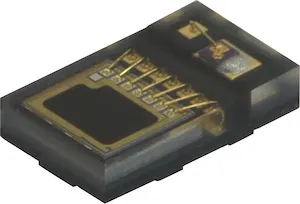
Vishay has introduced the VCNL3682S, a compact proximity sensor combining infrared sensing with a vertical-cavity surface-emitting laser (VCSEL) for applications including smart glasses and AR/VR equipment. The device is aimed at designs where sensing capability, small dimensions and low power consumption are important.
The sensor uses a 940nm VCSEL wavelength and integrates proximity detection in a small package measuring approximately 1.6 × 1.0 × 0.35mm. According to the specifications shown, it operates from a 1.65V to 2.0V supply and has a maximum VCSEL driving current of 18mA. Its operating range extends to about 50mm, while the listed idle-state supply current is 5µA.
The compact format is particularly relevant to wearable electronics, where available board space can be limited. In smart glasses and augmented- or virtual-reality devices, proximity sensing can help detect nearby objects or a user’s presence, supporting responsive functions without requiring a large sensing module.
The VCNL3682S is also described as a PS + VCSEL device and is RoHS compliant. The specification table indicates that samples and production quantities are available, with a stated lead time of 15 weeks. Its combination of optical sensing and integrated emission is intended to simplify implementation where designers need a compact proximity solution.
By combining the emitter and sensing functions in a small package, the device is positioned for integration into space-constrained electronic products. This approach may help designers add proximity detection while keeping overall hardware compact, an important consideration as wearable and immersive technologies become increasingly sophisticated. The specifications also point to relatively low idle-state power, which can be useful in battery-powered devices where energy efficiency is a priority.


