A small module helps devices run AI, process video, connect sensors, and manage tasks directly on the device.
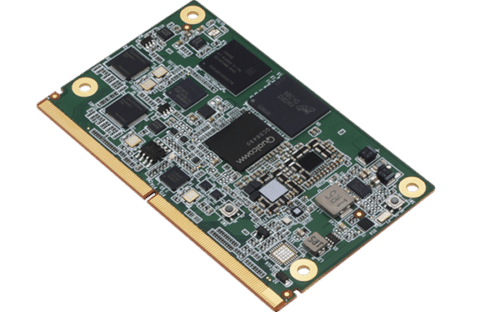
AAEON has introduced the uCOM-Q6490, a SMARC module based on Qualcomm Dragonwing QCS6490 processors for compact embedded and edge computing systems.
It is AAEON’s first product based on Qualcomm technology and uses an 8-core Qualcomm Kryo 670 CPU built on Arm v8 Cortex technology. The module provides up to 12 TOPS of AI performance through the integrated Qualcomm Hexagon 770 NPU, allowing developers to run AI workloads locally, including image analysis, object detection, and other computer vision tasks.
The module supports up to 16GB of soldered LPDDR5 memory, 64GB of UFS storage, SD cards through SDIO 3.0, and PCIe Gen 3 for expansion.
Built around the 82mm x 50mm SMARC 2.1 standard, the uCOM-Q6490 is intended for manufacturers and system developers building space-constrained products. Its compact form allows it to serve as the computing core inside larger systems.
Digital signage manufacturers can use it to power displays, process video, and add local AI features. Healthcare equipment makers can integrate it into portable imaging systems for processing and displaying medical images.
The module also targets robotics applications. Its two Gigabit Ethernet ports, three I2C interfaces, two SPI interfaces, and five USB interfaces can connect LiDAR sensors, IMUs, cameras, robotic controllers, and other peripherals. This allows robotic systems to collect sensor data, process camera feeds, run AI models, and communicate with controllers.
The integrated Qualcomm Adreno 643 GPU and video processing capabilities support multi-format video encoding and playback, which can be used for camera and other video workloads.
The standard operating temperature range is 0°C to 60°C, with a wider -40°C to 85°C range available upon request for systems requiring broader temperature support.
Click here for the original announcement.