How can thermal imaging improve visibility in darkness and dense foliage? A compact monocular uses heat signatures to reveal objects.
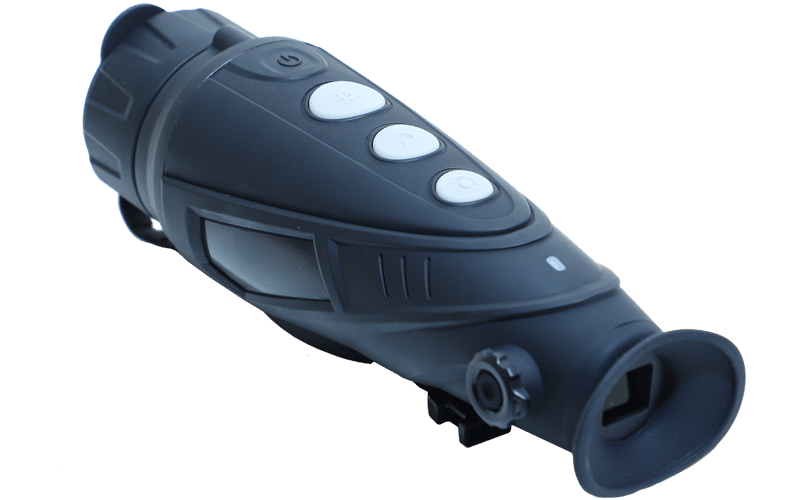
Noida-based TAK Technologies has developed DarVi, a thermal monocular designed to provide visibility when conventional optical systems struggle in darkness, smoke, fog, or dense foliage. The device uses a thermal detector to capture infrared radiation emitted by objects and convert differences in heat into a visible image.
At its core, DarVi uses a 12μm-pixel-pitch Vanadium Oxide (VOx) thermal detector with thermal sensitivity of ≤40mK. Instead of depending on visible light, the detector identifies variations in infrared radiation, allowing the system to produce an image even in conditions where conventional cameras may have limited visibility.
The device combines the thermal sensor with an image-processing algorithm designed to reduce noise and improve the clarity of the resulting thermal image. It supports different viewing modes, including White Hot and Black Hot, allowing operators to interpret heat signatures against their surroundings.
For field use, the monocular features a 1024×768-pixel display and a rugged IP67-rated enclosure. The sealed construction provides protection against dust and water, while the thermal imaging approach allows the device to operate in conditions such as total darkness, light fog, smoke, and vegetation.
DarVi also incorporates wireless connectivity for remote monitoring. Its built-in Wi-Fi capability can transmit live thermal video to up to four mobile devices simultaneously, allowing other team members to view the operator’s feed. Internal storage enables thermal videos and photographs to be recorded for later analysis.
The technology was developed for applications including surveillance, reconnaissance, infrastructure monitoring, extended patrols, search and rescue, and anti-smuggling operations. By combining a compact optical system, thermal sensing, onboard image processing, wireless transmission, and ruggedisation, the device was designed to extend visibility beyond what conventional cameras can provide.
Click here for the official announcement.