

Why deploying AI at the industrial edge demands far more than an accurate model.
A representative industrial lab deployment revealed a gap between model performance and platform readiness. Restructuring the handoff between model conversion, quantisation, and accelerator runtime can improve real-time performance without changing the model itself. On paper, the system looked complete: the model was running on an industrial computer, wired to a camera and using the operating system intended for the factory floor.
The accuracy numbers held steady. Almost nothing else did.
Frame rates fell well below the benchmark. The board’s neural processing unit (NPU), a dedicated chip built to accelerate AI workloads, sat mostly idle because the surrounding software stack had not been prepared to use it. A driver conflict surfaced only after several hours of sustained operation, the kind of fault that never appears in a quick demo. None of these failures came from the model. They came from the platform.
This is the gap that quietly decides whether an industrial edge AI system succeeds on a factory floor or dies in a proof-of-concept folder: platform readiness.
When model accuracy is not enough
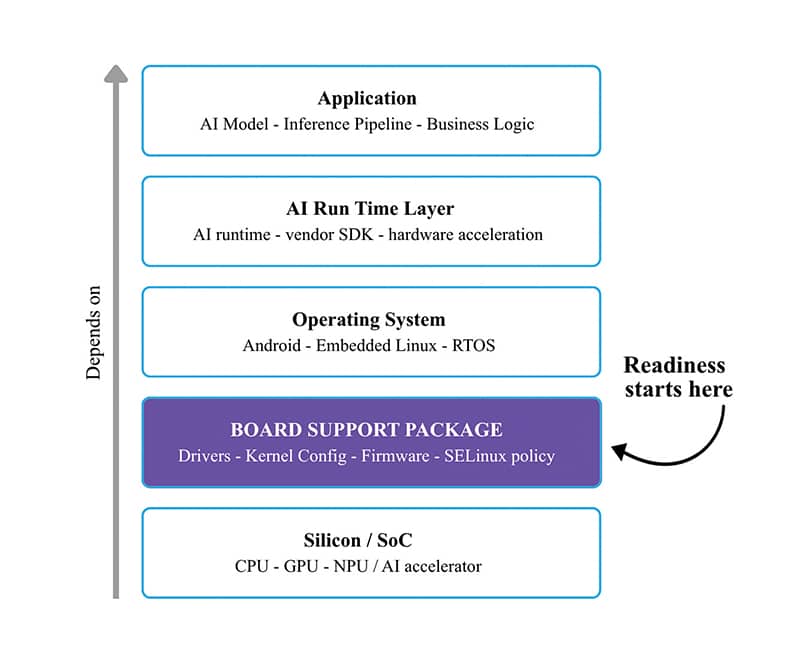
Every industrial device that runs AI at the edge sits on top of a board support package (BSP), the layer of firmware, drivers, and kernel configuration that lets an operating system talk to a specific piece of silicon. A model trained in a data centre knows nothing about this layer, and it does not need to. But the device running that model depends entirely on it.
Industrial computers rarely run one standard operating system. Some run a customised Android build tuned for kiosk-style or handheld use. Others run a Yocto Project-based embedded Linux distribution built specifically for that board. Increasingly, safety- and time-critical applications lean on a real-time operating system (RTOS) such as QNX. Each of these environments has a different driver ecosystem, a different way of exposing hardware accelerators, and a different set of constraints an AI pipeline has to respect.
A BSP that has not been validated for AI workloads will quietly bottleneck even a well-trained model because inference ends up running wherever the software stack allows—not necessarily where the silicon performs best. This is often the most under-budgeted part of an industrial AI deployment.
From edge AI to physical AI
The next phase of industrial AI will not be defined only by smarter models. It will be defined by how reliably those models can sense, decide, and act in the physical world.
The distinction becomes clearer when AI has to interact with the physical world. This is where edge AI starts becoming physical AI. In a factory, warehouse, hospital, energy site, or transportation system, intelligence does not live inside a cloud dashboard alone. It has to interact with cameras, sensors, motors, robotic arms, gateways, safety systems, and human operators. A vision model may identify a defect, but the business value appears only when that detection is converted into a timely action: stopping a conveyor, alerting an operator, adjusting a machine parameter, or triggering a quality workflow.
That transition from prediction to action raises the engineering standard. Latency is no longer just a performance metric; it becomes part of operational reliability. Camera synchronisation, sensor timing, fieldbus connectivity, thermal behaviour, power stability, enclosure design, update control, and failure recovery all become part of the AI system. In other words, physical AI cannot be separated from the embedded platform underneath it.
For technology leaders, this changes the investment conversation. Buying an AI-capable chip or training a high-accuracy model is not enough. The differentiator is the readiness of the complete system: silicon, operating system, BSP, drivers, accelerator runtime, I/O interfaces, security, remote management, and lifecycle support. When these layers are planned together, edge AI can move from a prototype to a deployable physical AI solution.
Organisations that address this early can reduce proof-of-concept failures, shorten deployment cycles and build AI systems that operate reliably where business actually happens: at the edge, in the field, and in the physical world.
| Edge AI readiness checks | |
| Readiness Area | What To Verify |
| Camera and sensor input | Stable input under real workload |
| Accelerator runtime | NPU/GPU/DSP path enabled and measured |
| Latency | Sustained response time under load |
| Thermal behaviour | No throttling during long-duration runs |
| OTA and rollback | Safe update and recovery path |
| Logs and diagnostics | Field-debug information available |
Aligning silicon and software from day one
Modern industrial edge platforms, including AI-enabled System-on-Chip (SoC)-based boards used in machine vision and robotics, often include dedicated AI accelerators such as NPUs, GPUs, or DSPs. These accelerators can improve latency and power efficiency for supported workloads, but those gains are not automatic.
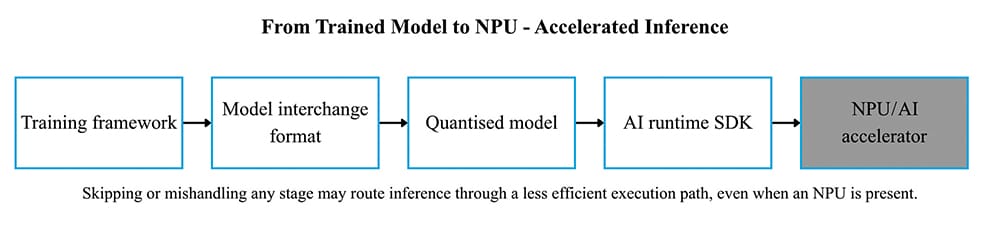
A typical path looks like this: a model is trained in a framework, exported to an interchange format, calibrated, quantised, and then deployed through the target chipset’s AI runtime or software development kit (SDK). If any of these steps are skipped or handled incorrectly, the model may fall back to CPU execution or run through a less efficient path. It may still function, but not with the latency, power efficiency, or real-time behaviour expected from the chosen hardware.
Getting this pipeline right earlier in a deployment rather than later can save weeks. In a representative industrial deployment scenario, restructuring the handoff between model conversion, quantisation, and accelerator runtime can move an object-detection pipeline from unusable frame rates to real-time camera performance without changing the model itself.
Trust comes from rigorous validation
An edge AI system does not get to fail gracefully in a factory the way a phone app might. Validation has to go well beyond checking that predictions are accurate.
Latency needs to be measured under sustained, realistic load, not during a five-minute demo. Thermal behaviour matters, since industrial enclosures often lack the airflow of a lab bench, and sustained NPU usage generates heat that can throttle performance if left untested.
Long-duration stability runs surface memory leaks and driver faults that never appear in short trials. Peripheral validation—confirming that cameras, sensors, and other inputs and outputs keep behaving correctly while the NPU is under load—matters just as much as the model’s own accuracy score.
Skipping these checks can leave a system that worked perfectly in the lab missing detections on the factory floor within its first week of continuous use.
Security and updates cannot wait
An edge AI device that works well today still has to work safely a year from now, which raises two questions that are easy to defer and expensive to ignore.
The first is security. Android-based industrial devices benefit from SELinux (security-enhanced Linux) policy hardening, a set of mandatory access controls that limit what any single process, including the AI inference pipeline, is allowed to touch on the system. Getting this wrong either leaves the device exposed or breaks legitimate functionality when policies are configured too restrictively; getting it right takes deliberate tuning, not a default configuration copied from a reference build.
The second is lifecycle management. Models drift, vulnerabilities get discovered, and firmware needs patching. None of that is possible without a reliable over-the-air (OTA) update pipeline and a device management approach that can be trusted across an entire fleet of deployed units, not just the one test unit sitting on an engineer’s desk.
Readiness is a team sport
A good model is necessary, but never sufficient. Systems that make it from validation to the factory floor involve embedded platform engineers from the first week, rather than handing them a finished model and asking them to make it run.
That means treating BSP readiness, hardware-software alignment, real-world validation, and lifecycle planning as part of the AI system itself, rather than problems to solve after the fact. Industrial edge AI rarely fails because the algorithms are wrong. More often, it fails because the platform underneath them was not considered until it was too late.
Pitchai Muthu M. leads embedded IoT engineering at Advantech India, building edge AI pipelines on industrial hardware. Off duty, he tends ancestral farmland near Madurai.