




A touch interface uses ordinary laser printing to detect finger movement, offering wiring-free controls for wearables, IoT devices, keyboards, and security applications without complex hardware.
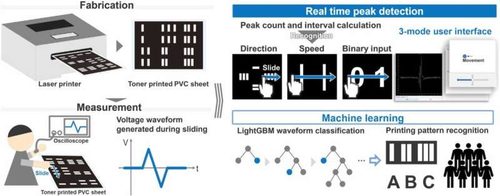
Shibaura Institute of Technology has developed a laser-printed PVC touch interface that can detect finger direction and speed without conventional wiring, batteries, or external electrodes. The low-cost technology turns a simple printed pattern into an interactive surface, opening up new possibilities for wearable electronics and internet of things (IoT) devices.
The interface is made by printing toner patterns directly onto a PVC sheet using a conventional laser printer. When a finger slides across the surface, contact between the skin and exposed PVC generates electrical signals through triboelectric effects. The printed toner pattern controls where contact occurs, shaping the timing and polarity of the resulting signal.
This means the same basic hardware can support different input functions simply by changing the printed pattern. Researchers demonstrated recognition of finger direction and sliding speed, along with binary inputs that could convert sequences such as 1010 into the decimal number 10. The interface also remained mechanically stable after 1000 sliding cycles, with no significant change in signal strength or waveform.
The team then combined the interface with machine learning to handle more complex interactions. Seven different printed patterns were recognised with 97.1 per cent accuracy, while all 26 alphabet characters were identified with 89.2 per cent accuracy. The system could also distinguish between seven users with 97.1 per cent accuracy by analysing differences in finger pressure, sliding speed, contact angle, and contact stability.
Unlike conventional touch controls, the approach does not require a complex electronic assembly for every new input function. The researchers say this could simplify controls for smart clothing, IoT equipment, keyboards, gaming devices, and smartphones.
The technology could also support personalised interfaces and user authentication, while its simple manufacturing process may help reduce costs. Further work will focus on improving reliability and evaluating performance under real-world conditions.


