




How do you pack a house for Mars into a single rocket? IISc’s modular Bheem concept offers one possible answer.
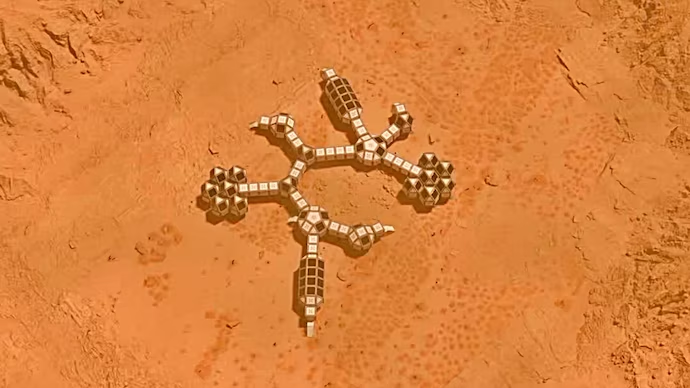
Researchers at the Indian Institute of Science (IISc), Bengaluru, have proposed Bheem (Bhartiya Extraterrestrial Expandable Modular Habitat), a modular, panel-based living space designed for astronauts on the Moon and Mars. Unlike pre-built space modules launched whole, Bheem is built from smaller structural panels that stack compactly for launch and get assembled after landing.
The concept is engineered specifically around the payload constraints of SpaceX’s Starship. Habitat panels would be stacked inside Starship’s payload bay, transported to the Moon or Mars, then joined on site into pressurised modules, addressing one of deep space exploration’s toughest engineering problems, fitting a full sized human habitat into limited rocket volume.
For engineers, the real story is in the systems design. Researchers mapped astronaut tasks to volume requirements, then tested triangular, square, and pentagonal panel geometries for structural rigidity, essentially a materials and mechanical engineering optimisation problem before any life support or embedded control systems even enter the picture. Each module will eventually need to carry sensor networks, power distribution, and environmental control electronics packed into the same compact, modular philosophy driving the panel design.
The payoff is significant. A single Starship payload could deploy the setup offering roughly twice the habitable volume of the International Space Station. Damaged panels can be swapped individually instead of replacing an entire module, a design logic familiar to anyone who has worked with modular embedded hardware.
Bheem is still a design concept. Materials science, life support integration, radiation shielding, and the electronics stack that will power it all remain ahead. But it marks a serious first step toward Indian engineered structures that could one day house astronauts beyond Earth.
Captain Shubhanshu Shukla, IAF fighter pilot, ISRO Astronaut, and BHEEM co-author, says, “The true journey toward building a home on another world doesn’t start with laying the first brick—it begins the moment we dare to imagine what that home could be.”


