

MIT researchers have demonstrated through-ice communication using magnetic fields, combining rugged sensors, robotics, and magneto-inductive electronics to collect data beneath Arctic sea ice.
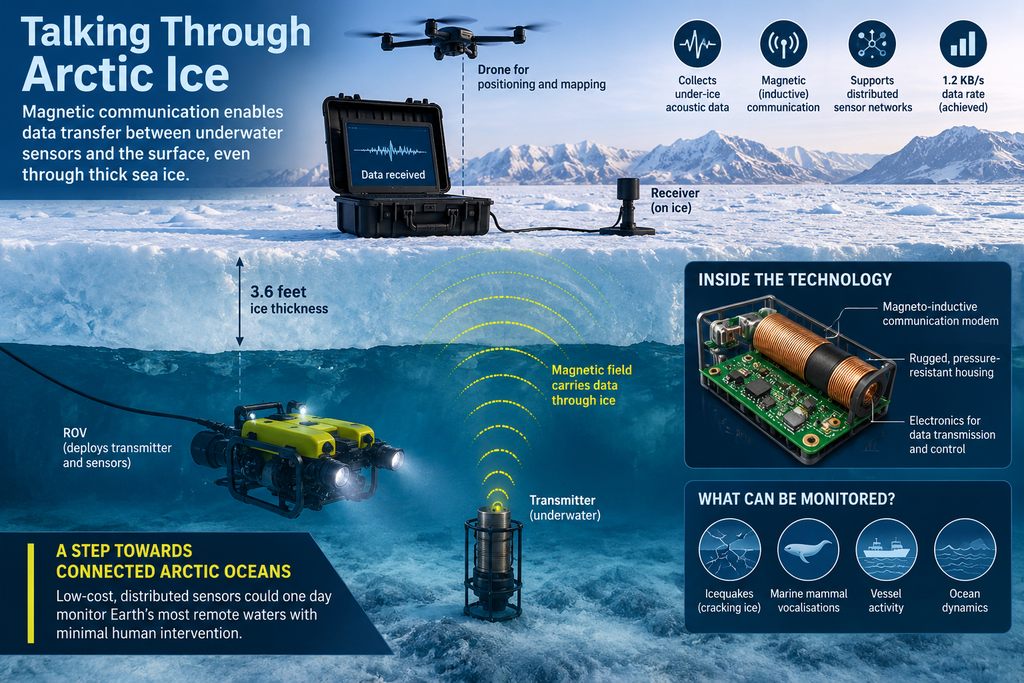
Researchers at MIT Lincoln Laboratory have demonstrated a way to transmit data through Arctic sea ice using magnetic fields instead of conventional radio-frequency signals. The technology could help create distributed sensor networks capable of collecting and relaying information from beneath ice without requiring people to repeatedly access remote and harsh environments.
At the centre of the test was a magneto-inductive communication modem developed with Norwegian technology company Havguard. Unlike radio signals, which are rapidly weakened by seawater, magneto-inductive systems use changing magnetic fields to transfer information. The prototype incorporated a transmitter below the ice and a receiver positioned above it, with the sensitive electronics protected inside polycarbonate pressure-resistant domes.
For the Arctic test, researchers drilled through 3.6 feet of ice and deployed the underwater transmitter using a remotely operated vehicle (ROV). The ROV also carried a Doppler velocity logger, allowing researchers to track its movement beneath the ice. Drone imagery was combined with the vehicle’s positioning data to map its location and evaluate communication performance.
The prototype achieved a data-transfer rate of approximately 1.2 kilobytes per second. MIT researchers describe the result as encouraging for an early-stage system, although further development is needed before the technology can become a practical Arctic communications platform. Future versions are expected to focus on improving the modem’s packaging, deployment and integration with other sensors.
The communication system is part of a broader effort to build low-cost, distributed Arctic sensing infrastructure. Researchers are also using geophones to capture vibrations travelling through sea ice. Earlier measurements detected sounds ranging from cracking ice to marine-mammal vocalisations and vessel activity.
Understanding these signals could help distinguish different sources of underwater and ice-borne sound. The team is exploring machine-learning techniques that could eventually classify signals such as icequakes and animal vocalisations.
A key engineering challenge remains deployment. Severe Arctic weather can make physical access unpredictable, so the researchers are working toward sensor systems that can be deployed with minimal human intervention and potentially relay collected data through drones or satellites.