

MIT researchers find that recoil and neutrinos’ fermionic nature prevent the quantum amplification needed to produce a directional neutrino laser beam.
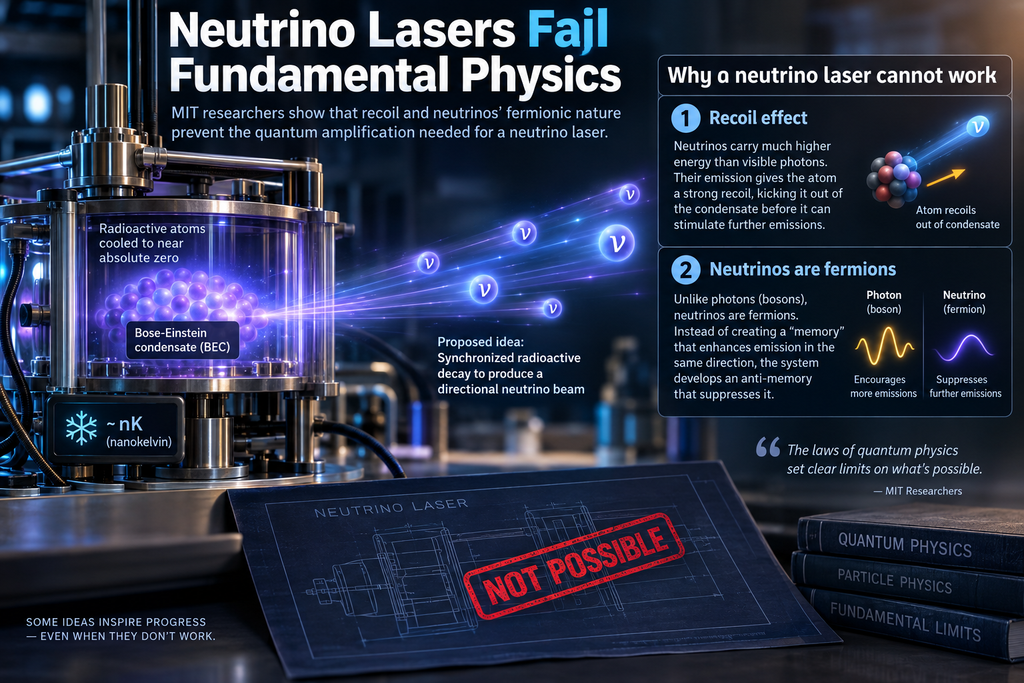
A proposed technology for generating laser-like beams of neutrinos has been ruled out by MIT researchers, who found that two fundamental quantum effects prevent the concept from working. The findings close off a theoretically intriguing route to controlling the elusive particles, while offering a deeper understanding of how quantum systems behave.
The original neutrino-laser concept relied on superradiance, a quantum amplification effect demonstrated with photons. Researchers had proposed cooling radioactive atoms to extremely low temperatures until they formed a Bose-Einstein condensate (BEC). In this state, atoms behave as a highly correlated quantum system. The expectation was that radioactive decay inside the condensate could become synchronized, causing neutrinos to emerge in the same direction and form a concentrated beam.
The proposed setup required temperatures around the nanokelvin range. A radioactive rubidium BEC, for example, was theoretically expected to accelerate radioactive decay dramatically, potentially changing a half-life of about 86 days to roughly one minute.
MIT physicists Wolfgang Ketterle, Hanzhen Lin, and Yu-Kun Lu examined the physics behind this mechanism in two companion studies published in Physical Review Letters. Their analysis identified two separate barriers that prevent neutrino superradiance.
The first is recoil. A neutrino produced during radioactive decay carries far more energy than a visible photon. Its emission therefore gives the remaining atom a much stronger momentum kick. According to the researchers, the recoiling atom would move so rapidly that it would almost immediately leave the condensate. This happens before the quantum system can retain the information needed to stimulate another neutrino emission in the same direction.
The second problem comes from the neutrino itself. Unlike photons, which are bosons, neutrinos are fermions. This difference changes how quantum correlations develop. Instead of creating a “memory” that encourages subsequent emissions in the same direction, the system develops an anti-memory that suppresses emission into the previously occupied direction.
Together, these effects prevent the coherent amplification required for a neutrino laser. The research also challenges a related proposal for a gamma-ray laser, showing how particle properties and recoil can impose fundamental limits on quantum technologies.
Rather than being simply a failed technology, the result demonstrates why ideas borrowed from optical lasers cannot automatically be transferred to other particles. It highlights the importance of particle statistics, energy, momentum, and quantum correlations when designing future advanced electronic and quantum systems.