




A receiver booster helps wireless devices improve signal reception while using less power and reducing the space needed on the circuit board.
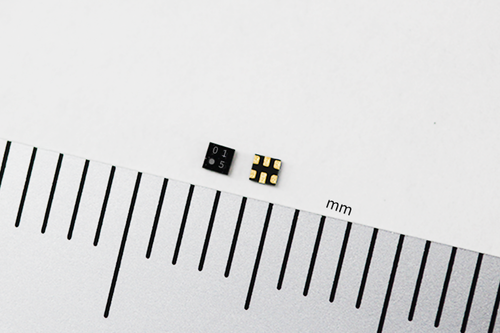
Nisshinbo Micro Devices Inc. (NSID) is set to launch the NT1741, a low-current receiver (Rx) booster designed for 2.4-GHz wireless technologies such as Bluetooth Low Energy (BLE), Thread, and Zigbee. The device is aimed at compact, battery-powered products that need better wireless reception without significantly increasing power consumption or board space.
The NT1741 consumes 1.5 mA in low-noise amplifier (LNA) mode and 1 µA in bypass mode. In LNA mode, it provides receiver amplification, while bypass mode allows the device to reduce power consumption when amplification is not required.
The device comes in a 1.0 mm × 1.0 mm EPFFP-6-FB package and integrates the RF input and output matching circuits. Only the power-supply bypass capacitor is required externally for the matching function, which can reduce component count and simplify PCB layout.
BLE is widely used in smartphones, wearables, and other IoT devices because it is designed for low-power wireless communication. While many BLE products can operate with a system-on-chip (SoC) and antenna alone, an additional Rx booster can be used when a product requires improved reception, greater communication range, or more reliable connections.
Hearing aids are one example where improved reception can be important. Modern hearing aids can connect to smartphones for functions such as sound adjustment and can also receive broadcast audio through Bluetooth LE Audio Auracast. They may need to receive announcements and other audio information in places such as airports, railway stations, and buses. Improving receiver performance can help maintain wireless connectivity in these situations.
At the same time, hearing aids have small batteries and limited space for electronic components. Adding an RF device therefore needs to have a minimal impact on both power consumption and PCB area. The NT1741 addresses these requirements through its low-current operation, compact package, and integrated matching circuits.
Beyond hearing aids, the NT1741 can be used in AI glasses, earphones, headphones, and other compact wireless products. Its support for 2.4-GHz applications also makes it suitable for BLE, Thread, and Zigbee-based devices where low power consumption and reliable reception are important.
Click here for the original announcement.


