




A flexible iodine electrode enables water-based zinc-iodine pouch cells to deliver high capacity for more than 1,200 cycles.
A research team has demonstrated aqueous zinc-iodine pouch cells at ampere-hour scale, bringing the battery chemistry closer to a format relevant for practical energy storage. The reported cells deliver up to 1.6 ampere-hours (Ah) of capacity and operate for more than 1,200 cycles.
Zinc-iodine batteries use a water-based electrolyte, avoiding the flammable organic electrolytes commonly used in lithium-ion cells. Zinc and iodine are also relatively abundant materials, making the chemistry attractive for energy-storage applications. However, two problems have continued to limit practical zinc-iodine batteries.
The first is areal capacity. For a battery to store a significant amount of energy in a compact area, each square centimetre of electrode must hold a large amount of active material. That requires thick, heavily loaded electrodes, but increasing electrode thickness can lead to cracking, delamination and poor electrical contact. The second is polyiodide shuttling. During discharge, iodine can form soluble polyiodide species that move through the electrolyte towards the zinc electrode, where they participate in unwanted reactions. This gradually consumes active material and reduces capacity over repeated cycles, creating a problem similar to the shuttle effect that has also limited lithium-sulphur batteries.
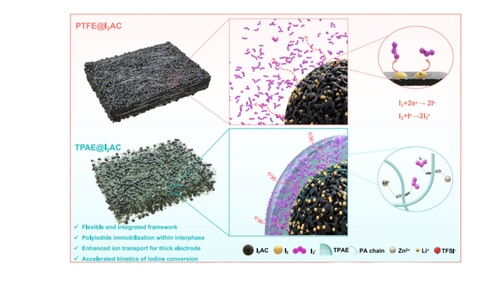
The researchers address both problems through the electrode structure. It is produced using rapid phase inversion of a polyamide thermoplastic elastomer network, creating a porous and mechanically robust electrode more than 2 millimetres thick that can still bend without failing. The design also includes what the researchers describe as a polyiodide-immobilisation hydrogelation interphase, a gel layer designed to trap polyiodide species near the iodine electrode and prevent them from migrating into the bulk electrolyte.
The electrode reaches up to 14 milliampere-hours per square centimetre (mAh/cm²) of areal capacity. At an active-material loading of 70 milligrams per square centimetre, the flexible electrode delivered an average areal capacity of 11.5 mAh/cm² and operated for more than 1,600 cycles at a current of 0.62 amperes per gram. When scaled into pouch-cell format, the researchers reported a capacity of up to 1.6 Ah with stable operation beyond 1,200 cycles. The result moves the approach beyond small laboratory cells and demonstrates the electrode in a larger battery format.
For stationary energy storage, the comparison with lithium-ion batteries is important. India currently relies heavily on lithium-based battery supply chains for grid and large-scale storage, with lithium iron phosphate (LFP) emerging as a major chemistry because of its cost, cycle life and relative safety. However, LFP cells still typically use flammable organic electrolytes and require thermal and fire-safety measures when deployed in large battery installations.
An aqueous zinc-iodine battery offers a different trade-off. Its water-based electrolyte removes one of the main sources of flammability associated with conventional lithium-ion cells, potentially simplifying some fire-safety and thermal-management requirements at the system level. Its lower energy density would be a major disadvantage for electric vehicles, where battery mass and volume are critical, but is less restrictive for stationary installations where footprint can be traded against safety, cost and lifetime. This makes zinc-iodine chemistry potentially more relevant to substations and grid-scale storage than to electric scooters or cars.
This remains a laboratory result demonstrated in pouch cells rather than a pilot-line process or commercial product. The researchers do not report a cost per kilowatt-hour or performance across the temperature range expected in an Indian outdoor installation. Long-term cycling beyond the reported results also remains to be demonstrated, while grid-storage systems are typically expected to operate through several thousand cycles. The 1.6 Ah pouch-cell result should therefore be viewed primarily as a demonstration of scalability beyond small laboratory cells rather than as a finished commercial cell specification.
India is expanding its battery energy-storage capacity as renewable generation grows, with government viability-gap funding supporting large-scale battery-storage deployment. Most projects currently rely on established lithium-ion supply chains, making alternative chemistries strategically interesting where they can use more readily available materials. Zinc is produced domestically in India, giving a zinc-based battery chemistry a potential supply-chain advantage if the technology can eventually be manufactured economically at scale. Indian research groups are also investigating zinc-based electrochemical systems, including work at institutions such as IIT Madras and the Central Electrochemical Research Institute.
That does not make this zinc-iodine chemistry ready for deployment. Manufacturing cost, long-term lifetime, temperature performance and large-scale production remain unanswered. The number to watch is not energy density but the cost per kilowatt-hour over the system’s installed lifetime, including the enclosure, cooling, fire protection and other infrastructure that may differ between aqueous and conventional lithium-ion systems.
That figure does not yet exist for this zinc-iodine technology. Until manufacturing cost and full system economics are demonstrated, the result remains a promising laboratory advance rather than a battery technology ready for procurement.
For more information, click here.


