

A machine-learning-designed carbonisation process produces hard carbon at 900 degrees Celsius and enables sodium-ion pouch cells reaching 208 Wh/kg.
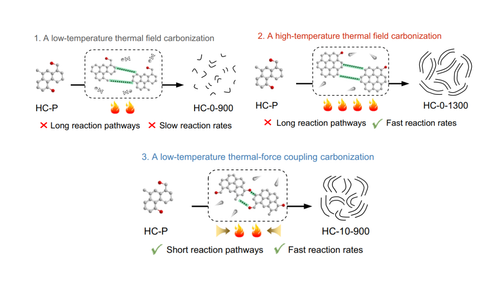
Researchers at Tianjin University have developed hard carbon for sodium-ion batteries using a carbonisation temperature of 900 degrees Celsius rather than the higher temperatures commonly required. Working with colleagues from Nankai University and Tsinghua University, the team used machine learning to identify suitable processing conditions before applying what they call thermal-force coupling carbonisation. The resulting hard-carbon anode was incorporated into a full sodium-ion pouch cell with a reported specific energy of 208.1 watt-hours per kilogram (Wh/kg).
Hard carbon is one of the key anode materials used in sodium-ion batteries. Unlike lithium ions, sodium ions are larger and do not intercalate efficiently into conventional graphite structures used in most lithium-ion batteries. Hard carbon provides a more suitable structure for sodium storage, but producing it typically requires high-temperature processing, making manufacturing energy use and cost important challenges for sodium-ion battery production.
Carbonisation is the step that converts an organic precursor into hard carbon, and temperature strongly influences the resulting microstructure. At lower temperatures, the material can retain defects and structures that trap sodium ions irreversibly. Higher temperatures can alter the carbon structure and increase sodium-storage sites, but may also reduce ion-diffusion performance. Balancing storage capacity against diffusion kinetics is therefore one of the central challenges in producing hard-carbon anodes.
The researchers address this trade-off by combining mechanical force with the thermal carbonisation process, allowing the hard-carbon microstructure to be tailored at a lower temperature. A machine-learning design stage was used to narrow the processing conditions before experimental optimisation, helping the team identify a route that produced the required electrode structure at 900 degrees Celsius.
The full sodium-ion pouch cell delivered a reported specific energy of 208.1 Wh/kg over a voltage window of 1.5 to 4.3 volts. According to the researchers, lowering the furnace temperature from 1,300 to 900 degrees Celsius cut energy consumption for the carbonisation step by 49.7 per cent and associated carbon dioxide emissions by 47.5 per cent.
Commercial lithium iron phosphate (LFP) cells typically deliver around 160 to 180 Wh/kg at cell level, while commercially available sodium-ion cells have generally operated at lower energy densities. A sodium-ion pouch cell reaching 208.1 Wh/kg would therefore represent a significant result, although direct comparisons depend on cell design, chemistry and the basis used to calculate specific energy.
The furnace saving may have the clearest manufacturing consequence. Carbonisation is an energy-intensive high-temperature process, so reducing the required temperature by 400 degrees Celsius could reduce both energy consumption and the thermal demands placed on production equipment. The full economic benefit would still depend on furnace efficiency, throughput and production scale.
This is a laboratory result demonstrated at pouch-cell scale, not a pilot-line or commercial manufacturing process. Pouch cells are a meaningful step beyond coin cells because their larger electrode area can expose problems involving electrode uniformity, gas generation and cell assembly that smaller laboratory cells may not reveal. However, demonstrating a material in a pouch cell is not evidence that it can be manufactured reliably at gigawatt-hour scale. The authors do not present the process as a production-ready manufacturing route.
India’s dependence on imported battery cells makes sodium-ion technology strategically interesting. Sodium is widely available and could reduce dependence on some of the critical materials associated with conventional lithium-ion supply chains. That gives sodium-ion batteries a potential role in domestic energy storage and, where energy density becomes competitive enough, selected electric-vehicle applications.
India’s Production Linked Incentive scheme for Advanced Chemistry Cell battery storage is also relevant because it is designed to expand domestic cell manufacturing and reduce dependence on imported advanced chemistry cells. The scheme is technology-agnostic rather than specifically allocated to sodium-ion chemistry.
The lower-temperature carbonisation process could further strengthen the manufacturing argument. India also has large volumes of biomass and agricultural residues that could potentially serve as feedstocks for hard-carbon production, although the suitability of a particular precursor depends on its composition and the processing route used.
If the process survives scale-up, the cost floor for Indian-made sodium-ion cells could fall for reasons that have nothing to do with cathode chemistry. Reducing the energy required to produce the hard-carbon anode could lower manufacturing costs at an earlier stage of the battery supply chain.
For more information, click here.