




Sandisk has launched new NAS SSDs in India, combining high endurance, performance, and scalable storage for demanding consumer and small-business network storage workloads and collaborative applications.
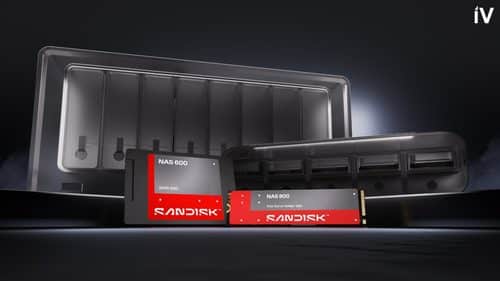
Sandisk has launched the Sandisk NAS 600 SATA SSD and Sandisk NAS 800 NVMe SSD in India, expanding its storage portfolio for network-attached storage (NAS) systems used by consumers, creative professionals and small businesses. The drives are designed to deliver high endurance and consistent performance for demanding, multi-user workloads.
The NAS 600 SATA SSD is aimed at users modernising existing NAS systems by replacing hard drives with solid-state storage. Available in capacities including a 4TB model, it offers endurance of up to 2.5PBW and a mean time to failure (MTTF) of up to 2.25 million hours. The drive can deliver sequential read speeds of up to 560MB/s, while its 2.5-inch, 7mm form factor supports integration into compatible NAS systems.
For higher-performance deployments, the NAS 800 NVMe SSD is designed for demanding all-flash NAS environments. It uses PCIe 5.0 and is available in capacities ranging from 500GB to 4TB. The drive supports high endurance for workloads involving caching, storage tiering and primary storage, while offering random-read performance of up to 2.3 million IOPS.
Sandisk has developed the drives for applications such as databases, virtualisation, content creation and AI-related workloads. Their focus on endurance is intended to support systems that operate continuously and handle frequent data access.
The company says growing use of private-cloud integration, local AI and collaborative workflows is increasing demand for dependable NAS storage. High-endurance SSDs can help improve responsiveness while reducing reliance on mechanical storage in frequently accessed workloads.
The Sandisk NAS 600 SATA and NAS 800 NVMe SSDs are available through Sandisk and selected retailers and e-tailers. The new range gives NAS users options to balance interface performance, endurance and storage capacity according to their requirements.

