


What does it take for a student rocketry team to move beyond commercially available components and build its own rocket motor, flight computer, and avionics? In an exclusive interview, Shaunak Purkayastha and Vedant Totla from thrustMIT discuss with Saba Aafreen of EFY how the team engineered Varuna, validated its in-house systems, and charted its next steps in propulsion and avionics.
Q. Could you introduce thrustMIT and tell us how the team is organised?
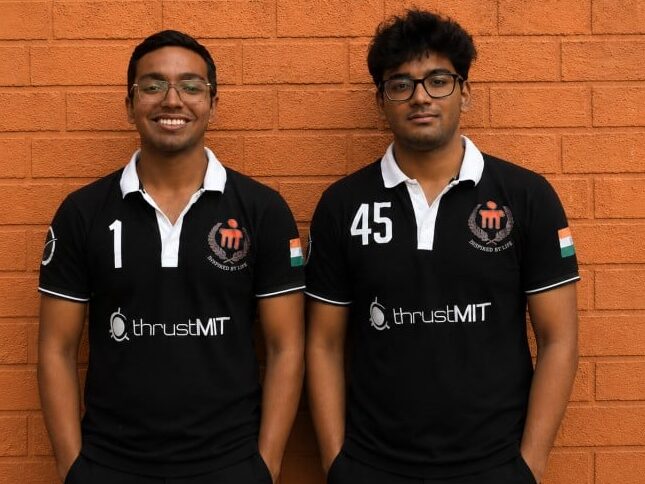
A. I’m Vedant Totla, Head of Management at thrustMIT, while Shaunak serves as our Team Leader. Founded in 2016, thrustMIT is India’s first student-led high-power rocketry team. We launched our first rocket in 2018 and have since represented MIT Manipal annually at the International Rocketry Engineering Competition (IREC), formerly the Spaceport America Cup. Our latest rocket, Varuna, flew at IREC 2026 in the 10,000 SRAD category and marked our first student-developed rocket motor. The team is organised into four core divisions—Management, Payload, Mechanical, and Avionics, with the Mechanical division further covering Recovery, Structures, Aerodynamics and Propulsion. Third-year students lead the subsystems, while second-year members support the design and development of the rocket.
Q. Could you introduce the team and the roles within it?
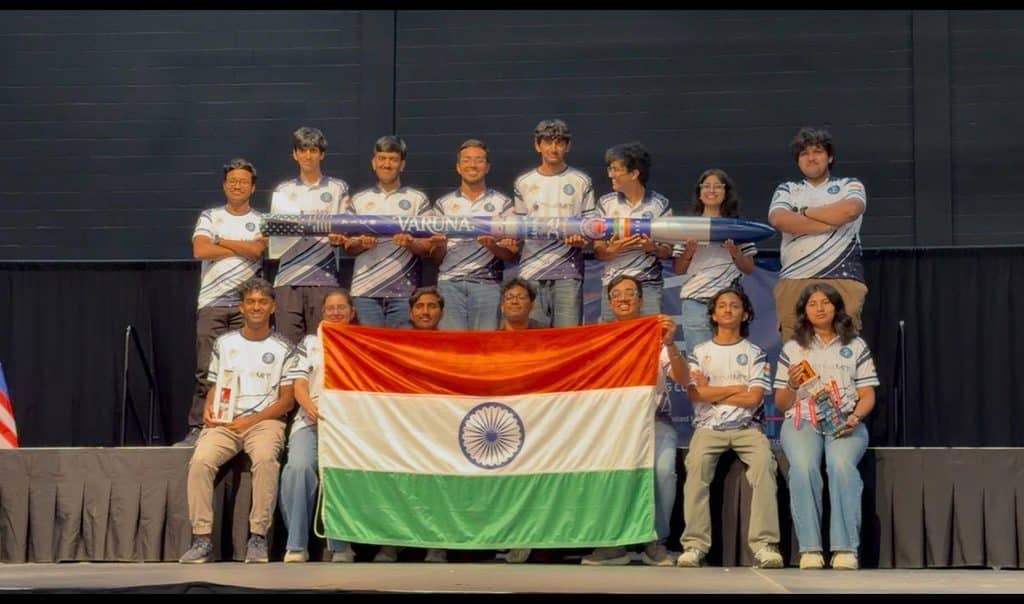
A. The team is led by Shaunak Purkayastha, our Team Leader, and Anushka Prabhutendolkar, our Team Manager, who oversee the project and represent thrustMIT in official engagements and competitions. As Head of Management, I, Vedant Totla, directly assist Anushka in handling finances, logistics, shipping, while directly heading sponsorships, social media publicity, and public relations. Mutra Sai Tharun leads the Payload division, which develops the research payload that gives the rocket its mission. Sanskruti Ginde heads Avionics, responsible for the rocket’s electronics and onboard systems, while Dhruv Phalod leads Ground Systems, managing communication and launch support. The Mechanical division includes Shaurya Mittal (Aerodynamics), Samrudh Raja (Recovery), and Tushit Chatterjee (Structures), who work together on the rocket’s design, stability, and structural integrity. Dhruv Jadhav (Propulsion), overseeing the development of the motor and propellant systems.
Q. Do members come from different engineering disciplines?
A. All of us are B.Tech students at MIT Manipal, but we don’t restrict recruitment to any specific branch. Students from mechanical or aeronautical engineering may contribute to management or avionics, while those from computer science or IT often work on mechanical systems or payloads. As long as they’re engineering students with the right interest and commitment, they’re welcome to join the team.
Q. What inspired the team to build a high-power rocket?
A. A shared passion for aerospace brought the team together. The seven founding members established thrustMIT in 2016 after seeing student teams abroad build and compete with their own rockets, and wanted to prove that Indian students could do the same. After two years of preparation, the team debuted at the 2018 Spaceport America Cup and won the Best Debutant Award. That spirit continues today, with members joining out of genuine interest in rocketry rather than academic requirements. While the technical teams focus on designing and building the rocket, the management team supports the effort through sponsorships, vendor partnerships, logistics, and outreach.
Q. What was the overall architecture of Varuna, and what made it different from your previous rockets?
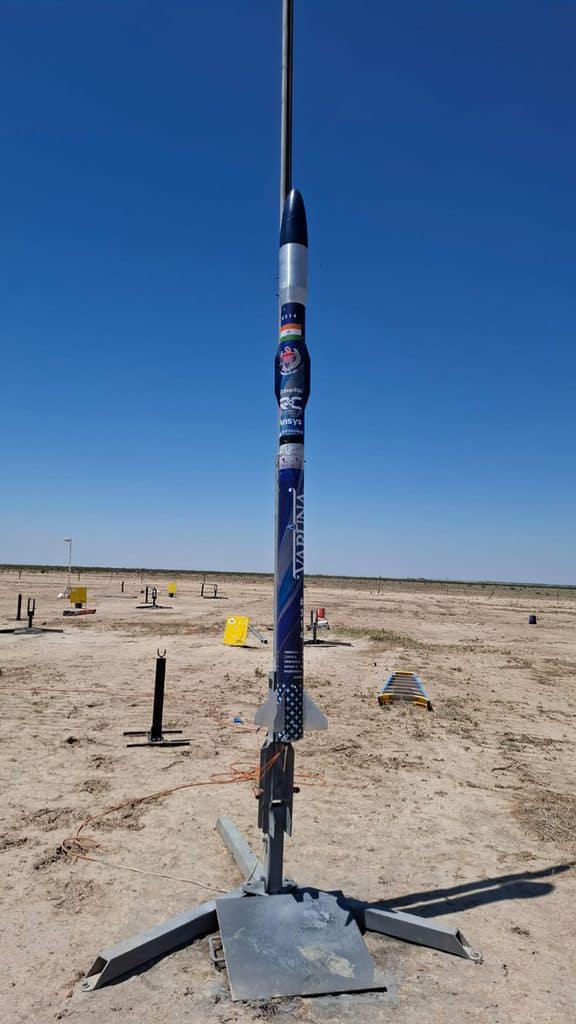
A. Until this year, we competed using commercially available solid rocket motors in standard altitude categories. For Varuna, we moved to the SRAD (Student Research and Developed) category and built our own solid rocket motor in-house. Another key change was adopting a variable-diameter airframe, with a wider payload bay to accommodate a CubeSat-format payload. Below the payload bay sat the avionics and recovery systems, followed by the propulsion system.
Q. Could you explain the propulsion system and the rocket’s flight performance?
A. Varuna was powered by an in-house developed N-class solid rocket motor with a total impulse of about 10,500 Ns, designed for the 10,000-ft SRAD category. Rather than rewarding the highest altitude, the competition scores teams on how closely they reach the target altitude. Our rocket reached 9,038 ft, slightly below the target due to manufacturing and environmental variations encountered during assembly at the competition site. For a first attempt at designing, building, and flying our own motor, we considered the performance highly encouraging.
Q. What innovations did you introduce in the recovery and avionics systems?
A. The recovery system used a dual-event, single-bay architecture, housing both the drogue and main parachutes in the same compartment while deploying them independently through a Tender Descender mechanism. This reduced space requirements without compromising deployment reliability, allowing the rocket to be recovered with minimal damage. On the avionics side, the team improved system reliability after issues in the previous mission by developing an in-house flight computer and PCB, supported by commercial backup sensors as required by competition rules. The system used LoRa-based long-range RF communication, sensor fusion, onboard cameras, GPS, and barometric sensors, successfully maintaining end-to-end communication throughout the flight.
Q. What research payload did Varuna carry, and what were the results?
A. Varuna carried a magnetic levitation payload designed to protect sensitive scientific components from high vibrations during flight. Instead of physically mounting the specimen, the team used magnetic levitation to eliminate direct mechanical contact and reduce vibration transfer. Despite experiencing peak accelerations of around 30 G, the specimen remained successfully levitated throughout the flight. The innovation earned thrustMIT an Honourable Mention in the Space Dynamics Laboratory Payload Challenge at IREC 2026.
Q. What was built in-house, and how was it different?