




A photonic processor brings light-based Fourier transforms to AI computing, potentially lowering processing time, power consumption and cooling requirements.
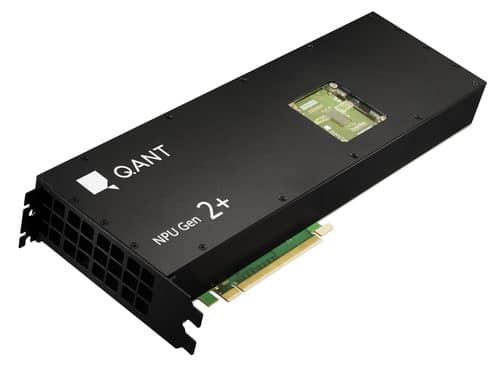
Q.ANT has launched the NPU Gen 2+ photonic processor, which can perform Discrete Fourier Transforms (DFTs) directly in light, enabling faster, leaner AI models and HPC applications. DFT is a mathematical operation used in signal and image processing, simulations and data analysis.
It can also help AI models work with fewer parameters and less data. Unlike conventional digital hardware, which performs DFT through sequences of electronic calculations, the photonic processor uses the physical properties of light to complete the transformation in a single operation. The technology aims to reduce the time and energy required for computationally intensive operations while potentially lowering data centre energy consumption and operating costs.
The processor can complement central processing units (CPUs) and graphics processing units (GPUs), handling selected computationally intensive workloads as a co-processor. The company have also demonstrated a hybrid computing system combining the NPU Gen 2+ with an AMD GPU to run a large language model (LLM). The demonstration used optical Fourier transforms to replace a computationally intensive attention layer in the language model, addressing a major computational bottleneck in generative AI.
“With Gen 2+, we’re opening the door to software that uses what light does naturally. That allows leaner AI models with fewer parameters and less data, and that is what will make the next wave of AI affordable,” said Michael Förtsch, CEO of Q.ANT. “With the DFT performed natively, developers now have a new tool to reshape the mathematics of AI models. This is an important step on our roadmap to combine more optical components on our chips for even more sophisticated functions, driving new algorithms and applications. By running a large language model in a hybrid system with an AMD GPU, we have shown that our processors work as co-processors with GPUs. We’re building a community with pioneering developers on the journey to a new era of computing.”

