New 6nm chips support local AI processing, computer vision, video processing, and low-power operation in cameras and Internet of Things devices.
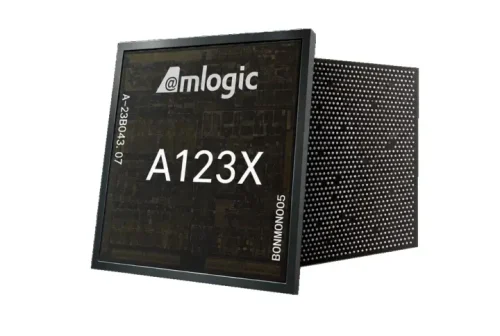
Amlogic has introduced two 6nm system-on-chips (SoCs), C305X2 and A123X, for devices that need to run AI workloads locally while keeping power consumption low. The chips target battery-powered IP cameras (IPCs), smart home cameras, industrial machine vision systems, dashcams, access control equipment, and other Internet of Things (IoT) devices.

The two SoCs combine Armv9-based computing with neural processing units (NPUs), image signal processing, and video processing. They use the Arm Cortex-A320 CPU and can run computer vision algorithms and compact large language models (LLMs) on the device, reducing dependence on cloud processing and latency while keeping data local.
The Cortex-A320 is based on the Armv9 architecture and is designed for low-power IoT workloads. It delivers a 34% increase in SPECint2006 performance compared with the Arm Cortex-A35 and includes Scalable Vector Extension 2 (SVE2) vector extensions for machine learning (ML) workloads.
The processor is paired with an 8 TOPS Transformer-native ADLA3 NPU. This provides hardware acceleration for Transformer-based workloads and allows the platform to run lightweight computer vision algorithms and compact LLMs locally.
The A123X is the higher-performance option, with four Cortex-A320 cores for systems that need to process video, AI, and control workloads simultaneously. It combines a 4 TOPS ADLA2 NPU for convolutional neural network (CNN) workloads such as object detection and tracking with an 8 TOPS ADLA3 NPU for hardware-accelerated Transformer operations used in Vision Transformers (ViT), LLMs, and similar workloads.
It also includes a neural network-based sound event detection engine for low-power audio event identification. Its low-light high dynamic range (HDR) image signal processor (ISP) supports two four-lane MIPI image sensor inputs, with support for up to 16MP at 30 frames per second (fps) in standard dynamic range (SDR) and 13MP at 30fps in HDR. The integrated AI-ISP supports up to 4K at 30fps to improve image quality in low-light conditions.
The chip supports Always-on Video (AOV) and pre-roll low-power modes to extend battery life. It also includes a neural network-based sound event detection engine for low-power audio detection. Its low-light HDR ISP supports two four-lane MIPI image sensor inputs and up to 4K 30fps, with AI-ISP enhancement also supporting up to 4K 30fps.
Both chips support Linux and come with reference designs, pre-validated embedded operating system stacks, and neural network software development kits (SDKs) compatible with mainstream ML frameworks. The platform also provides hardware schematics, production-ready firmware, and global certification support for original equipment manufacturers (OEMs) and original design manufacturers (ODMs).
Click here for the original announcement.