


An 800V battery pack integrates 48V power conversion, reducing cable length, connector count, cooling needs, and space in electric vehicles.
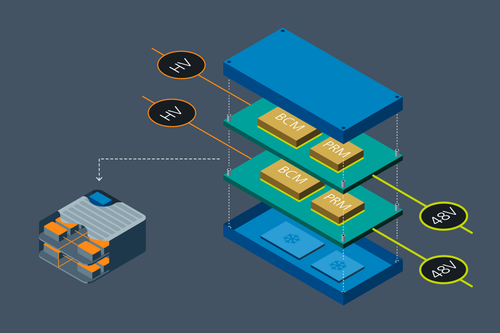
South Korea’s INFAC Corporation has developed an 800V battery pack design for electric vehicles (EVs) that integrates an isolated and regulated 800V-to-48V DC-DC converter inside the battery pack. The approach reduces the length and size of high-voltage cables and the number of connectors while supporting 48V zonal power distribution across the vehicle.
Instead of placing the DC-DC converter outside the battery pack as a separate subsystem, the design converts high voltage to 48V at the battery itself. The 48V supply can then be distributed through the vehicle as a safety extra-low voltage (SELV) network. This allows EV manufacturers to build 48V zonal architectures for different vehicle platforms without removing battery cells or reducing the vehicle’s driving range.
The converter uses Vicor’s BCM6135 DC-DC converter and PRM3735 regulator. Both are installed inside the 800V battery pack, allowing the system to use the battery’s existing liquid-cooling system. This removes the need for a separate cooling system for a remotely mounted DC-DC converter and also saves space and weight.
The design addresses power distribution across an EV. The traction motor and inverter can require hundreds of kilowatts and continue to use high-voltage power. Other powertrain, body, and chassis electronics typically require about 3.5–12 kW and can be supplied through a 48V SELV zonal network.
INFAC uses the battery pack as a central power and distribution point. Since the battery already has a liquid-cooling system to manage its thermal load, integrating the DC-DC converter allows the same infrastructure to handle the converter’s heat. This removes the separate cooling loop normally required for an external converter.
The approach also changes the conventional ‘silver-box’ arrangement, in which the DC-DC converter is housed separately from the battery pack. Earlier designs made battery-integrated conversion difficult because of limitations related to size, power management, electrical isolation, safety, and packaging.
With fewer external interfaces, the architecture can simplify manufacturing and make production processes more consistent. The modular power architecture also allows the 48V distribution system to be adapted for different EV platforms.
By moving the DC-DC conversion stage into the battery pack, INFAC is using the battery as both an energy source and a power distribution hub. This supports the shift towards 48V zonal architectures while reducing the space, weight, wiring, and cooling infrastructure needed outside the battery pack.