Can data centres move information faster without relying on power-hungry lasers? A scaled-down LED design points to a lower-power option for short-range optical links.
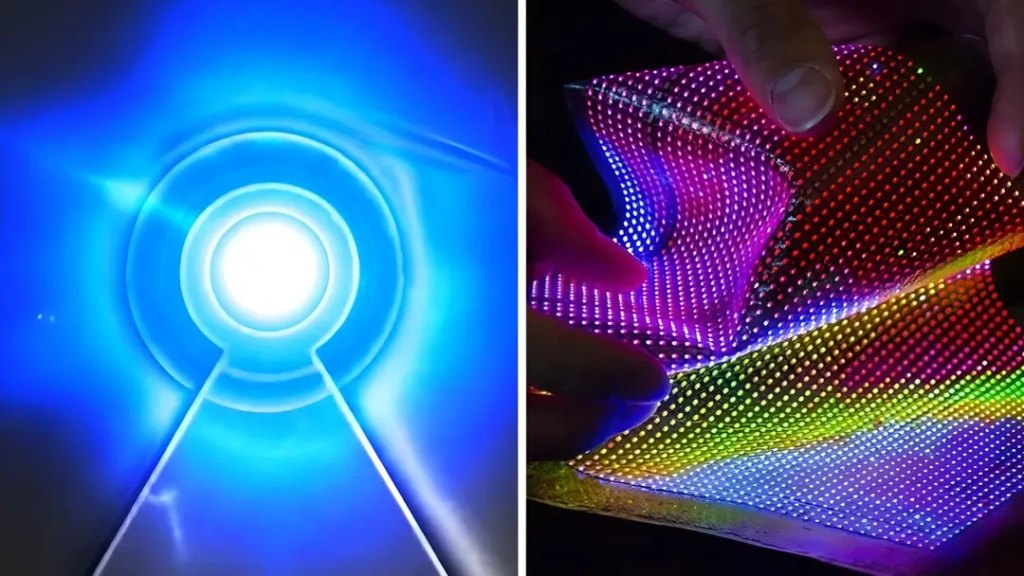
Researchers from the University of Illinois Urbana-Champaign and the University of Notre Dame have developed a gallium nitride (GaN) micro-LED with an optical modulation bandwidth of 2.75 gigahertz (GHz), while consuming 25 milliwatts (mW). The device sets a record for optical switching speed in quantum well LEDs, the industry-standard design, and is intended for short-range optical communication in data centres.
The development could offer a lower-power alternative to laser-based links, which are commonly used to transmit data over short distances. According to the research team, around 90% of data-centre communications take place over distances below 10 metres. LEDs could help reduce the power consumed by these links, although their switching speed has traditionally limited their use in high-frequency communication.
To understand how device size affects performance, the team looked at various sizes of micro-LED. By reducing the size of the micro-LED from 100 micrometres to 2 micrometres, the research team led by Abdelghany Abouelnagga discovered that there was not a linear relationship between size and performance of the device. The size of 5 micrometres provided the best trade off between switching speed and energy consumption.
Using theoretical models and experimental testing, the team accounted for any defects and parasitic effects in the material. This gave the team a design methodology for optimising the size of the LED for maximum performance.
The 5-micrometre diameter also allows the possibility of arranging multiple emitters in compact two-dimensional arrays, with each emitter carrying a separate data stream. The team says the design could offer a scalable route to high-speed, low-power optical communication.