


A student team from IIT Madras beat 22 other teams with an autonomous vessel that docked, avoided collisions, manoeuvred and found its way through a course.
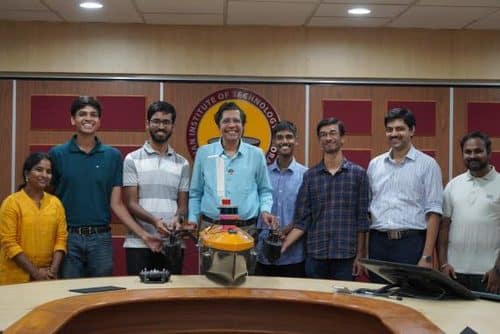
A boat built by IIT Madras students has won an international competition for autonomous ships. Team Aritra from the institute’s Department of Ocean Engineering secured first place at the Njord Autonomous Ship Challenge 2026 in Trondheim, Norway, competing against 22 other teams from nine countries.
The competition was organised by the Norwegian University of Science and Technology (NTNU) and held from 10 to 14 August 2026. IIT Madras announced the result on 18 September. The 2026 edition brought together 23 teams and about 150 students. Team Aritra scored 90.42 points, more than 10 points ahead of Türkiye’s MYS YAVUZ, which scored 79.90 points. Poland’s AGH Solar Boat finished third with 79.63 points.
An autonomous surface vessel is a boat that can navigate without direct human control by combining sensors, positioning systems and onboard software. At Njord, the vessels were tested on autonomous docking, collision avoidance, manoeuvring and pathfinding. Teams were also assessed through technical inspection, a technical report and a presentation, while a surprise autonomy challenge tested how their systems responded to an unfamiliar task.
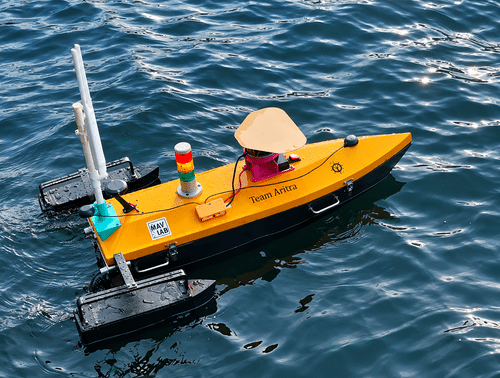
For Team Aritra, the competition also exposed problems that are difficult to reproduce in controlled testing. According to IIT Madras, strong magnetic interference at the competition arena caused drift in the vessel’s Inertial Measurement Unit (IMU), affecting measurements used for autonomous navigation. The team also encountered electromagnetic interference between the camera and GPS receiver. Testing at IIT Madras’s wave basin and campus lake helped prepare the vessel before the team travelled to Norway.
“Winning first place was the goal from day one. Winning it by this margin is what makes it special,” said team member S. Gurukesav.
Team Aritra was represented by Aarav Patel, S. Gurukesav and Madhava Sai. Faculty advisors named by IIT Madras are Dr Abhilash Sharma Somayajula, Prof. M.A. Atmanand and Dr Prabhakaran Jay.
The 2026 result builds on IIT Madras’s earlier participation in the competition. According to the institute, a different Team Aritra cohort finished third globally and won the Sustainability Award at the 2023 edition.
The competition vessel is a student-built autonomous surface vessel rather than a commercial ship. IIT Madras has not disclosed detailed specifications such as the vessel’s dimensions, propulsion system, onboard computer or complete sensor configuration in its press release. The result therefore demonstrates the team’s work in autonomous navigation, perception, controls and system integration rather than representing a commercially deployable maritime system.
The achievement also comes as India continues to develop its maritime and port infrastructure. The Ministry of Ports, Shipping and Waterways now lists India’s revised coastline at 11,098.81 km, including the country’s coastal states and Union Territories. Autonomous vessels can be used in areas such as surveying, inspection and monitoring, but their deployment in operational maritime environments involves additional requirements beyond a student competition.
For engineering students, the project highlights how marine robotics brings together electronics, sensors, navigation, control systems and software. Team Aritra’s performance shows how these disciplines can be combined in a working autonomous vessel and tested under real-world conditions.
For more information, click here.