


Can India’s first working micro-GPU bring programmable graphics to affordable embedded devices? An FPGA demonstration points towards that possibility.
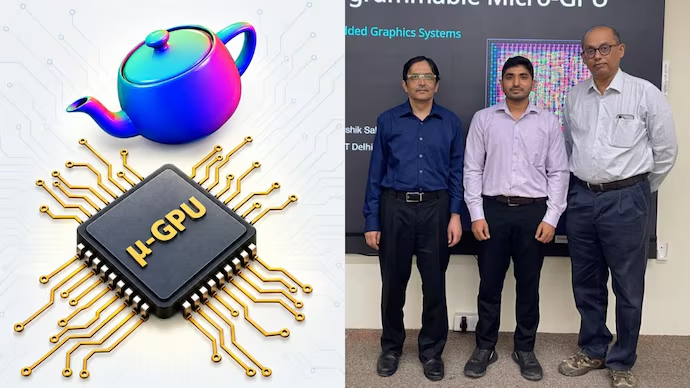
Researchers at IIT Delhi have developed a working, demonstrable micro-GPU for embedded graphics and display applications, with the architecture designed to eventually support both programmable hardware and custom silicon. The team demonstrated programmable graphics rendering using a custom floating-point GPU engine implemented in register-transfer language (RTL) and mapped to a Spartan-7 FPGA.

Unlike GPUs designed for high-performance computing or gaming, the architecture targets devices where basic graphics and visualisation need to be delivered within tighter cost and hardware constraints. Potential applications include industrial control displays, low-cost human-machine interfaces, e-rickshaw dashboards, navigation terminals for small fishing boats, and educational e-book readers.
The programmable approach is significant because the same processor architecture can be adapted for different embedded applications instead of being tied to a single display function. The current design is implemented entirely in RTL, allowing it to be mapped onto an FPGA for development and testing, while IIT Delhi says the architecture can also eventually be realised as an application-specific integrated circuit (ASIC).
The project was led by MTech students Nammi Akash and M Ravi Teja under the guidance of professors Jayadeva and Kaushik Saha. The team describes the work as, to its knowledge, the first working and demonstrable indigenously designed micro-GPU developed by a university in India.
The next stage is aimed at increasing the processor’s capability. The researchers are exploring an 8–16-core vector-style graphics architecture, alongside an optimised compiler and graphics software toolchain. They also plan to pursue a proof of concept using a 65nm ASIC process, moving the work from programmable FPGA hardware towards fabricated silicon.
The team is seeking funding for ASIC development, system integration, and eventual commercialisation. If realised, the approach could provide a locally designed graphics-processing option for embedded systems where affordability and application-specific functionality matter more than high-end graphics performance.